
A Scottish council has been accused of failing to consult a rural community over soon-to-be-installed traffic lights on a historic rural bridge. Adding to the sense that this is a local authority weak on communication, Argyll and Bute Council declined to answer several of the technical questions put to it by TransportXtra, including whether the ostensibly operational decision was, in fact, a political one (see panel).
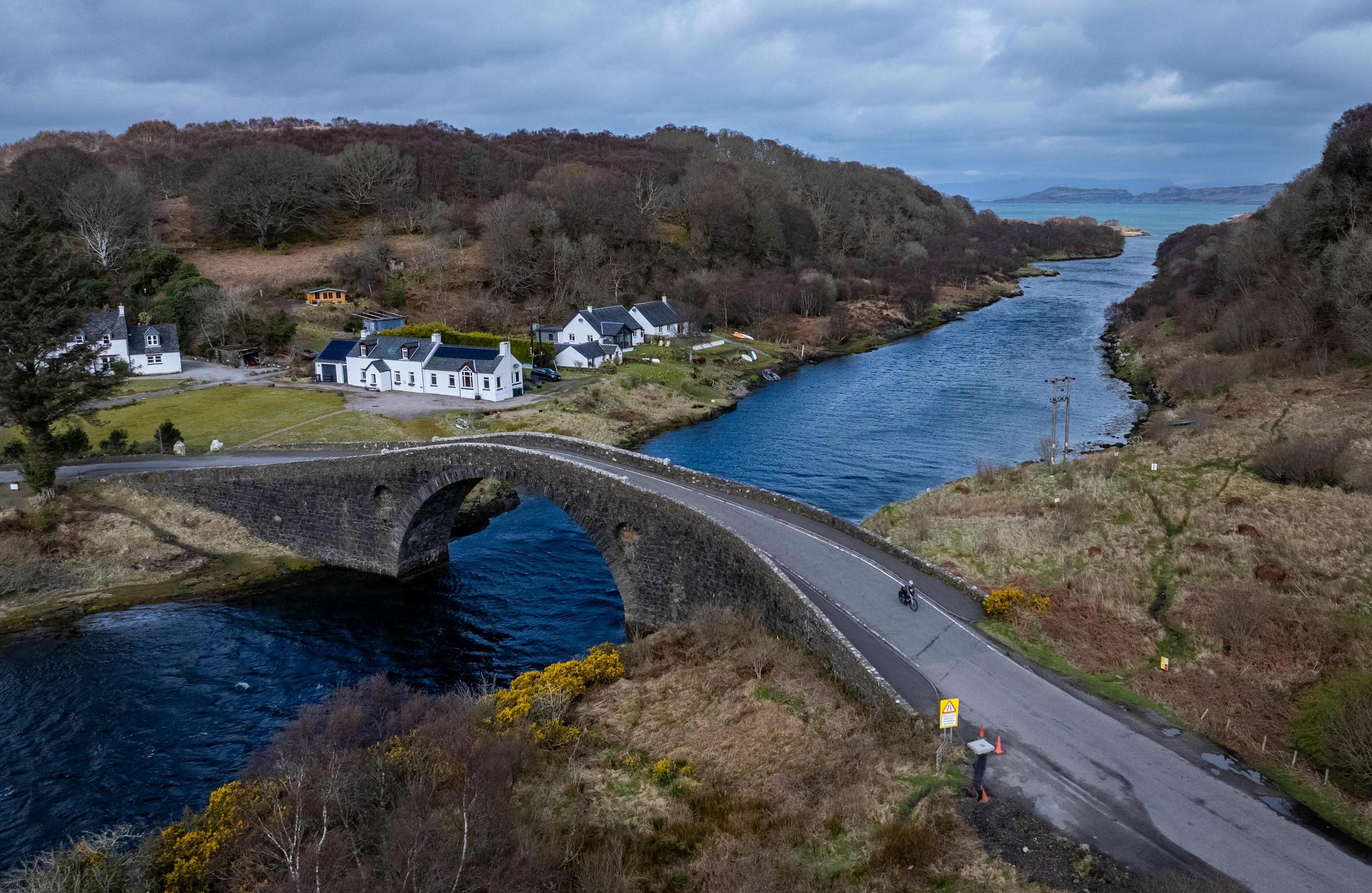
Preliminary work has started on the installation of traffic lights beside the scenic Clachan Bridge on Scotland’s Argyll coast. Known since the early 1800s as the “Bridge over the Atlantic”, the 234-year-old crossing to the Isle of Seil attracts visitors eager to boast of their trans-oceanic journey. However, there are fears that motorists given the green light will soon act aggressively towards pedestrians on what is a much-photographed landmark.
The installation of traffic lights at such a sensitive heritage site makes little sense to locals and has been described as a “1980s-style intervention” by an experienced former town planner. This place-making expert adds that the council has also ignored current guidelines on transport hierarchies.
“Somebody in a car or a bus or a lorry, [will think], ‘I’ve now got the green light, there’s nobody stopping me’,” said Grant Baxter of Fife, who has spent 30 years as a chartered planner in Scottish local government.
Thanks to adoption of the Sustainable Travel Hierarchy, it has long been official Scottish government policy to prioritise pedestrians, he adds.
“The pedestrian is at the top of the road hierarchy, and the car is at the bottom. Installing traffic lights is a 1980s-style intervention that completely fails for this location,” said Baxter.
Local residents are incensed that they weren’t consulted about what they say is a “bizarre,” “not-at-all-needed” scheme. Many feel it has been “imposed” upon them by a council based 35 miles away.
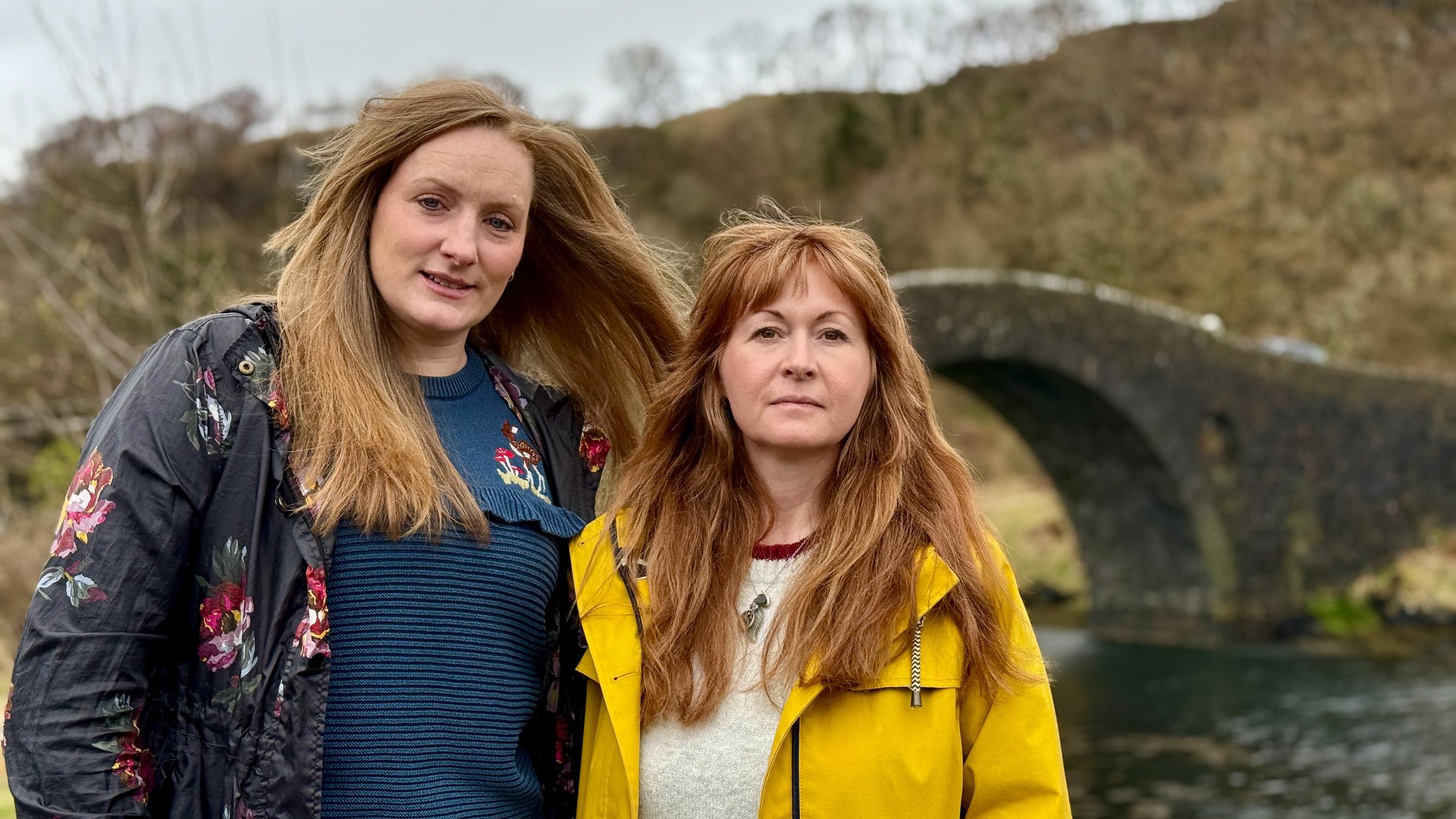
“The council has a history of making decisions for communities, not with the communities,” seventh-generation islander and local councillor Julie McKenzie said from a window table in the old inn opposite the bridge.
With us was fourth-generation islander Sarah Nicholson.
“We only found out about the traffic lights when workmen started digging up the road,” said Nicholson, adding that the council had so far not responded to any of her concerns.
And she’s not alone, with many other residents claiming to have been ignored by the council over the matter. An online petition against the traffic scheme has gathered 1,500 signatures, which is three times the area’s population, suggesting overwhelming rejection of the council’s plans.
The next traffic lights south will be in Lochgilphead, headquarters town for the council, which is working with SWARCO on the now controversial installation that’s costing at least £35,000 before connection to the grid.
Given the extremely low number of crashes at the bridge – all non-serious – the council’s claim that it was acting to improve road safety doesn’t hold water, salty or otherwise
Located 13 miles south-west of Oban and built in 1792, Clachan Bridge is tourist attraction brown-sign-posted from the A816, with visitors often getting out of cars and buses to amble over the narrow tidal channel that opens out into the North Atlantic.
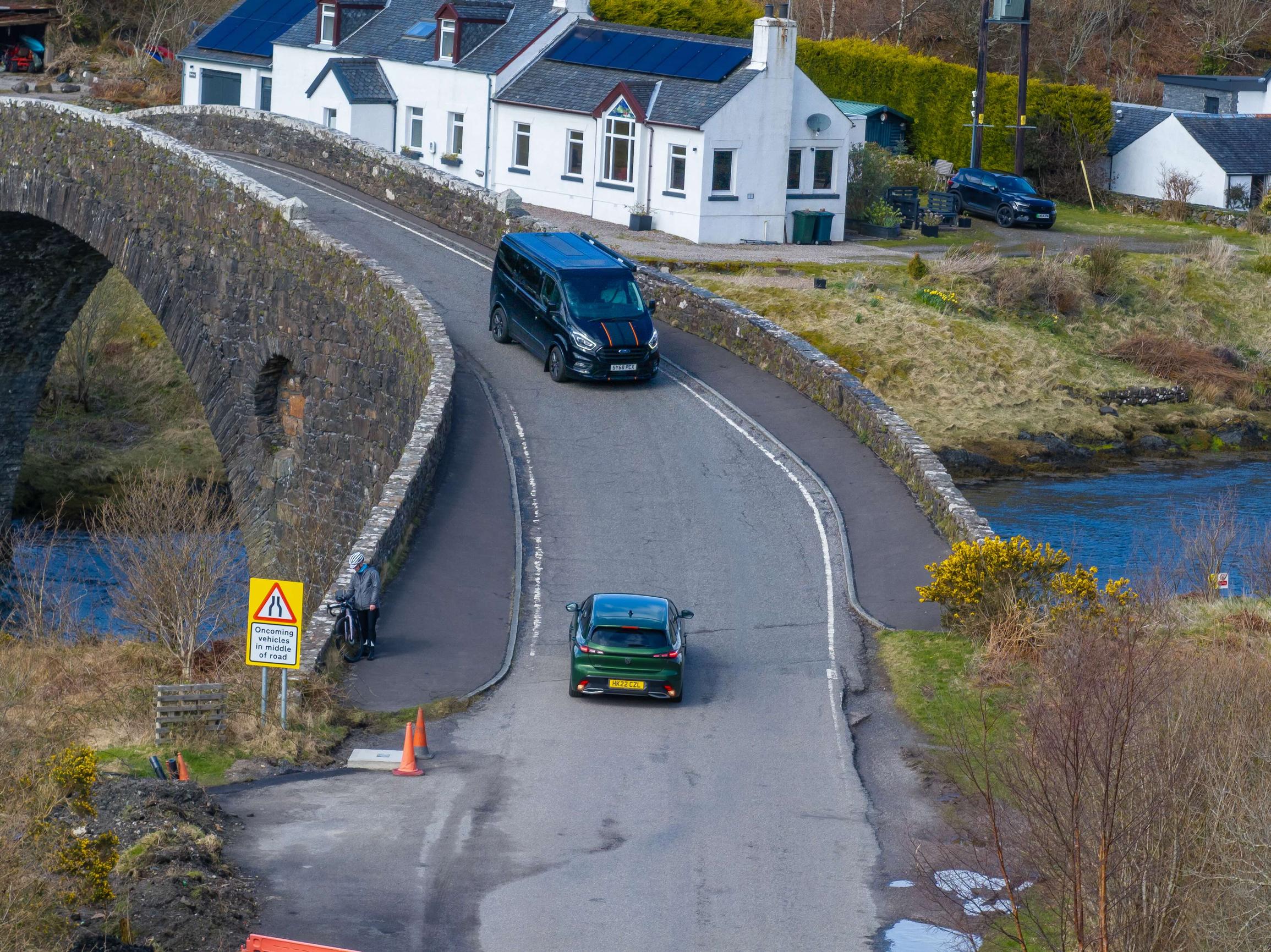
The footway on the humpback bridge fades to kerb-width, leaving selfie-taking pedestrians to share the narrow road with motorists who currently negotiate the crossing carefully.
The council says it has to install traffic lights on the bridge for “safety” reasons yet an incident search reveals that there have been just three “slight” collisions at the bridge over the 25-year period from 1999 to 2024.
“If Clachan Bridge was a crash hot spot, there’s nobody in this community who would be against a traffic calming measure,” said McKenzie, who started the petition.
On a site visit, with the build-out finished but the traffic light poles yet to be erected, it appeared that those in cars and on foot shared the bridge amicably, with motorists approaching the steep brow of the road gingerly.
Residents say the council’s scheme has been implemented without consultation, without the provision of evidence, and without input from heritage bodies.
The bridge is part of a historic landscape, they stress, arguing that the unwelcome intervention risks damaging the bridge’s bucolic setting and the visitor experience.
Talking to us from the inn opposite the bridge, McKenzie said that the council did not consult Historic Environment Scotland (HES) before beginning work.
In response, a HES spokesperson said: “It is for the planning authority to decide what consents are needed for a particular proposal and what consultation they should undertake.”
Nevertheless, HES guidance states that “key views to or from [a] historic asset or place” should not be altered.
Cathy Craig, CEO of Argyll & the Isles Tourism Cooperative (AITC), said that any changes to the bridge should be “carefully considered, with close collaboration between the local authority and the community, to ensure the character, beauty and visitor experience of the area are preserved”.
Nicholson believes installing traffic lights will be detrimental to tourism – a mainstay for the island community – because motorists will believe they have signal-sanctioned priority, making walking across the bridge more perilous.
Standing by the bridge, McKenzie and Nicholson suggested that cheaper, less disruptive measures could address any perceived risks without damaging the bridge’s historic and scenic setting. They said periodic trimming of foliage along the approach to the bridge would improve sight lines for all concerned, at a fraction of the cost of traffic lights.
Keeping it simple and frugal didn’t seem to be an option for Argyll and Bute Council, and their refusal to answer five of our eight questions suggests there’s more to this supposedly operational highways decision than meets the eye.
Changes to infrastructure are supposed to be evidence-based, and any council should be able to point to measurable benefits of spending taxpayers’ money. Given the extremely low number of crashes at the bridge – all non-serious – the council’s claim that it was acting to improve road safety doesn’t hold water, salty or otherwise. Was it therefore an evidence-free sign-off by an officer with a must-spend bit of budget or a non-engineering decision to appease a politician? Or perhaps it was just another example of mundane motonormativity? The council won’t say.
Carlton Reid is a previous winner of the transport category of the Press Gazette’s British Journalism Awards. He has written for The Guardian (on sustainable transport), WIRED.com (on electric cars) and Forbes.com (on sustainability). As a historian, he has researched Britain’s 1930’s MoT-funded cycle tracks and is the author of Roads were Not Built for Cars and Bike Boom, both from Island Press, USA.
Five days after being supplied with eight questions, Argyll and Bute Council referred us to a previous statement issued on the council’s website, and directly answered just three of our questions: “It’s not unusual to have large distances between traffic lights in rural local authority areas. We are currently developing a design for traffic lights that would support all users of the bridge. There is currently no completion date confirmed.”
The council pointedly chose not to answer these questions:
1: Councillors were briefed that Clackmannanshire and Dunblane MSP Keith Brown contacted the CEO of Argyll and Bute council saying a constituent of his witnessed a collision at the bridge and that he therefore suggested traffic lights should be installed at the bridge. Is this correct? If so, why was any weight given to an out-of-area MSP and his constituent? Did the communication from the MSP state the date of collision? (There have been three collision reports between 1999 and 2024, each being described as "slight" in severity – August 2015, July 2001, and January 2024.)
2: The council has permitted development rights under planning legislation, and – to date – the council does not believe the installation of traffic lights creates “any negative or differential impact that would require a full Integrated Impact Assessment.” However, given the unusually stiff local opposition will this decision be revisited?
3: As well as no Integrated Impact Assessment the council has not carried out an environmental impact assessment, a strategic environmental assessment, or a business impact assessment. Nor has the council published any traffic modelling on the impact of the traffic lights. If any these assessments have been carried out, please supply. If not, why not?
4: Councils, as per guidance in the National Transport Strategy, endorsed by COSLA [the umbrella body for all Scottish local authorities], are supposed to adhere to the Sustainable Travel Hierarchy. This hierarchy stresses that priority is given to walking and wheeling, followed by cycling, followed by public transport, followed by taxis and shared transport, followed by private car. However, the installation of traffic lights at Clachan Bridge reverses this guidance and appears to design for motorists.
Currently, motorists cede priority to pedestrians when met on the bridge (the footway is a sliver over much of the bridge) but once given a green go signal it's highly likely that motorists will treat this as a “do not stop” instruction and, given the time sensitive nature of traffic signals, will be far less likely to cede priority to pedestrians already on the bridge. So, what measures have been put in place to make sure it’s pedestrians given priority on the bridge?
5: There’s also guidance in the National Transport Strategy stating that councils should adhere to the Place Principle. Has the council run impacts of the traffic lights through the Scottish government’s Place Standard? If so, please supply. If not, why not?

TransportXtra is part of Landor LINKS

© 2026 TransportXtra | Landor LINKS Ltd | All Rights Reserved
Subscriptions, Magazines & Online Access Enquires
[Frequently Asked Questions]
Email: subs.ltt@landor.co.uk | Tel: +44 (0) 20 7091 7959
Shop & Accounts Enquires
Email: accounts@landor.co.uk | Tel: +44 (0) 20 7091 7855
Advertising Sales & Recruitment Enquires
Email: daniel@landor.co.uk | Tel: +44 (0) 20 7091 7861
Events & Conference Enquires
Email: conferences@landor.co.uk | Tel: +44 (0) 20 7091 7865
Press Releases & Editorial Enquires
Email: info@transportxtra.com | Tel: +44 (0) 20 7091 7875
Privacy Policy | Terms and Conditions | Advertise
Web design london by Brainiac Media 2020
