
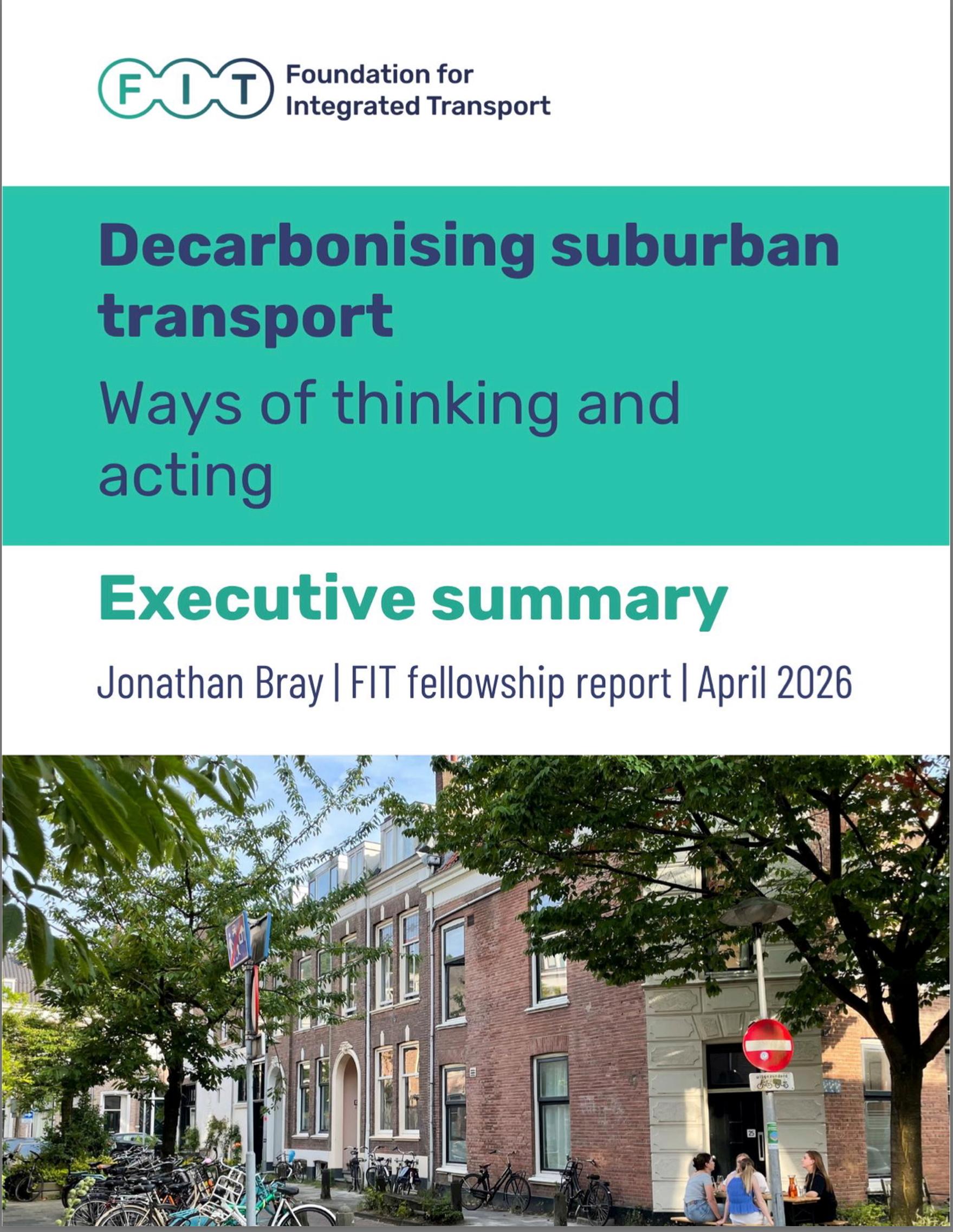
Central and local government must take urgent action to decarbonise suburban areas and make them more climate resilient, says a new report by the Foundation for Integrated Transport (FIT).
Report author Jonathan Bray found that many new suburbs in the UK are badly built, poorly designed and located, and often designed around the car, lacking public amenities and services including public transport. They are also often hostile to wheeling, cycling and walking.
With the Government planning to accelerate new house building, it must take a “fresh focus” on transport in the suburbs if its housing plans are not to “degenerate into more bleak and car dependent sprawl”, he warns.
“Given the urgent need to decarbonise transport, it’s time to start a conversation about what kind of approaches are going to work best in different kinds of suburbs,” writes Bray, who spent a year researching the decarbonisation of suburban transport in the UK and mainland Europe.
Based on his research, Bray has called on the DfT to identify “missing pieces” in policy making in relation to suburbs and to tackle potential obstacles to transport initiatives with the greatest potential in suburbs.
Decarbonisation and improved climate resilience of suburbs is best achieved through coordination between the energy, transport and built environment sectors, he asserts.
The Government should establish a cross-departmental working group to assess the scope for a template approach between the three sectors, states Bray.
But Bray believes that decarbonising the suburbs will not succeed “without the consent of the suburbs – given this is where the backlash against decarbonisation usually comes from”, he notes. “The suburbs therefore need to be the place where a just transition is born.”
The report draws up a set of recommendations for how to decarbonise suburban areas. It calls for a ‘future suburbs’ funding stream to support pilots such as mobility hubs, demand responsive transport and greater take-up of electric bikes.
More must be done to cut the cost and speed up the implementation of light rail schemes, with the Government co-ordinating planning processes, engineering standards and co-procurement, Bray writes.
Government must also shift the balance of national funding for roads from building new highways to greening and reducing flood risk from existing roads, he adds.
Another area of concern has been the paving over of the UK’s front gardens to fit in more and bigger cars. Bray wants central and local government to support the re-greening of front gardens, for example through supporting a Dutch style competition for which area can remove the most paving tiles from their gardens.
Millions of households have no way of charging vehicles on or outside their property, which is holding back the transition to electric cars, analysis shows.
Some of the most promising alternatives to single occupancy car use are the most neglected by policy makers, according to Bray. These include car pooling and car clubs, and new forms of ‘light mobility’ like electric bikes. He points out that Germany has 5.4 shared cars per 10,000 people, France has 2.1 while the UK has only 0.6.
On the positive side, Bray observes that the energy sector has decarbonised at an “extraordinary rate” and the transition to electric vehicles is “well underway”. The technology is also now available to create “various forms of microgrids which can balance generation, supply, storage and use of electricity for households and vehicles in more efficient and equitable way”.
Decarbonising suburban transport: Ways of thinking and acting

TransportXtra is part of Landor LINKS

© 2026 TransportXtra | Landor LINKS Ltd | All Rights Reserved
Subscriptions, Magazines & Online Access Enquires
[Frequently Asked Questions]
Email: subs.ltt@landor.co.uk | Tel: +44 (0) 20 7091 7959
Shop & Accounts Enquires
Email: accounts@landor.co.uk | Tel: +44 (0) 20 7091 7855
Advertising Sales & Recruitment Enquires
Email: daniel@landor.co.uk | Tel: +44 (0) 20 7091 7861
Events & Conference Enquires
Email: conferences@landor.co.uk | Tel: +44 (0) 20 7091 7865
Press Releases & Editorial Enquires
Email: info@transportxtra.com | Tel: +44 (0) 20 7091 7875
Privacy Policy | Terms and Conditions | Advertise
Web design london by Brainiac Media 2020
