
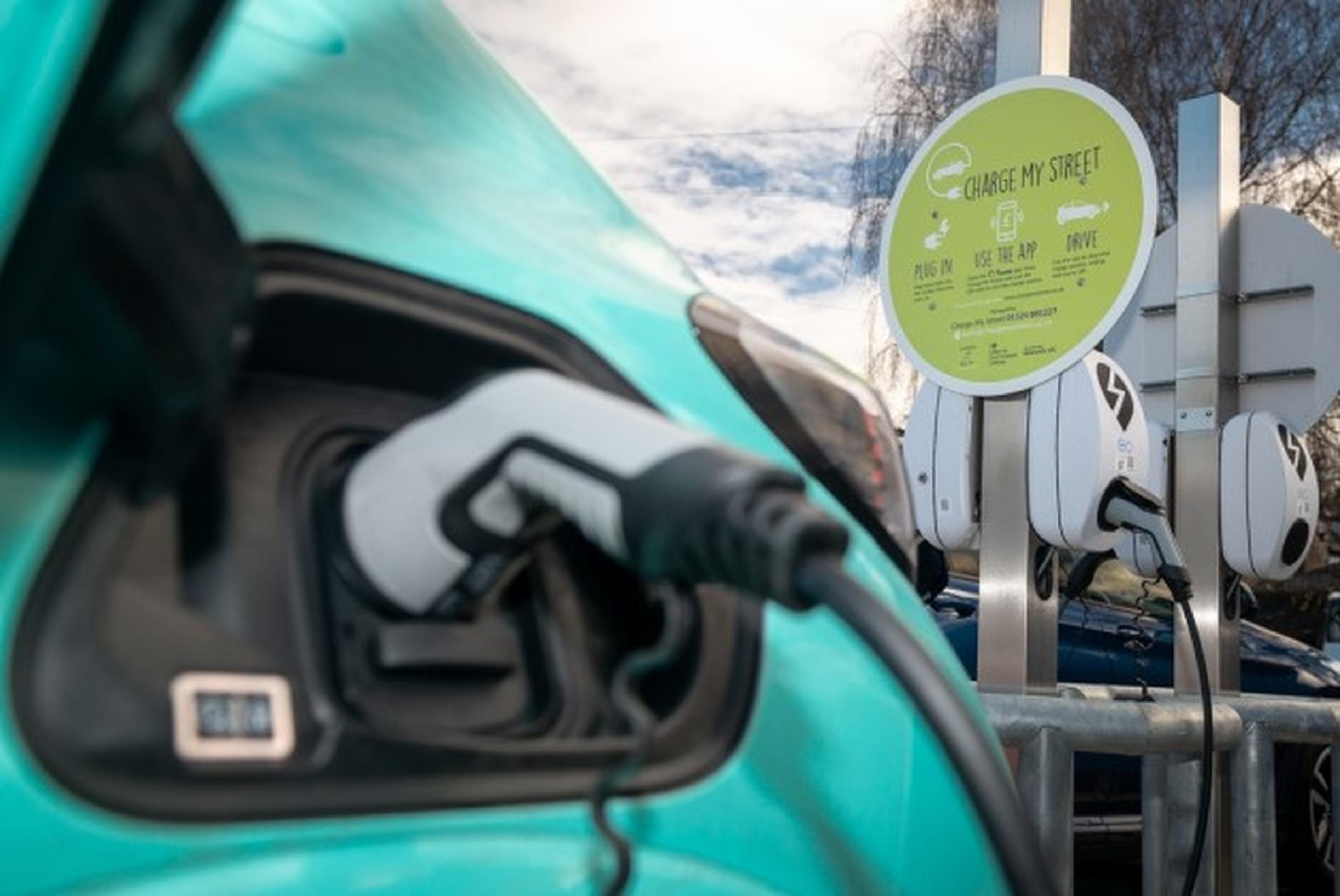
A UK tax tribunal has ruled that the 5% domestic VAT rate should apply for charging an electric vehicle (EV) on the public network, instead of the 20% currently paid by drivers.
HM Revenues & Customs requires chargepoint operators to charge the full 20% VAT. However, community chargepoint operator Charge my Street has successfully argued at appeal against the 20% rate.
Charge my Street was advised by tax experts at Deloitte who had noticed that existing VAT law says that the provision of less than 1,000kWh per month of electricity to a person at any particular premises counts as ‘domestic’. This would mean the 5% rate already should apply to public EV charging, provided it was under that limit. It calculated that even if an EV driver always charged at the same public chargepoint, it would still be nigh-on impossible to exceed 1,000 kWh per month.
Daniel Barlow, tax partner at Deloitte, said: “The First-tier Tribunal found that, under existing UK law, drivers should be charged the 5% reduced rate of VAT when charging their electric vehicles at any public charging facility.
“Specifically, the Tribunal interpreted the de-minimis provision in Note 5(g), Group 1, Schedule 7A, VAT Act 1994 as applying the 5% reduced rate of VAT to supplies of electricity at public EV charging locations where the amount of electricity supplied is below 1,000 kilowatt hours per month per customer at each location.”
At the First-Tier Tribunal Tax Chamber hearing last October, Charge my Street was represented by Sarabjit Singh KC.
The Tribunal found that Charge my Street’s model of providing accessible, community-based EV charging met the criteria for the reduced VAT rate previously reserved for domestic electricity supplies.
Charge my Street is a social enterprise (Community Benefit Society) which installs and operates community EV chargepoints, raising money through community shares. All profits are reinvested with a view to growing the EV chargepoint network.
Daniel Heery, director at Charge my Street, said: “This is a hugely important outcome – not just for Charge my Street, but for communities across the UK who rely on affordable, local EV charging. Our mission has always been to make neighbourhood charging accessible to everyone, and today’s ruling supports that mission.
“Lower VAT on charging improves fairness and helps accelerate the shift to cleaner transport for all. We rely on investment from ordinary EV drivers to extend our chargepoint network, and this result helps the commercial case for our current share offer.”
Dr Will Maden, director at Charge my Street, said: “EV adoption must be both practical and affordable at a community level if the UK is to meet its Net Zero commitments. The Tribunal’s decision recognises the essential role of local, public chargepoints in enabling that transition. We are pleased that the ruling provides clarity for operators like us and reassurance for the people and places we serve.”
The decision is expected to have wide-ranging implications for EV drivers, community charging networks, local authorities and smaller operators working to expand equitable access to charging in areas historically underserved by commercial providers.
Oliver Jarret, a director of Deloitte's Litigation Advisory & Settlement Group, said: “An electrifying victory for the EV charging industry!”
Writing on LinkedIn, Jarret stated: “The First-tier Tribunal has just given its judgment, ruling that the 5% rate indeed applies to public EV charging in those circumstances. The judgment is clear, unequivocal and a thumping victory for Charge my Street. While HMRC could seek permission to appeal, query if permission would be granted given how strongly the Tribunal rejected HMRC’s arguments on what the terms ‘premises’ and ‘rate’ meant.
“This is fabulous news not only for Charge my Street, led by Daniel Heery and Will Maden (who both appeared as witnesses), but also for the wider EV charging industry. The Deloitte team is massively grateful to Daniel and Will for all their efforts, and to Sarabjit (Sab) Singh KC for his brilliant advocacy and incisive thinking on this issue.”
In its decision, First-Tier Tribunal Tax Chamber’s, ruled that the 5% rate applies to public EV charging in those circumstances, rejecting arguments put forward by HMRC.
The Tribunal’s ruling overturns HM Revenues & Customs’ initial decision requiring chargepoint operators to charge the full 20% VAT.
HMRC issued a briefing note in 2021 around the VAT liability for EV charging through charging points in public places. It stated that there is no exemption or relief that reduces the rate of VAT charged based on the de minimis provision.
There is a reduced rate of VAT for supplies of small quantities of electricity, known as “de minimis”, but HMRC’s briefing stated this provision only applies if the supply of electricity is ongoing, to a person?s house or building and is less than 1,000kWh a month.
HMRC Brief 21/07 explained that supplies of electric vehicle charging through charging points in public places are charged at the standard rate of VAT. There is no exemption or relief that reduces the rate of VAT charged.
While is a reduced rate of VAT for supplies of small quantities of electricity, known as “de minimis”, HMRC stated that de minimis provision only applies if the supply of electricity is all of the following: ongoing; to a person's house or building; or less than 1,000 kilowatt hours a month.
“The de minimis provision does not apply to supplies of electric vehicle charging at charging points in public places,” wrote HMRC. “This is because these supplies are made at various places such as car parks, petrol stations and on-street parking, not to a person's house or building. In addition, these supplies are not usually an ongoing supply to one person where the rate of supply can be calculated.”
The HMRC said it is considering the decision and its next steps.
The 20% VAT rate of public chargepoint use has been widely criticised as being a barrier to equitable EV adoption. The disparity between the public and domestic VAT has been the subject of the long-running FairCharge campaign championed by the late Quentin Willson.
The First-tier Tribunal decision was welcomed by Matt Waller, general manager of The Charge Scheme, which enables employees to bundle EV charging salary sacrifice with their car, maintenance and home charger. He said: “For too long, drivers without a driveway have been penalised by a VAT system that charges them four times more than homeowners for exactly the same electricity. This ruling confirms what the industry has argued for years, and HMRC must now apply the 5% rate across all public charging without delay rather than dragging this through an appeal.”
The ruling was also welcomed by Lorna McAtear, deputy chair at the Association of Fleet Professionals (AFP), though she pointed out the decision may not prove definitive. “It’s been an AFP objective featured for some time in our Tax Manifesto to get VAT reduced on public charging and, while the implications of the Charge my Street decision are not yet clear, it could prove a staging post towards that objective,” said McAtear. “As it stands, however, this judgement only applies in very limited circumstances and could yet be appealed. We are watching the situation with interest.”
Guy Bartlett, chief executive of chargepoint operator Believ, said: “As a business dedicated to making EV charging fair and accessible for all, we see this initial tribunal ruling in favour of Charge my Street as an important and very welcome signal that the case for aligning VAT on public charging with domestic electricity has finally been recognised at a legal level. This is around fairness and creating sustainable and affordable charging solutions for all consumers.
“It is, however, important to note there is still a formal process to go through, including the possibility of an appeal by HMRC, so nothing changes overnight for consumers or public chargepoint operators. But this is a strong step in the right direction, and we would urge government and HMRC to move quickly to provide clarity and ensure a fair, consistent VAT framework that supports continued investment in public charging and accelerates the UK’s transition to zero-emission transport.”
Russell Olive, UK director at vaylens, comments: “Charging EV drivers more tax simply because they can’t charge at home has always been a structural flaw in the system. If this tribunal ruling ultimately leads to change, it would remove a clear imbalance for fleets and drivers without access to home charging.
“However, even if VAT is reduced, it won’t by itself transform fleet electrification. Businesses still have to make the operational model work in practice. Public charging is rarely the backbone of a fleet strategy. What we’re seeing instead is a layered approach: depot charging first, shared or semi-public infrastructure second, and public charging as a back-up. Better use of existing depot capacity, combined with clearer insight into how vehicles are actually used, will have just as much impact as any tax adjustment.”

TransportXtra is part of Landor LINKS

© 2026 TransportXtra | Landor LINKS Ltd | All Rights Reserved
Subscriptions, Magazines & Online Access Enquires
[Frequently Asked Questions]
Email: subs.ltt@landor.co.uk | Tel: +44 (0) 20 7091 7959
Shop & Accounts Enquires
Email: accounts@landor.co.uk | Tel: +44 (0) 20 7091 7855
Advertising Sales & Recruitment Enquires
Email: daniel@landor.co.uk | Tel: +44 (0) 20 7091 7861
Events & Conference Enquires
Email: conferences@landor.co.uk | Tel: +44 (0) 20 7091 7865
Press Releases & Editorial Enquires
Email: info@transportxtra.com | Tel: +44 (0) 20 7091 7875
Privacy Policy | Terms and Conditions | Advertise
Web design london by Brainiac Media 2020
