
For the second time in less than five years, Europe is managing the economic consequences of a fossil fuel shock. In 2025, the EU spent around EUR 340 billion on fossil fuel imports, with a further EUR 24 billion added in the early phase of the current crisis following disruption to the Strait of Hormuz. These costs feed directly and negatively into household budgets, industrial costs, inflation and competitiveness.
The underlying exposure is beginning to shift but remains structurally significant. While the EU has reduced its vulnerability to individual suppliers through diversification of oil and gas imports and has benefitted from the rapid expansion of renewables and electrification – creating a ‘green shield’ to fossil fuel shocks, over half (57%) of EU energy consumption is still based on imported fossil fuels. The response to the 2022 crisis demonstrated that coordinated action can reduce demand and stabilise markets, but the recurrence of crisis conditions shows that supply-side adjustment alone has not resolved structural dependence.
At the same time, the economics of the system are shifting. Electrified technologies are scaling, driven by lower operating costs and reduced exposure to fuel price volatility. Yet this shift is not reflected in the structure of demand. While 71% of EU electricity generation came from clean energy in 2024, electricity still represents less than a quarter of final energy consumption.
The result is a system where clean, domestic electricity is expanding, but most energy demand from business and consumers remains tied to fossil fuels and exposed to global markets.
The European Commission’s AccelerateEU-Energy Union proposal is framed as a dynamic emergency response that will evolve as conditions change, combining short-term relief with measures to accelerate structural transition. It is organised around five areas of action – coordination, consumer protection, electrification, energy system transformation and investment mobilisation.
While acknowledging the short-term crisis response needed to support immediate household and industry exposure to fossil fuel price volatility, this analysis focuses on how AccelerateEU contributes to accelerating electrification as a route to long-term economic resilience, energy security and reduced climate risk.
AccelerateEU places electrification at the centre of the response, framing it as the primary route to reducing exposure to fossil fuel price shocks and import dependence by shifting the energy demand to homegrown, domestically produced electricity from clean sources. It commits to introducing an electrification target, improving the electricity-to-fossil fuel price ratio, accelerating uptake of electrification technologies and addressing cross-sector barriers.
This marks a shift from earlier frameworks. Electrification is no longer treated as one pathway among many, but as the central mechanism linking energy security, affordability and decarbonisation. This aligns with broader system trends, where electrification is the most direct route to translating clean power supply into reduced fossil fuel use across end-use sectors.
What remains missing: The strategy stops short of defining the scale and pace of this shift. The electrification target and the intention to lower the electricity-fossil fuel price ratio are welcome actions, and we hope to see both a high level of ambition for the target and the promised action required to meet that target.
AccelerateEU explicitly links electrification, clean energy deployment and energy efficiency as mutually reinforcing components of energy security. It highlights the role of demand reduction, efficiency improvements and electrified end-uses in reducing fossil fuel consumption, particularly in buildings and industry.
In buildings, for example, replacing gas and oil boilers with heat pumps could halve final energy consumption and reduce bills, while scaling deployment from 2.4 million units today to 4 million units per year by 2030 would significantly reduce fossil fuel demand and improve energy efficiency.
It also reflects the role of system-wide measures such as the EU ETS, which has already contributed to reduced gas consumption equivalent to around 100 bcm, strengthening energy security.
What remains missing: Electrification, efficiency and energy security are recognised as linked, but not yet embedded in a coherent legislative or delivery framework. In particular, the absence of a clear long-term energy efficiency trajectory, including a 2040 target, limits the ability to fully capture efficiency gains as a driver of energy security.
AccelerateEU sets out a wide range of short-term measures to stabilise the system, including coordinated gas purchasing, storage management, oil stock releases and targeted consumer support. These include coordination through EU-level mechanisms such as gas storage filling, oil stock releases, optimisation of refinery capacity and the establishment of a Fuel Observatory to monitor supply and distribution.
Importantly, it recognises that these measures must be temporary and aligned with long-term goals, stating clearly that short-term relief “must not detract from” the transition to a decarbonised and resilient energy system.
What remains missing: In practice, the balance remains weighted toward managing fossil fuel supply. A significant share of the framework is focused on stabilisation measures that do not reduce underlying dependence. Without stronger safeguards, short-term interventions can slow structural change by prolonging fossil fuel use or delaying investment in alternatives.
Ensuring that relief measures actively accelerate electrification and efficiency, rather than simply cushioning fossil fuel demand, remains an unresolved challenge.
AccelerateEU places greater emphasis on enabling infrastructure, including grid expansion, interconnection, storage and system flexibility. It calls for faster delivery of the Grids Package and identifies infrastructure as essential to unlocking electrification at scale.
It also sets out concrete delivery parameters, including renewable deployment capacity reaching around 100 GW per year and permitting timelines reduced to a maximum of two years by the end of this year, alongside expanded storage capacity towards 200 GW by 2030.
What remains missing: While AccelerateEU recognises the need for expanded storage, demand-side flexibility and digital infrastructure, it does not define a framework to deliver these at scale. The importance of grid reinforcements cannot be overstated, and efforts need to fully embrace both short-term permitting issues as well as ensuring electrification scenarios are at the heart of long-term grid planning. Without stronger action there is the risk of limiting the benefits of electrification.
AccelerateEU recognises that current price structures disadvantage electricity relative to fossil fuels and commits to improving the electricity-to-fossil fuel price ratio, including through action on network charges and taxation. It also signals the phase-out of fossil fuel subsidies, which continue to distort investment and consumption decisions.
What remains missing: The direction is clear, but the mechanism is not. The proposal provides limited detail on how pricing reforms will be implemented across Member States or how quickly distortions will be addressed. Without clearer timelines and instruments, electricity will continue to face structural disadvantages, slowing electrification. The signal to phase out fossil fuel subsidies comes after repeated EU, G20 and COP commitments to do so, yet these subsidies remain widespread across the European Union. Fossil fuel subsidies are estimated at around $1.1 trillion globally, continuing to distort markets and slow the uptake of clean alternatives.
AccelerateEU strengthens the link between electrification and industrial competitiveness, highlighting that access to clean, affordable electricity is becoming a defining factor in investment decisions. It also sets out measures to mobilise capital, including a Clean Energy Investment Summit and the use of EU funding instruments to accelerate deployment. This reflects broader investment dynamics, where access to grids, permitting timelines and electricity price stability increasingly determine investment location decisions.
The role of the ETS in supporting the longer-term energy transition is highlighted with plans to work with Member States to steer ETS revenues towards electrification in transport and heating.
What remains missing: The proposal does not yet translate this into a coherent investment framework. Key determinants of investment location, including electricity pricing, grid access, permitting timelines and policy stability, are addressed separately rather than as part of an integrated competitiveness strategy. Without that integration, Europe risks slower deployment and weaker investment signals relative to competing markets.
The commission will present an Electrification Action Plan by the summer, including an electrification target and measures to remove barriers across industry, transport and buildings. AccelerateEU identifies electrification as the route to replacing oil and gas across the economy, while demand remains predominantly fossil-based despite an increasingly clean electricity supply.
A target can define the pace and scale of that shift, provide a reference for grid and storage planning, align investment across end-use sectors, and reduce uncertainty around demand-side transition. Pricing, efficiency measures and industrial strategy can then be calibrated against a common trajectory rather than progressing independently. Without a defined trajectory, progress is likely to remain uneven; a target can provide the basis for coordinated, system-wide delivery.
AccelerateEU sets out a clear and welcome level of ambition from the commission, particularly in linking electrification, energy security and competitiveness. Realising this ambition will now depend on translating it into concrete legislative progress that drives coordinated action at Member State level. This will be essential to ensure consistent implementation and accelerate deployment across the EU. Business stands ready to support these efforts, working with both EU institutions and member states to help turn this ambition into delivery.
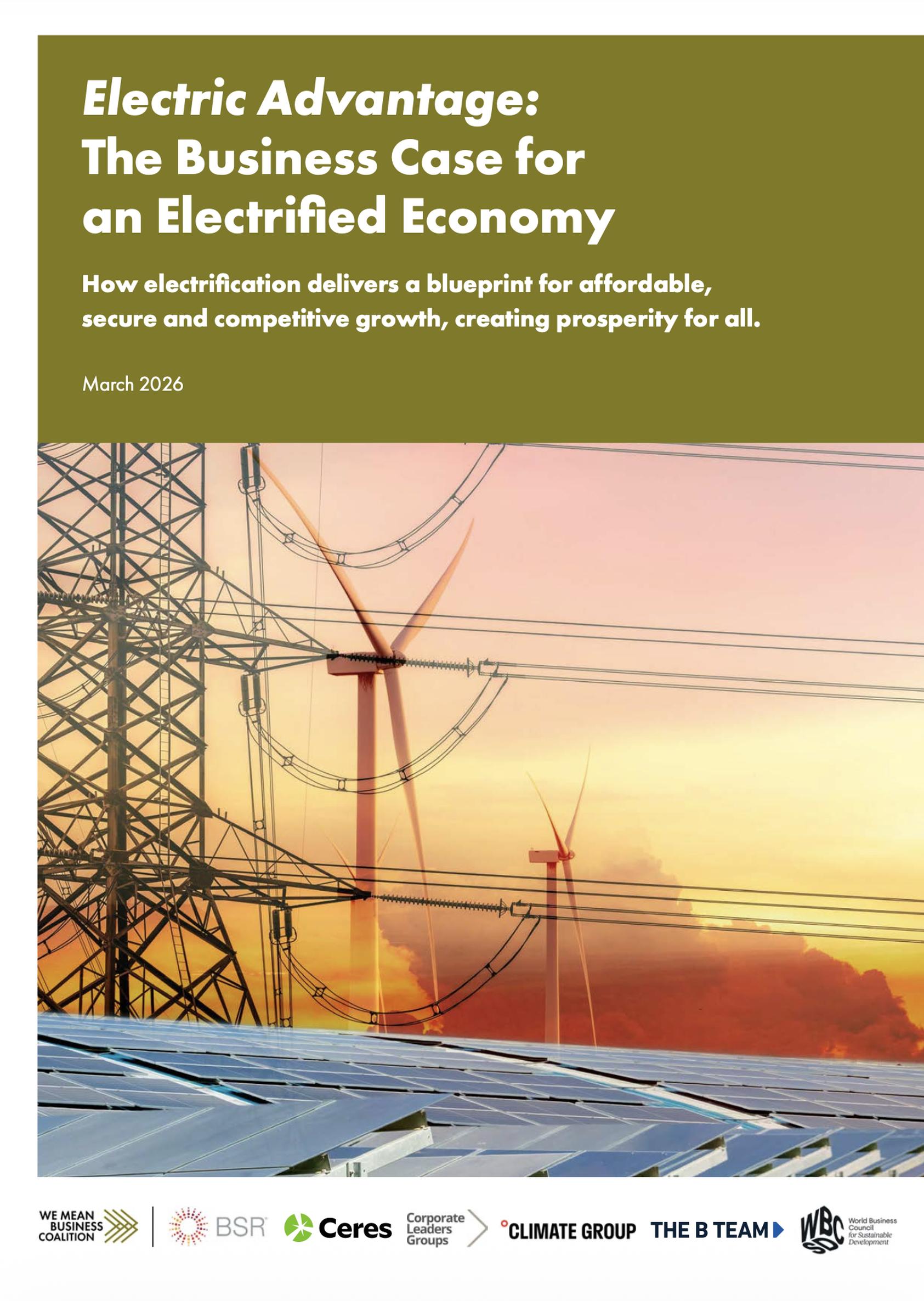
Link to the electrification white paper
We Mean Business Coalition works with businesses to take action on climate change. The coalition is a group of seven non-profit organisations: BSR, CDP, Ceres, Climate Group, CLG Europe, The B Team and WBCSD.

TransportXtra is part of Landor LINKS

© 2026 TransportXtra | Landor LINKS Ltd | All Rights Reserved
Subscriptions, Magazines & Online Access Enquires
[Frequently Asked Questions]
Email: subs.ltt@landor.co.uk | Tel: +44 (0) 20 7091 7959
Shop & Accounts Enquires
Email: accounts@landor.co.uk | Tel: +44 (0) 20 7091 7855
Advertising Sales & Recruitment Enquires
Email: daniel@landor.co.uk | Tel: +44 (0) 20 7091 7861
Events & Conference Enquires
Email: conferences@landor.co.uk | Tel: +44 (0) 20 7091 7865
Press Releases & Editorial Enquires
Email: info@transportxtra.com | Tel: +44 (0) 20 7091 7875
Privacy Policy | Terms and Conditions | Advertise
Web design london by Brainiac Media 2020
