
TRICS is not just a database used for trip generation analysis. It is also an excellent data source for examining levels of parking provision and utilisation at a wide range of development types. TRICS is the system of multi-modal trip generation analysis for developments in the UK and Ireland.
Founded in 1989, it is a database which now contains almost 10,000 transport surveys covering a wide variety of development types. Analysis of development-specific trip generation rates is a fundamental part of the process of writing Transport Assessments, which in turn are important documents that become part of planning applications.
I have worked on this project for almost 35 years, meaning my entire employed life. I started in February 1991 as a technical assistant (office boy), and I am now, as managing director, tasked with running TRICS Consortium Limited, following some 20 years in the role of project manager.
TRICS is used by both transport planning consultants, who write Transport Assessments, and by local authorities, who are tasked with auditing these documents as they consider planning applications. TRICS users apply inclusion criteria to represent development scenarios, from which trip generation rates are calculated from a selected set of transport surveys. A good analogy is a hotel comparison website where people undertake filtering to get a shortlist of properties that match their needs. The general principle is the same.
The ever increasing size of the TRICS database and the subsequent broadening of its selection options over time means that the system offers a great deal of flexibility. Each year, we commission over 300 surveys across the UK and Ireland, continuously adding to our evidence base and enabling the ongoing development and improvement of the system through an interactive partnership with everyone involved with TRICS, collectively known as the TRICS community. This approach has been invaluable to us over the years. It is vital that we always listen, adapt, evolve and take big steps forward, and the involvement of the TRICS community allows this.
From the earliest versions of our system, it was considered highly important that parking information, expressed in both quantitative and qualitative forms, was included in each of the survey records, with this information complementing various other numeric and descriptive data sitting alongside the inbound and outbound transport counts, these are broken down for multi-modal surveys into seven TRICS vehicle classifications plus cyclists, scooters, public transport users, vehicle occupants and pedestrians.
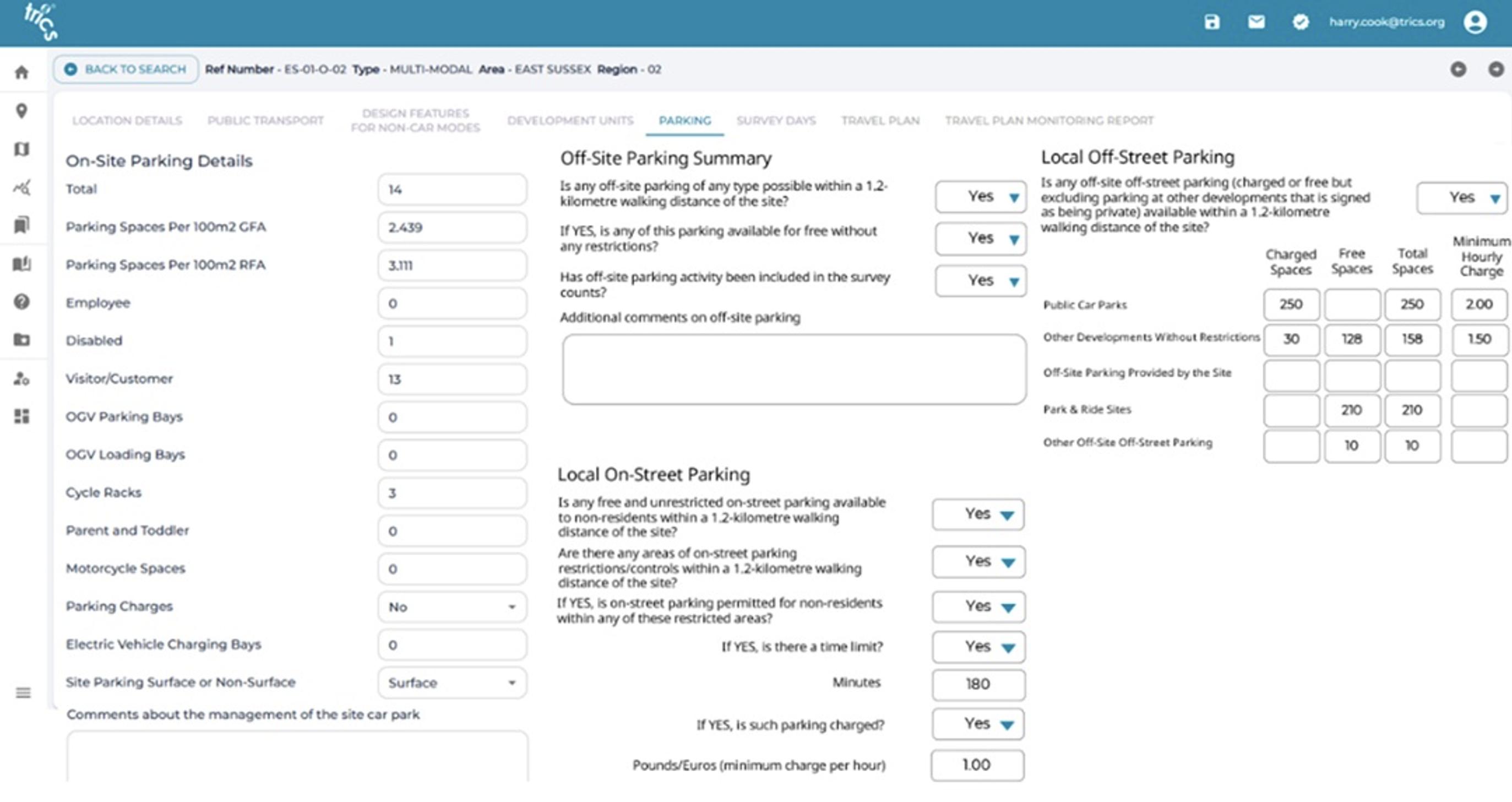
Over time, more detail has been introduced as much valued feedback has been received from the TRICS community, and these days a dedicated parking section within individual survey records is broken down into sub-sections showing on-site parking spaces, off-site parking accessibility, servicing vehicle parking types and information on parking restrictions. It really has become a thorough and data-rich information source for parking at a wide variety of development types, with the information provided for an individual record being applicable at the time when the survey took place.
The way that parking information is presented in TRICS depends on the development types being surveyed, with there being somewhat different approaches to residential and non-residential land uses. For residential developments, on-site parking spaces are broken down into on-street, driveway, garage, communal, allocated and electric vehicle charging bay spaces. There is also something important to consider when it comes to the recording of parking spaces at residential developments.
TRICS often undertakes specifically commissioned surveys, requested by transport planning consultants, at new residential builds that are at various stages of construction and occupation. These commissions are undertaken as part of our Standardised Assessment Methodology (SAM) for monitoring Travel Plans at developments, and further information on SAM can be found at our website. For these developments, the number of on-site parking spaces shown in the database record represents only those at occupied dwellings or in shared areas. This is because in TRICS, all unoccupied dwellings are not included in the total used to calculate trip generation, to avoid underestimation in the results.
For non-residential development types the breakdown of parking spaces is different, with the categories being employee, disabled, visitor/customer, ordinary goods vehicle (OGV) parking bay, OGV loading bay, parent and toddler, motorcycle, and EV charging bay spaces. As these categories are broad, they cover all non-residential development types in a unified and consistent way.
Other parking information within our individual database records includes whether parking at a development is surface or non-surface in nature (e.g. multi-storey or basement), the number of on-site cycle spaces, and the types of parking that can be undertaken by servicing vehicles. It is also important to note that parking is included as part of the TRICS filtering and selection process, so our users can set minimum and maximum levels of parking spaces at developments within their selection criteria, adding to the overall flexibility of this process. For residential development types this option goes further, with users able to select minimum and maximum parking space ranges per dwelling.
TRICS adds further context to its survey records by providing information on off-site parking accessibility plus local restrictions and charges. Combined with the on-site data, this provides a good overall parking picture. Information includes details of any local controlled parking zones (CPZs), the availability of on-street and off-street parking external to the development, and information on local parking charges and time limits. There is also space for additional annotation to provide extra detail and context. For the new TRICS 8 system, a full redesign and upgrade which has taken place in 2024 and 2025, the off-site parking section has been fully reviewed, and all new surveys added to the database in 2026 will see a much improved and easier to interpret set of data displayed. This shows the commitment of TRICS to providing a comprehensive evidence base of parking data within its system, which has evolved, grown and improved since the system’s early days to the level of detail available today.
So how do we collect all of this information, and how do the physical TRICS surveys contribute towards it? TRICS has a long-established survey methodology, which has evolved over time in the same way as the system itself. This is complemented by its comprehensive descriptive information, with all data fully defined through documentation that is supplied to our TRICS-approved data collection contractors, the suppliers who undertake the surveys for us. The collection of this supporting information is a desktop exercise and is something that our contractors fine-tune as they become accustomed to undertaking TRICS survey commissions over time. The recording of parking activity during a survey is where our survey methodology comes in
The seven TRICS vehicle classifications are:
All vehicles visiting a surveyed development, split by these categories, are recorded separately arriving and departing. These counts, presented hourly inbound and outbound in the database, are obtained by observation, interview, or a combination of both. As it is important that records of all off-site parking associated with a development are also obtained, to achieve an accurate and representative record of all activity, interviews of people walking into and out of developments are also conducted wherever necessary. This is of particular importance for certain development types (e.g. schools and any developments where limited or no
on-site parking is available).
There are many nuances and slight variations in our survey methodology which deal with a variety of different scenarios, but the end result is always the same: to obtain a full record of all trips undertaken, based on the main method by distance, both inbound and outbound throughout a survey’s duration. The method may differ for some development types and situations, but in the end there will always be consistency in the representation of the results. The TRICS Multi-Modal Methodology document explains everything in full detail, and is freely downloadable from the TRICS website.
The standard approach when it comes to the recording of parking activity is firstly, wherever possible, to record the number of vehicles on-site prior to the commencement of a survey. By doing this, we can obtain a running total of vehicles at a development by adding arrivals and deducting departures throughout the day. This is supplemented by interviews at a development’s access points to obtain off-site parking activity. This approach provides us with what we call parking accumulation, with this running total of vehicles at a development shown on an hourly basis alongside the inbound and outbound counts. This is an excellent means by which we can examine levels of utilisation of parking spaces at a development.
One of the count types that may be of additional relevance to parking is our vehicle occupants count. This is included in all multi-modal TRICS surveys, splitting the number of people within each vehicle recorded inbound and outbound into columns of one occupant, two occupants, etc, up to seven occupants.
Bus and coach passengers are excluded, as they are covered by other count types, and it is important to note that drivers of vehicles picking up and dropping off passengers at developments are also excluded wherever this is possible. Therefore, the results of a vehicle occupants count can provide a good indication of levels of car-sharing, and the variations between counts across a number of developments can provide additional and helpful context in this regard.
When undertaking trip rate calculations, our users can also select trip rates per parking space as one of a number of options, for many of our development types. This is another helpful way of examining parking activity levels and provides another example of how parking blends into our system in numerous different ways. I consider it vital that TRICS continues to remain an important evidence base for parking information, with this continuing to grow year on year as we add further survey data to our system and fulfil our role within the transport planning industry.
Ian Coles is Managing Director of the TRICS Consortium Limited. He can be contacted at: ian.coles@trics.org
www.trics.org

TransportXtra is part of Landor LINKS

© 2026 TransportXtra | Landor LINKS Ltd | All Rights Reserved
Subscriptions, Magazines & Online Access Enquires
[Frequently Asked Questions]
Email: subs.ltt@landor.co.uk | Tel: +44 (0) 20 7091 7959
Shop & Accounts Enquires
Email: accounts@landor.co.uk | Tel: +44 (0) 20 7091 7855
Advertising Sales & Recruitment Enquires
Email: daniel@landor.co.uk | Tel: +44 (0) 20 7091 7861
Events & Conference Enquires
Email: conferences@landor.co.uk | Tel: +44 (0) 20 7091 7865
Press Releases & Editorial Enquires
Email: info@transportxtra.com | Tel: +44 (0) 20 7091 7875
Privacy Policy | Terms and Conditions | Advertise
Web design london by Brainiac Media 2020
