
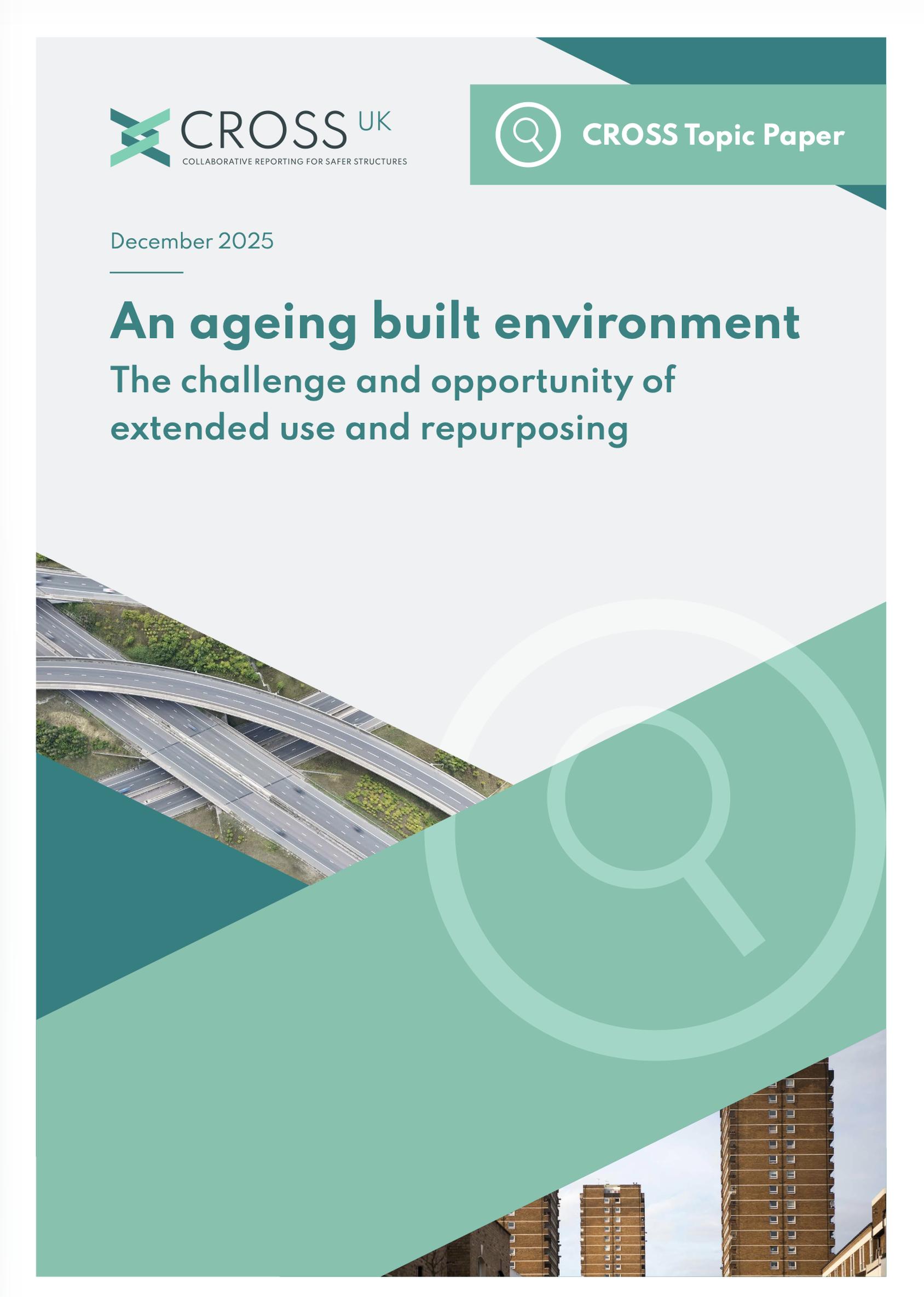
Our ageing built environment means many structures are now reaching, or even exceeding, their intended service life.
The challenge lies in understanding, maintaining and safely extending the life of buildings whose materials may have degraded and for which documentation may be incomplete.
If not properly maintained, or renovated and re-used in an uninformed manner, structures may deteriorate or even collapse.
A new Topic Paper from CROSS-UK examines the key factors and challenges involved in prolonging the service life of existing structures. An ageing built environment: The challenge and opportunity of extended use and repurposing draws on experiences confidentially reported to CROSS by engineers, asset managers, and construction professionals.
The Topic Paper is aimed at:
Car parks are among the building types considered by CROSS-UK.
Predicting degradation rates is essential for prioritising interventions and managing risk, says CROSS-UK. In 1997, a localised failure of the top-deck waterproofing system at Pipers Row car park in Wolverhampton led to water ingress into areas of poor-quality concrete repair. The prolonged exposure caused deterioration of the reinforced concrete, resulting in a punching shear failure and the collapse of a 120-tonne section of the top deck, the report states.
Car parks also provide an example of how contemporary use can present risks that were not envisaged in a structure's original design specification. Modern vehicles are heavier, larger, and more closely spaced than when many car parks were designed. Increased plastic content raises fire loads, and plastic tanks can fail during a fire, spreading fuel. Electric vehicles add further complexity, as they may burn for longer and are more difficult to extinguish than fires in traditional vehicles.
Across the UK and beyond, the built environment is ageing. Many buildings and other structures have reached or exceeded their intended service life. Their continued use presents both a challenge and an opportunity.
The challenge lies in understanding, maintaining, and safely extending the life of assets that were not designed with modern expectations in mind. Materials may have degraded, documentation may be incomplete, and design philosophies may differ from today’s standards.
Decisions about continued use must be informed by careful investigation, sound engineering judgement, and a clear understanding of risk. Safety must be central to this process.
Structures that are not properly assessed or maintained can pose serious hazards, and the consequences of failure can be severe.
The opportunity is equally significant. Reusing or repurposing existing structures supports sustainability, reduces carbon emissions, and aligns with the principles of the circular economy. It helps to reduce the environmental and financial costs of demolition and new construction, and can preserve heritage and character in the built environment.
The Topic Paper examines the key factors and challenges involved in prolonging the service life of existing structures. It draws on the experience of engineers, asset managers, and construction professionals, sourced from numerous CROSS reports to highlight best practices and common pitfalls.
Sections address the challenges of existing structures, the value of reliable data, the importance of inspection and maintenance, the case for reuse, and the constraints that must be acknowledged.
Doing nothing is not a viable option. By recognising both the potential and the limitations of existing structures, we can make choices that are safe, sustainable, and economically sound. This is a shared responsibility that requires collaboration and competence, as well as a long-term view.
As structures age, materials change in ways that can compromise safety and performance. Deterioration and degradation, terms often used interchangeably, occur in all materials exposed to environmental conditions. In some cases, degradation is slow and has little impact on performance. In others, it can be significant and require intervention.
Modern structures are designed with a defined service life. This is outlined in BS EN 1990:2023 Eurocode: Basis of structural and geotechnical design as the assumed period for which a structure is to be used for its intended purpose with anticipated maintenance, but without major repair being necessary. Importantly, reaching the end of this period does not necessarily imply a loss of functionality.
Deterioration and degradation may be influenced by:
Collaborative Reporting for Safer Structures UK (CROSS-UK) is a scheme for built environment professionals to report concerns about fire and structural safety. CROSS-UK was created by the Institution of Structural Engineers, Institution of Civil Engineers and Institution of Fire Engineers. It seeks to help create a safer built environment by improving competence through the sharing of technical knowledge, and by encouraging more open and collaborative attitudes.

TransportXtra is part of Landor LINKS

© 2026 TransportXtra | Landor LINKS Ltd | All Rights Reserved
Subscriptions, Magazines & Online Access Enquires
[Frequently Asked Questions]
Email: subs.ltt@landor.co.uk | Tel: +44 (0) 20 7091 7959
Shop & Accounts Enquires
Email: accounts@landor.co.uk | Tel: +44 (0) 20 7091 7855
Advertising Sales & Recruitment Enquires
Email: daniel@landor.co.uk | Tel: +44 (0) 20 7091 7861
Events & Conference Enquires
Email: conferences@landor.co.uk | Tel: +44 (0) 20 7091 7865
Press Releases & Editorial Enquires
Email: info@transportxtra.com | Tel: +44 (0) 20 7091 7875
Privacy Policy | Terms and Conditions | Advertise
Web design london by Brainiac Media 2020
