
Most electric vehicle owners are satisfied with their experience and are planning to invest in a new vehicle.
The majority of EV drivers have access to charger at home, but when using the public charging network would like cheaper prices, quicker charging and better reliability.
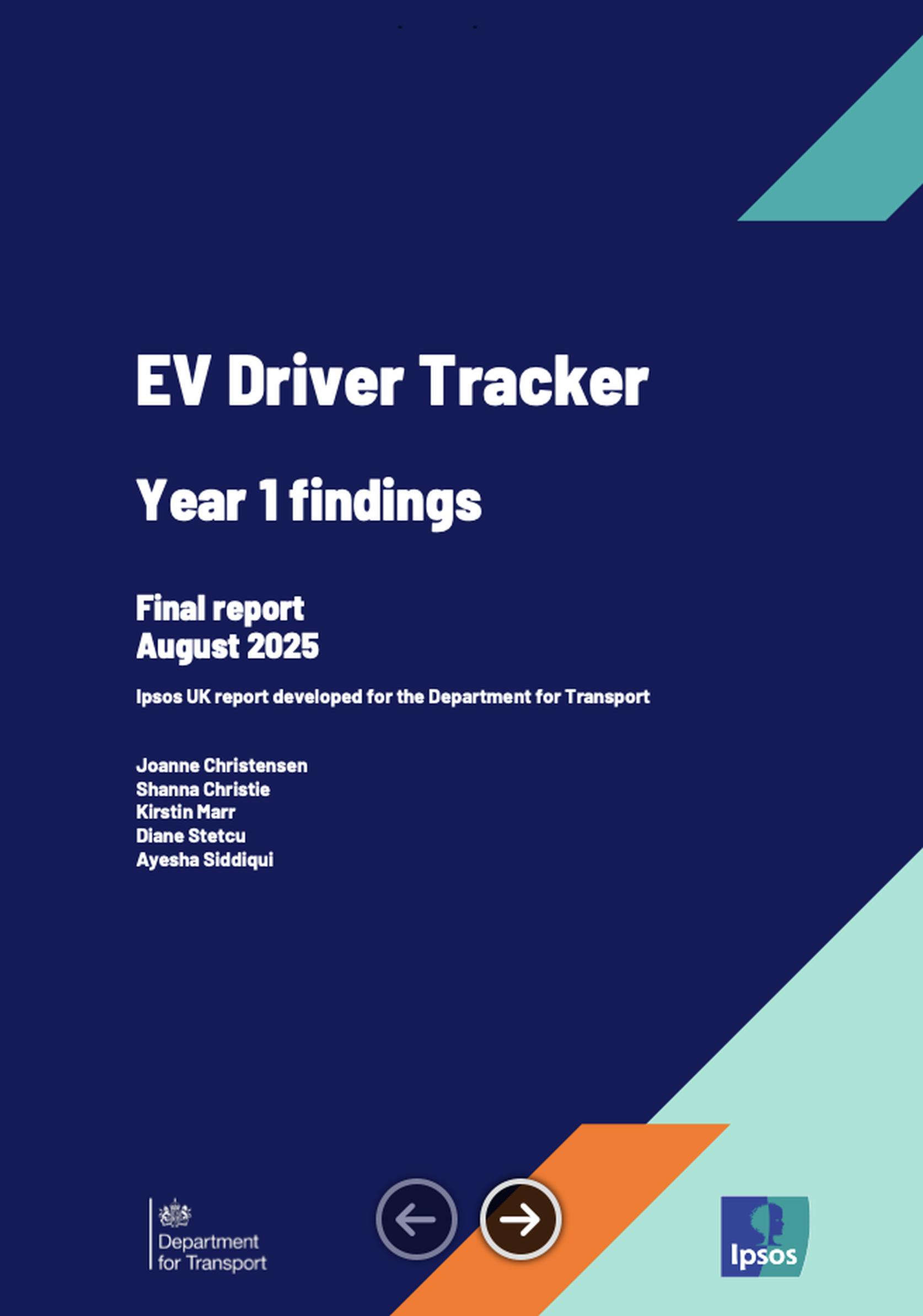
These are among the findings of an Ipsos study into attitudes and behaviours of battery electric vehicle (BEV) and plug-in hybrid electric vehicle (PHEV) drivers.
Commissioned by the Department for Transport (DfT), the research is dersigned to inform policy and decision-making.
The study reveals that the vast majority of EV drivers had access to a method of charging at home (91% BEV, 88% PHEV), with BEV drivers more likely to have a dedicated home charger installed (76%) compared to PHEV drivers (53%).
Urban BEV drivers, renters and those without off-street parking were less likely to have home chargers and therefore were more reliant on public charging.
Among those with home charging, most (78%) had the charger installed themselves after the house was built, with only around 11% reporting that the charger was installed by previous owners or tenants, and a further 10% stating that it was installed whilst the house was being built.
Three-quarters (74%) of BEV and 58% of PHEV drivers had smart chargers, allowing for drivers to operate the charger remotely. Among those with non-smart chargers, half (52%) of BEV drivers had a home charger that enabled specific charging times to be set compared to only 36% of PHEV drivers.
BEV drivers with home charging typically charged at least 1-2 times weekly, with overnight charging being slightly more common than daytime charging. Specifically, 86% reported they charge at least 1-2 times a week overnight, whilst 71% reported they charge at least 1-2 times a week throughout the day.
Almost half (49%) of EV drivers had a specific EV tariff. The most common home charging costs for BEVs were 0-9p/kWh (31%), followed by 10-19p/kWh (18%) and 20-29p/kWh (16%). Whereas for PHEVs, the most common home charging costs were 10-19 p/kWh (23%), followed by 0-9 p/kWh (12%) and 20-29p/kWh (11%).
The travel and charging diary evidence found that participants charged their vehicle an average of four times over a two-week period. BEV drivers charged more frequently at public chargers compared to PHEV drivers (1.8 times compared to 1.2 times).
Over a third (37%) of diary participants did not know the cost of public charge.
The research also explored those who rely on the public chargepoint network. For the 9% of BEV drivers totally reliant on public charging, the most common locations used were business/organisation car parks (27%), dedicated EV charging hubs (23%), and work/school (19%). 42% primarily used 22-49kW chargers and 23% 50kW+ chargers.
Among all EV drivers, dedicated charging hubs were the most frequently used public chargers, with 32% of BEV drivers and 29% of PHEV drivers using these at least once a week. Workplace charging was also common (27% BEV and 33% of PHEV drivers using these at least weekly).
Motorway and A-road service areas were used less often.
On journeys, 71% of BEV drivers reported that they would stop to charge when their vehicle’s battery was between 10-29% of the total capacity. Most EV drivers reported charging their vehicle’s battery to 70% (73% BEV, 60% PHEV).
Around half of UK EV drivers were satisfied with public chargepoint availability in their local area (52%). In England, and focusing on the services available on the strategic road network, around half of EV drivers were satisfied with public chargepoint availability at motorway service areas (56%), and major A-road service areas (50%). However, notable proportions expressed dissatisfaction (24% local, 18% motorways, 22% A-roads).
Satisfaction was higher among 17-34 year olds, Greater London, urban residents, and BEV drivers compared to their counterparts.
Over half of EV drivers felt confident taking long journeys (58%) and thought public chargepoints were easy to locate (58%). However, many had concerns about public chargepoints including: unclear pricing (55%), poor reliability (49%), and insufficient provision in relation to demand (47%).
The majority (84%) of EV drivers felt safe using public chargepoints. Feeling unsafe was uncommon (3%) and mainly associated with poor lighting and leaving cars unattended. Men and younger groups felt safer than women and over 55s.
The top improvements desired for the public charging network were cheaper prices (47%), quicker charging (45%), and better reliability (29%). Those without home charging wanted to see more local chargepoints.
EV drivers strongly preferred additional ultra-rapid and rapid chargers at on-route locations like motorways, A-roads and EV charging hubs. For destinations like residential streets, workplaces and car parks, slower chargers were more desired. Home chargers favoured rapid units on motorways and A-roads while those without home charging wanted more local standard chargers.
The majority (78%) of EV drivers intended to get another EV for their next vehicle, favouring BEVs (50%) over PHEVs (28%) and new (76%) compared to used (20%). 88% of BEV drivers and 83% of PHEV drivers would likely recommend their vehicle type. Less than 6% of EV drivers were unlikely to recommend an EV, indicating high satisfaction overall.
TransportXtra is part of Landor LINKS

© 2026 TransportXtra | Landor LINKS Ltd | All Rights Reserved
Subscriptions, Magazines & Online Access Enquires
[Frequently Asked Questions]
Email: subs.ltt@landor.co.uk | Tel: +44 (0) 20 7091 7959
Shop & Accounts Enquires
Email: accounts@landor.co.uk | Tel: +44 (0) 20 7091 7855
Advertising Sales & Recruitment Enquires
Email: daniel@landor.co.uk | Tel: +44 (0) 20 7091 7861
Events & Conference Enquires
Email: conferences@landor.co.uk | Tel: +44 (0) 20 7091 7865
Press Releases & Editorial Enquires
Email: info@transportxtra.com | Tel: +44 (0) 20 7091 7875
Privacy Policy | Terms and Conditions | Advertise
Web design london by Brainiac Media 2020