
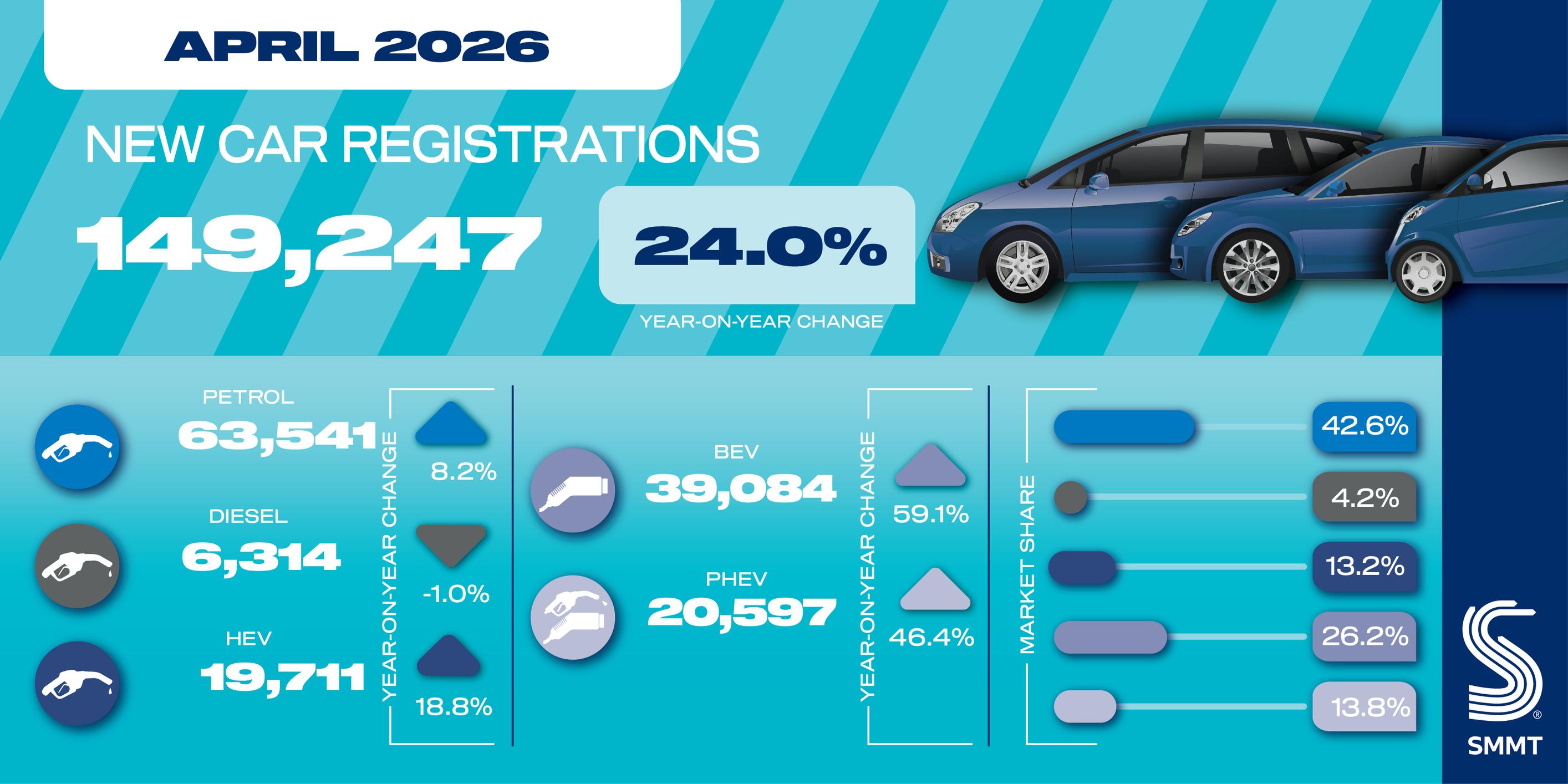
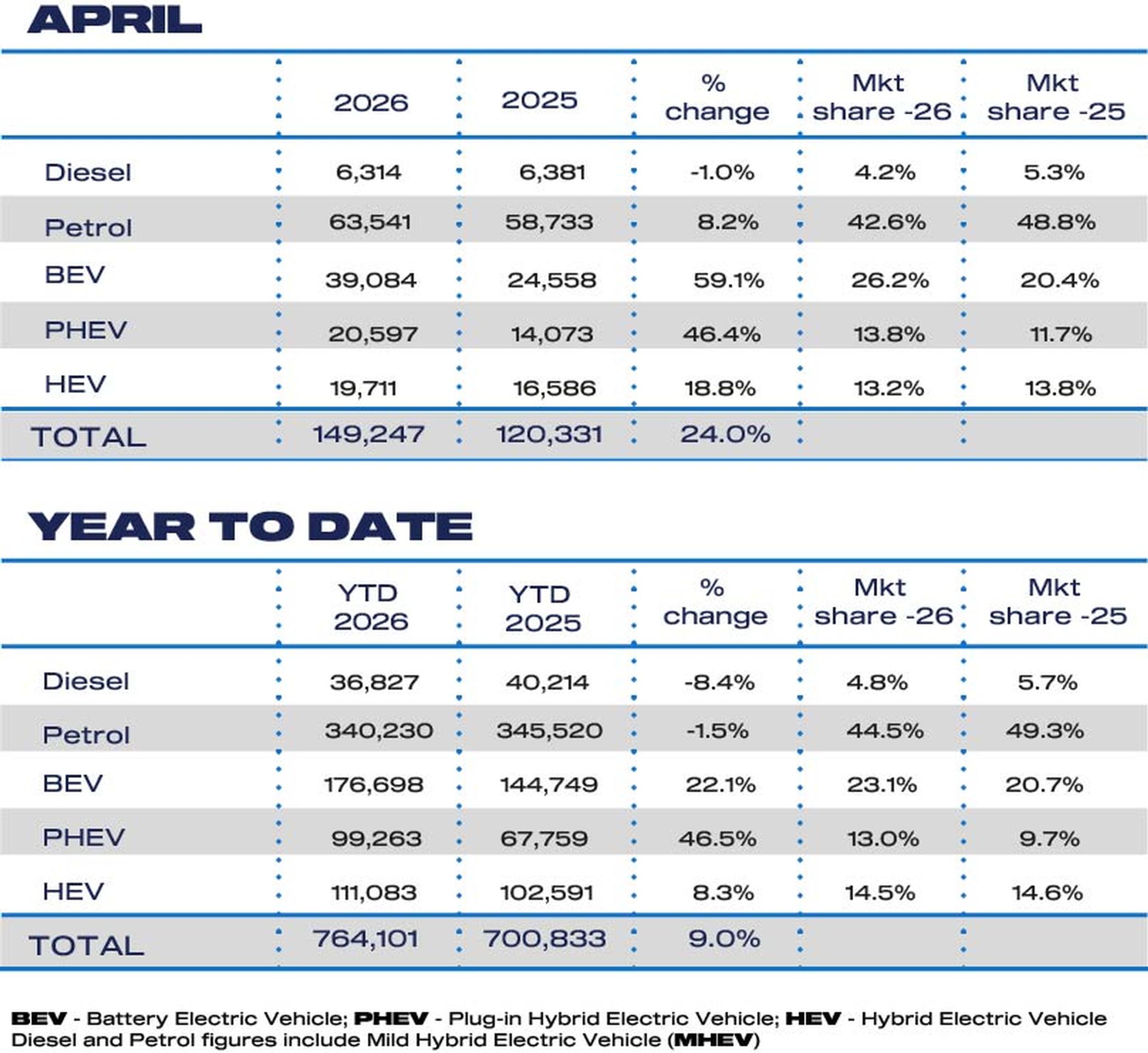
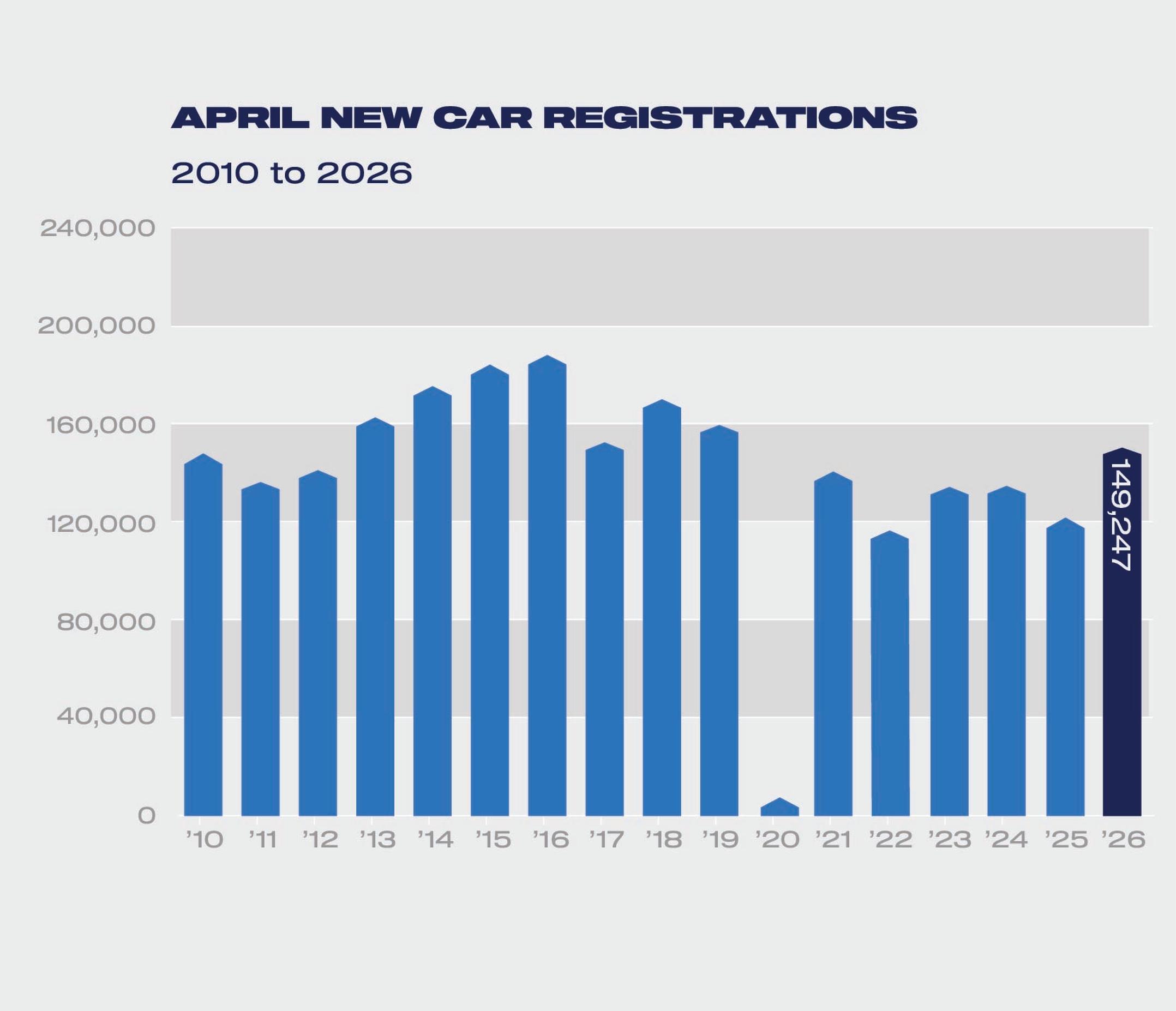
The UK new car market grew by 24.0% to reach 149,247 registrations last month, according to the latest figures published by the Society of Motor Manufacturers and Traders (SMMT).
The increase reflects a rebound from an unusually weak April last year, when buyers pulled purchases forward to March to beat incoming vehicle tax increases, including the application of VED and the Expensive Car Supplement (ECS) on battery electric vehicles (BEVs).
While April remains a traditionally low volume month, magnifying year-on-year variation, this was the best outturn since 2019’s 161,064 units.
Growth was recorded in all sectors, led by fleets, up 26.8% to 90,462 registrations. Private retail deliveries grew 20.2% to reach 56,116, while registrations by the smaller business sector rose 15.0% to 2,669.
Demand for petrol cars rose 8.2%, while diesel registrations fell -1.0%. Electrified cars accounted for more than half (53.2%) of the market for the second month this year. Plug-in hybrid (PHEV) registrations rose 46.4% to take a 13.8% market share, while hybrid electric vehicles (HEVs) increased 18.8%, securing 13.2% of new registrations.
Marking a market milestone, April also saw the two millionth battery electric car registered (2,012,758), following bumper growth of 59.1% compared with last year. As a result, BEV uptake reached a robust 26.2% share of registrations in what is a typically low volume month.
Year to date, BEVs comprise 23.1% of the overall new car market, significantly short of the 33% required by the Zero Emission Vehicle Mandate, despite manufacturer discounts and the introduction of the Electric Car Grant last year.
The latest automotive industry outlook, also published today, shows improving confidence in overall market volumes but also reflects weaker expectations for EV demand. Total new car registrations in 2026 are now expected to rise 3.6% to 2.093 million, up from January’s 2.048 million outlook, but BEV share has been downgraded to 26.8%, from 28.5%, following an underperforming first quarter.
Looking ahead, the 2027 market is anticipated to reach 2.121 million units, 32.0% of them BEVs – leaving a persistent gap of around six percentage points against the mandate target. Energy, production and charging costs remain high and, as a result, demand has not grown as fast as assumed when the regulation was formulated.
The Iran conflict adds further uncertainty, with rising interest in EVs potentially tempered by concern over inflation, higher energy prices and the resultant negative impact on the cost of living.
Other major international markets are revising their transition plans to reflect geopolitical and market realities. The SMMT says that the UK similarly needs an urgent review of the transition to avoid being put in an uncompetitive position, undermining consumer choice, investment and growth.
Mike Hawes, SMMT chief executive, said: “April’s rebound is welcome, but underlines just how significantly fiscal changes can influence the market. Two million electric car registrations is a considerable milestone to celebrate, although natural demand is still well below the level demanded by the mandate. The mounting cost of compliance threatens to limit consumer choice, overall decarbonisation and the sector’s competitiveness so the need for a rapid review of the transition to align policy with market realities is unchanged, else Britain’s attractiveness as a vehicle market and manufacturing hub will be put at risk.”
Commenting on the figures, Sue Robinson, chief executive of the National Franchised Dealers Association (NFDA), added: “April’s figures represent a positive and encouraging performance for the new car market, highlighting the resilience of the sector despite ongoing economic pressures. It is particularly reassuring to see continued uptake of electrified vehicles as consumers increasingly engage with zero-emission mobility.
“Franchised dealers remain committed to supporting customers through the transition and are well placed to sustain this momentum. However, it is vital that there is continued collaboration between industry and government and most importantly, that there is greater clarity from government to ensure long term growth and stability in the market.”
Colin Walker, Head of Transport at the Energy & Climate Intelligence Unit (ECIU), said: “With prices at the pump rising as a result of war in the Middle East, it’s no surprise to see EV sales jumping 59% in April. Drivers are voting with their feet seeking to shield themselves from these sudden jumps in the oil price, and save hundreds - even thousands - of pounds a year in running costs. Just recently Autotrader pointed out that EV sticker prices are now cheaper on average than petrol cars.
“With more than a quarter of new cars sold now EVs this reduces the UK’s demand for oil boosting energy security, with electric cars increasingly powered by electricity generated in British wind and solar farms. Calls from parts of the car industry to slow down the UK’s switch to EVs risks leaving our car industry in the slow lane, our drivers worse off, and the UK less energy secure. This is another step on the road to achieving net zero emissions.”?

TransportXtra is part of Landor LINKS

© 2026 TransportXtra | Landor LINKS Ltd | All Rights Reserved
Subscriptions, Magazines & Online Access Enquires
[Frequently Asked Questions]
Email: subs.ltt@landor.co.uk | Tel: +44 (0) 20 7091 7959
Shop & Accounts Enquires
Email: accounts@landor.co.uk | Tel: +44 (0) 20 7091 7855
Advertising Sales & Recruitment Enquires
Email: daniel@landor.co.uk | Tel: +44 (0) 20 7091 7861
Events & Conference Enquires
Email: conferences@landor.co.uk | Tel: +44 (0) 20 7091 7865
Press Releases & Editorial Enquires
Email: info@transportxtra.com | Tel: +44 (0) 20 7091 7875
Privacy Policy | Terms and Conditions | Advertise
Web design london by Brainiac Media 2020
