
Britain’s transition to zero-emission vehicles must reviewed before zero-emission vehicle targets accelerate from 2027, the Society of Motor Manufacturers and Traders (SMMT) has warned.
The SMMT is calling for a review of the country’s transition to zero-emission vehicles, warning that weakening policy certainty now risks slowing progress just as the shift to electric gathers pace.
The comments follow the publication of new SMMT analysis arguing that changing economic conditions mean the UK’s EV transition pathway should be reassessed.
Mike Hawes, SMMT chief executive, said: “The UK’s EV transition pathway was conceived with the best of intentions – but the assumptions behind it have proved over-ambitious. A landscape which once looked solid has turned out to be quicksand.
“Recognising the world of 2026 is not the one envisaged five years ago is not a retreat from ambition; it is a necessary step to achieving it. We need an urgent review that reflects today’s realities, that delivers decarbonisation not deindustrialisation and offers consumers the choice they have always expected.”
New analysis published by SMMT suggests the UK’s transition pathway – the Zero Emission Vehicle (ZEV) Mandate – was built on assumptions that have proved to be over-optimistic.
Despite changes to regulatory flexibilities and the return of consumer incentives, in Same Destination, Smarter Route the SMMT argues gap between policy ambition and market reality continues to widen.
The SMMT says the automotive sector remains fully committed to net zero. However, the report argues that conditions have changed so much, that failing to reassess the route risks undermining the very objectives the policy was designed to achieve.
Despite having the highest battery electric vehicle (BEV) market share of any major European market, the UK is already falling short of its own expectations, says the SMMT.
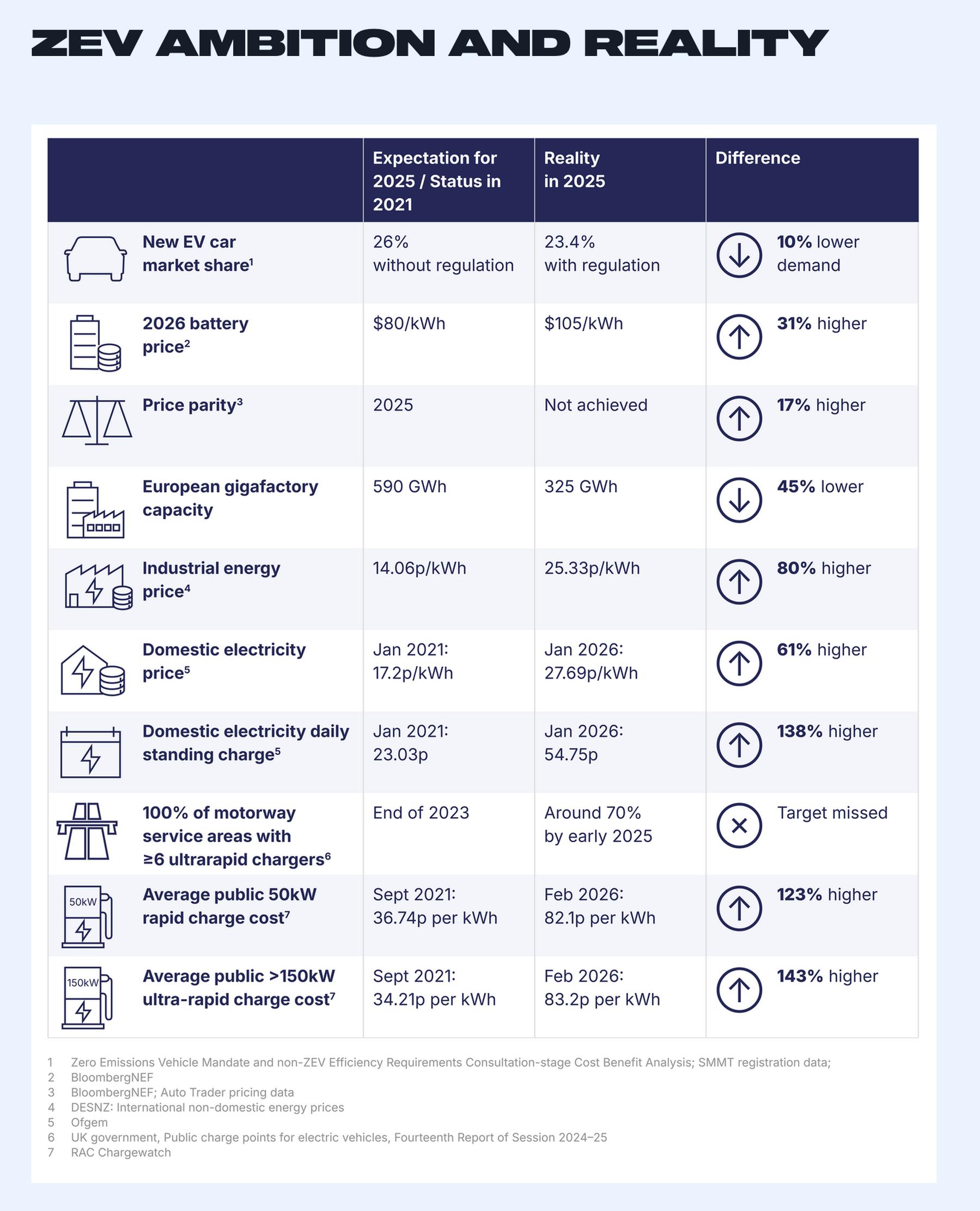
In 2025, battery electric vehicles accounted for 23.4% of new car registrations – below the 28% ZEV mandate requirement, and short even of the 26% government originally expected would be achieved without regulation. This is despite UK drivers enjoying a choice of more than 160 BEV models, says the SMMT.
The industry has sought to bridge the gap between ambition and demand through heavy levels of discounting – more than £10 billion over the past two years – and by using mandate flexibilities. However, the SMMT warns such subsidies are unsustainable and undeliverable when at the end of 2027 the targets become significantly tougher (52% for cars, 46% for vans).
The SMMT argues that natural market demand will not deliver the doubling in new car market share in two years, yet alone the quadrupling of electric van market share needed to achieve these targets. The SMMT says that without action to close the gap, fleet renewal and parc decarbonisation will slow, and the UK’s attractiveness as both a vehicle market and manufacturing base will be put at risk.
Global events have also undermined the assumptions underpinning the transition. Analysis in Same Destination, Smarter Route, unveiled at SMMT’s Electrified conference, shows how battery costs are more than 30% higher than anticipated, raw material costs remain stubbornly high, and UK and EU industrial energy prices have risen 80% and 28% respectively since 2021. As a result, the SMMT says the expected price parity between electric and conventionally fuelled vehicles has not materialised, restricting the pace of transition.
Charging infrastructure has increased, but the SMMT reports that cost of public charging has, in some instances, gone up by more than 140% in the past five years, while a target of at least six ultra-rapid chargepoints at every UK motorway service area by the end of 2023 was only around 70% complete in early 2025.
The challenges are even greater for commercial vehicles, says the SMMT. While almost two-thirds of new van models are now available as zero-emission, uptake in 2025 was 9.6%, barely half of the 16% required by regulation.
For heavy goods vehicles, adoption is only just beginning – just 1.4% of the market in 2025 – reflecting the sector’s diverse operating requirements, high upfront costs and the scale of charging and refuelling infrastructure still needed.
The SMMT says the geopolitical landscape has fundamentally changed with knock-on effects on energy markets, business and consumer confidence, and attitudes to trade which are increasingly protectionist. Last week EU published its draft Industrial Accelerator Act which the SMMT suggests threatens trade in the very vehicles the EU and UK seek to promote.
The SMMT adds that other major markets, such as the EU and Canada, have already altered their transition plans, and the US has rowed back on its EV commitments altogether.
Responding to the SMMT report. Fiona Howarth, founder and director of Octopus Electric Vehicles, said the transition is already well underway and that maintaining policy certainty is essential to continue building momentum among drivers, investors and infrastructure providers.
“Drivers are already choosing electric in growing numbers because the technology and economics make sense. The ZEV Mandate provides the certainty that brings more choice and better value to drivers,” she said.
“Weakening this policy now would be the wrong approach. We should be doubling down on ways to power our cars and homes with energy produced here in the UK, rather than relying on imported fossil fuels. The focus now should be on building confidence and accelerating the transition, not slowing it down.”
Another industry leader, Tanya Sinclair, chief executive of Electric Vehicles UK, said that as EV adoption continues to grow and the UK remains one of Europe’s leading EV markets, the priority should now be building confidence among drivers and businesses to accelerate the transition rather than revisiting the overall direction of travel.
She said: “The UK’s EV transition is already well underway. Electric vehicles accounted for almost a quarter of new car sales last year, and more than two million drivers are already enjoying the benefits of going electric.
“If some manufacturers now want to weaken the targets designed to bring these vehicles to market, they are only hurting themselves. Drivers are increasingly choosing electric because the technology, performance and running costs are better.
“Asking government to slow the roll-out of EVs goes against what drivers want and risks reducing choice just as demand is growing. Weakening the ZEV Mandate will not stop the transition. It will only leave the companies calling for it further behind.”
Commenting on the call from the SMMT for Britain’s transition to zero-emission vehicles to be urgently reviewed, Colin Walker, head of transport at the Energy and Climate Intelligence Unit (ECIU), noted: “It has been confirmed today that the car industry exceeded its EV sales targets in 2024. Analysis indicates it also exceeded them in 2025, and it already appears to be on course to do so again in 2026, despite some in the industry having inaccurately claimed otherwise.
“At a time when oil has hit $100 a barrel, petrol prices are going up and concerns are being raised about the UK’s energy security, weakening the mandate would slow the shift to EVs, and leave British drivers paying higher prices and exposed to this kind of global instability. It could also undermine investor confidence, and see billions of pounds of investment in the nation’s charging infrastructure, and wider economy, being held back.”
TransportXtra is part of Landor LINKS

© 2026 TransportXtra | Landor LINKS Ltd | All Rights Reserved
Subscriptions, Magazines & Online Access Enquires
[Frequently Asked Questions]
Email: subs.ltt@landor.co.uk | Tel: +44 (0) 20 7091 7959
Shop & Accounts Enquires
Email: accounts@landor.co.uk | Tel: +44 (0) 20 7091 7855
Advertising Sales & Recruitment Enquires
Email: daniel@landor.co.uk | Tel: +44 (0) 20 7091 7861
Events & Conference Enquires
Email: conferences@landor.co.uk | Tel: +44 (0) 20 7091 7865
Press Releases & Editorial Enquires
Email: info@transportxtra.com | Tel: +44 (0) 20 7091 7875
Privacy Policy | Terms and Conditions | Advertise
Web design london by Brainiac Media 2020