
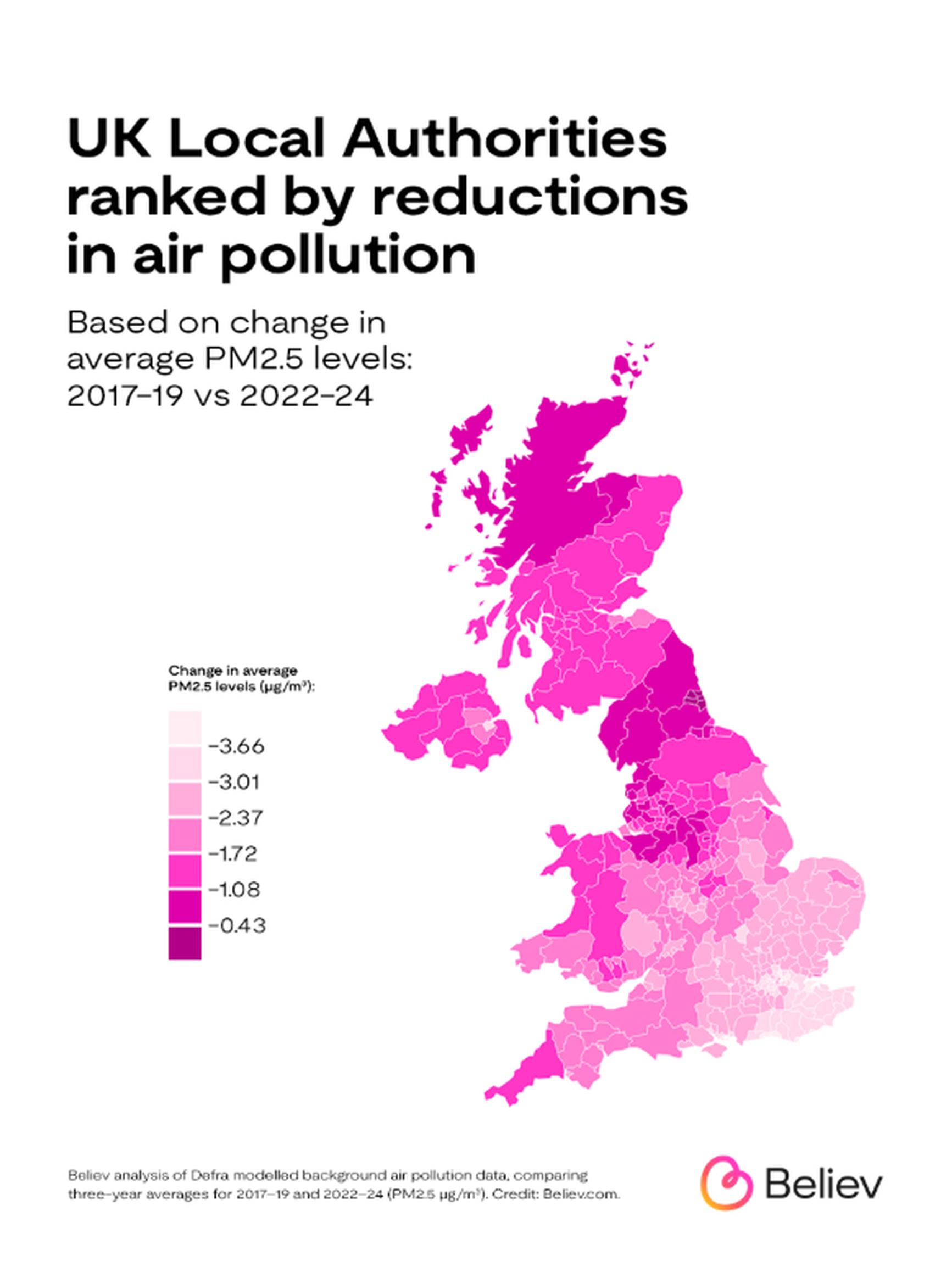
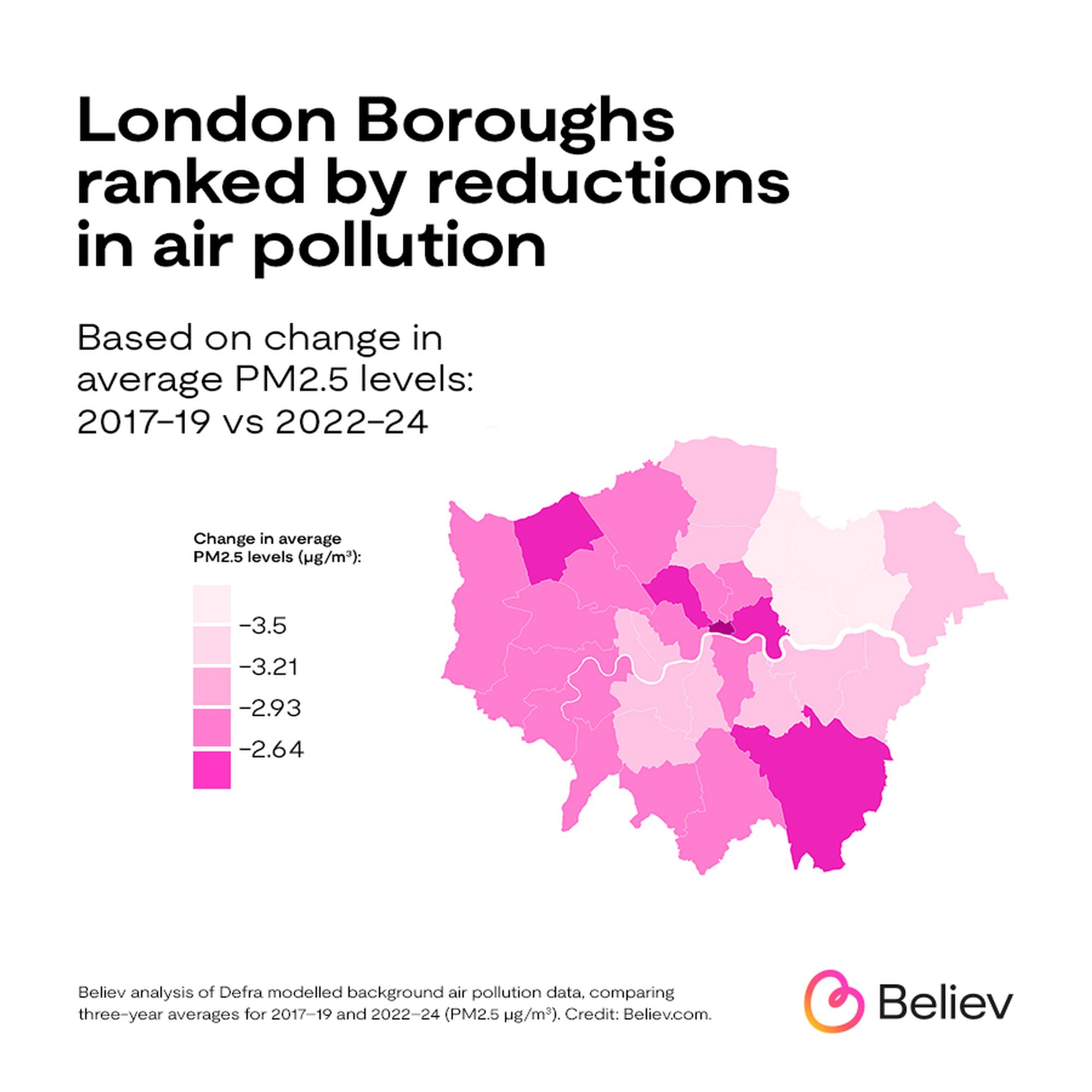
New analysis reveals that 34% of local authorities in England and Wales have now cut fine particle pollution (PM2.5) to within the UK’s legal limit – delivering on the government’s 2030 air quality ambition four years ahead of schedule. This leaves the City of London as only local authority yet to meet the target.
Data analysis from electric vehicle chargepoint operator Believ examining clean air progress reveals third (34%) of local authorities have cut air pollution levels to meet the UK’s 2030 clean air threshold target for average annual levels of fine particulate matter (PM2.5). They join the 65% that had already met the target. Yet 95% of neighbourhoods are still above the more stringent World Health Organization (WHO) target, and experts warn against complacency.
The air pollution cuts mean 99% of lower super output areas (LSOAs) in England and Wales meet the UK’s PM2.5 target air quality guidelines, and 100% meet the standard for nitrogen dioxide (NO2). LSOAs were created by the Office for National Statistics to create local areas or neighbourhoods designed for statistical analysis at a more granular level than entire local authorities.
At a local authority level, the City of London is the only area that has not yet met the UK target legal threshold of PM2.5 for the most recent three-year average.
Comparatively, Portsmouth, Brighton & Hove and Medway were among the top local authorities for air quality improvement in the UK, based on reductions in PM2.5.
Believ’s analysis shows every local authority in Scotland and Northern Ireland now meets WHO limits for PM2.5, but none in London, the South East, Yorkshire and the Humber, the East Midlands or the East of England improved enough to meet those standards.
Believ analysed the change in air pollution levels in 2017–2019 vs 2022–2024, excluding COVID years, using annual mean data from Defra (Department for Environment, Food & Rural Affairs).
To contextualise what these changes mean for population health, Believ consulted Professor Stephen Holgate, Professor of Immunopharmacology from the University of Southampton, and Professor Frank Kelly, Battcock Chair of Community Health and Policy, Imperial College London.
PM2.5 refers to tiny particles in the air that are less than 2.5 micrometres wide and are small enough to breathe deep into the lungs and enter the bloodstream, with long-term exposure linked to serious health problems, including heart disease, strokes, lung cancer, respiratory infections, COPD, type 2 diabetes, and complications during pregnancy.
Professor Stephen Holgate explains the impact of pollution: “It accelerates ageing in all organs within the human body, and 700 diseases, from osteoporosis to dementia, are linked to pollution.
“This is no longer just an environmental issue. It is a public health issue. It is going to be important to further educate local authorities and the wider public that this is a problem that impacts the entire life course, so there is even more incentive to make further improvements.”
Holgate added that the increase in EVs on the road will contribute to an improvement in air pollution and reduction of health risks.
Guy Bartlett, Believ CEO, said: “It’s positive to see the progress that local authorities are making in reducing air pollution. This shows local action on cleaner transport, energy and planning can deliver real results. But with 95% of neighbourhoods still above the WHO guideline, we cannot afford to slow down.
“At Believ, we are focused on helping councils build sustainable transport infrastructure to help accelerate progress towards cleaner air in local communities.
“Clean air should not be postcode lottery. Every community deserves air that is safe to breathe. So it is crucial that we don’t lose this momentum and continue to strive for cleaner air for all.”

TransportXtra is part of Landor LINKS

© 2026 TransportXtra | Landor LINKS Ltd | All Rights Reserved
Subscriptions, Magazines & Online Access Enquires
[Frequently Asked Questions]
Email: subs.ltt@landor.co.uk | Tel: +44 (0) 20 7091 7959
Shop & Accounts Enquires
Email: accounts@landor.co.uk | Tel: +44 (0) 20 7091 7855
Advertising Sales & Recruitment Enquires
Email: daniel@landor.co.uk | Tel: +44 (0) 20 7091 7861
Events & Conference Enquires
Email: conferences@landor.co.uk | Tel: +44 (0) 20 7091 7865
Press Releases & Editorial Enquires
Email: info@transportxtra.com | Tel: +44 (0) 20 7091 7875
Privacy Policy | Terms and Conditions | Advertise
Web design london by Brainiac Media 2020
