
The UK’s zero-emission vehicle mandate is delivering in the real world. Total battery electric car registrations hit almost half-a-million and almost twice the volumes seen before the policy came into force. This has cemented the UK’s position as a global ZEV frontrunner ahead of major European markets where EVs made up 17.3% of new car sales across the EU, but behind leading markets like Vietnam (42%) and China (30%).
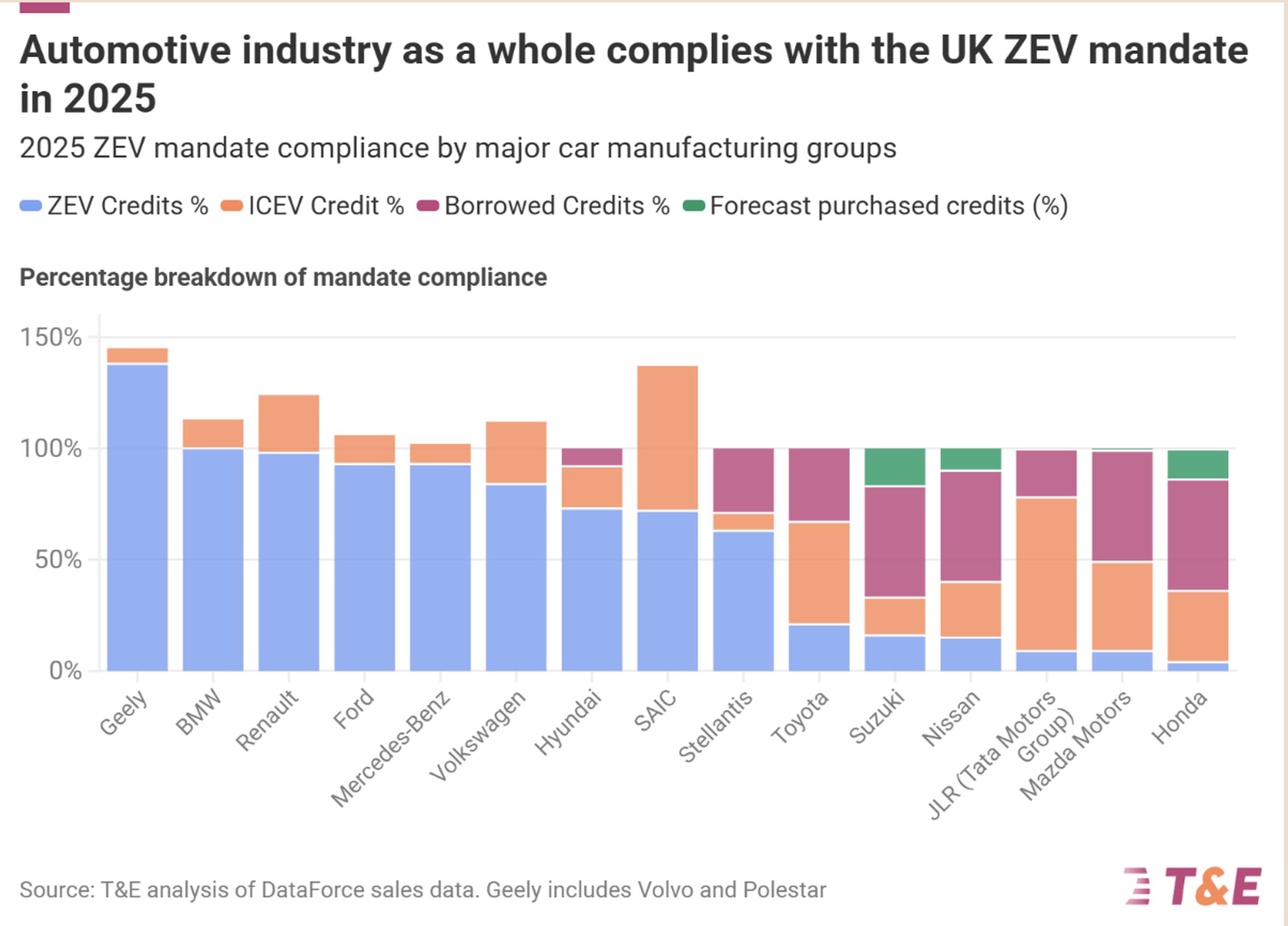
At manufacturer level, the Zero Emiission Vehicle (ZEV) Mandate is clearly separating the winners from the laggards: brands like Ford are comfortably meeting or nearing the 28% target off the back of early investment, competitive pricing and strong BEV line?ups across key segments. While those that chose to ignore years of clear policy trajectory are now scrambling to catch up in a market where consumer appetite is already strong, with around 70% of drivers saying they plan to go electric within the next five years.
Manufacturers that have been slow to invest in battery electric vehicles (BEVs) or left gaps in their model ranges are relying heavily on the UK’s flexibility measures to meet sales targets. Toyota is a clear example: with only one BEV on sale in the crowded mid-size SUV segment. They borrowed credits equal to 4,900 BEV sales in 2024 and 12,500 in 2025, around 19% of its total UK sales over the two years. This situation isn’t irreversible. Other carmakers have shown that with timely investment, a clear product strategy, and a focus on genuine electrification it’s possible to recover quickly.
Ford exceeded the 28% headline target without the use of flexibilities. Succeeding due to early investment, competitive pricing and new model launches. The electric Ford Puma, now eligible for the full £3,750 Electric Car Grant, recorded close to 10,000 registrations in 2025, making it one of the best-selling affordable BEVs of the year. And this year Nissan has a range of new models, including the Sunderland-built LEAF, showcasing a clear opportunity to rebuild their BEV sales at scale, and move back onto a sustainable compliance pathway.
However, some car manufacturers, such as JLR and Lexus, have relied heavily on plug-in hybrid models (PHEVs) to meet their targets. Data shows that PHEVs accounted for 11% of new car sales in 2025 – a 34% increase on the previous year. Yet not only can these vehicles cost drivers up to £900 more annually to run , their real-world emissions are proven to be almost five times higher than official test figures. The government should act swiftly to curb this growing emissions scandal, and avoid a repeat of ‘Dieselgate’.
No more changes, keep the ZEV mandate ambitious. Regulatory certainty must be real, not just rhetoric to keep the BEV success story on track. The Department for Transport and the Secretary of State must vigilantly monitor manufacturer compliance. Stepping in early where excessive borrowing risks a compliance cliff-edge later this decade, and urgently updating how PHEVs emissions are calculated so that official ratings reflect real world emissions.
Tim Dexter is T&E UK vehicles policy manager. T&E is an organisation advocating for clean transport and energy.

TransportXtra is part of Landor LINKS

© 2026 TransportXtra | Landor LINKS Ltd | All Rights Reserved
Subscriptions, Magazines & Online Access Enquires
[Frequently Asked Questions]
Email: subs.ltt@landor.co.uk | Tel: +44 (0) 20 7091 7959
Shop & Accounts Enquires
Email: accounts@landor.co.uk | Tel: +44 (0) 20 7091 7855
Advertising Sales & Recruitment Enquires
Email: daniel@landor.co.uk | Tel: +44 (0) 20 7091 7861
Events & Conference Enquires
Email: conferences@landor.co.uk | Tel: +44 (0) 20 7091 7865
Press Releases & Editorial Enquires
Email: info@transportxtra.com | Tel: +44 (0) 20 7091 7875
Privacy Policy | Terms and Conditions | Advertise
Web design london by Brainiac Media 2020
