
A new practical roadmap for councils covers every stage of electric vehicle infrastructure delivery, from strategic planning and business case development through to procurement, funding, distribution network connections and providing equitable access for drivers without off-street parking.
The guide has been published by UK100, a network of councils led by all political parties working together to tackle climate change.
Powering Local EV Infrastructure: A Guide for Councils shows councils that using planning tools achieve 100% first-time success in government funding applications – compared with just 37% on average.
The guide provides a practical roadmap for councils across England, covering every stage of EV infrastructure delivery – from strategic planning and business case development through to procurement, funding, distribution network connections and equitable access for drivers without off-street parking.
The advice was developed jointly by UK100 working with energy distributor UK Power Networks DSO and low-emission vehicle consultancy Cenex.
The guide combines local government insight, technical energy-system expertise and independent validation from a Local EV Infrastructure (LEVI) Fund support body. It is available now to all local authorities across England.
The guide supports councils through their entire EV delivery journey, from shaping early strategy to managing procurement and installation.
It explains how to match chargepoint types with local travel and parking patterns, structure long-term partnerships with chargepoint operators, minimise connection costs through early engagement with electricity operators, and take a portfolio approach that balances the financial viability of high-demand and low-demand areas.
The publication comes as the government’s LEVI fund is releasing almost £400m to support the installation of 100,000 new EV chargepoints across England with EV adoption accelerating to record levels. Many councils, however, still face complex technical, financial and operational challenges that risk slowing progress, the group added.
The guide illustrates the impact of evidence-based digital planning. Councils using ChargePoint Navigator – a free digital tool developed by UK Power Networks DSO with Field Dynamics, Cenex and Zapmap – achieved a 100% first-time Local Electric Vehicle Infrastructure (LEVI) funding success rate, compared with an average success rate of 37% for those not using the tool.
ChargePoint Navigator integrates network cabling capacity information, pavement widths, on-street household data and localised EV demand projections, enabling councils to identify viable sites earlier. Councils such as Kent and Brighton & Hove have used it to align district-wide planning, identify priority sites, engage chargepoint operators with collaborative work space, improve procurement decision-making and track delivery.
The guide also sets out how councils can work effectively with wider partners, including DNOs, DSOs, chargepoint operators, regional Net Zero Hubs, government bodies and community groups.
Christopher Hammond, chief executive of UK100, said: “Local authorities are absolutely central to making the electric vehicle transition work for everyone, yet too many councils have struggled to navigate the complex funding, technical and commercial challenges involved. Until the way local climate action is funded is fundamentally reformed, this new guide is indispensable.
“This collaboration between UK100, UK Power Networks DSO and Cenex brings together policy expertise, technical infrastructure knowledge and practical delivery experience in a way that’s never been done before. It’s exactly the kind of practical support that helps councils create thriving places powered by clean energy and clean air.”
Lynne McDonald, head of local net zero at UK Power Networks, said: “Local authorities are clear about what their communities need, and our job is to help them deliver it. We’re proud to work with UK100 and Cenex to create a guide to help councils navigate the end-to-end journey of getting electric vehicles moving.
“In the guide we celebrate ChargePoint Navigator, a digital tool developed by Field Dynamics, alongside partners Cenex and ZapMap, It was built on councils needs for straightforward insights on existing chargepoints, areas of charging needs and data on where to connect in one place, so they can plan confidently and secure funding first time. The 100% LEVI success rate shows the impact of listening to our customers and responding with tools that genuinely solve their challenges.”
Chris Rimmer, head of department, policy, strategy and implementation, Cenex, said: “Local Authorities are at the heart of the electrification revolution and critical players as we seek to clean and green our streets and our environment. This guide showcases key examples of collaboration and innovation from UKPN and others who are powering Local EV Infrastructure across the UK.”
What's the guide about?
Local authorities are central to delivering the UK's legally binding target to balance emissions by 2050. However, transport remains the largest source of greenhouse gas emissions, accounting for 29% of UK emissions. Electric vehicles offer a crucial solution, providing lower carbon emissions, reduced air and noise pollution, and cheaper running costs for drivers.
The guide, developed collaboratively by UK100, UK Power Networks DSO and Cenex, provides senior leaders and officers with a practical roadmap for accelerating electric vehicle infrastructure deployment. It emphasises strategic planning, equitable access and financial sustainability whilst helping councils create thriving places powered by clean energy.
Why do you need this guide?
It will help you understand your pivotal role in EV infrastructure delivery. Local authorities manage public assets that will host EV infrastructure, influence planning policies, and shape street design. The guide explains how councils can lead by example through fleet electrification, develop inclusive charging networks, and ensure equitable access for all communities, including those without off-street parking.
It will outline how you can plan and implement an effective EV infrastructure strategy
The guide walks you through developing comprehensive EV strategies, from mapping community needs and auditing available sites to choosing the right commercial arrangements. It helps you understand different delivery models—own and operate, land lease, external operator, and concession—so you can select the approach that best suits your authority's capacity and objectives.
It will provide practical guidance on funding and partnership?
It covers funding opportunities including the Local EV Infrastructure (LEVI) Capital Fund, workplace and public sector schemes, and alternative financing arrangements beyond government grants. The guide also explains how to build robust business cases, minimise costs through strategic site selection, and leverage partnerships with Distribution Network Operators and other stakeholders.
It will help you navigate the connection process and technical requirements
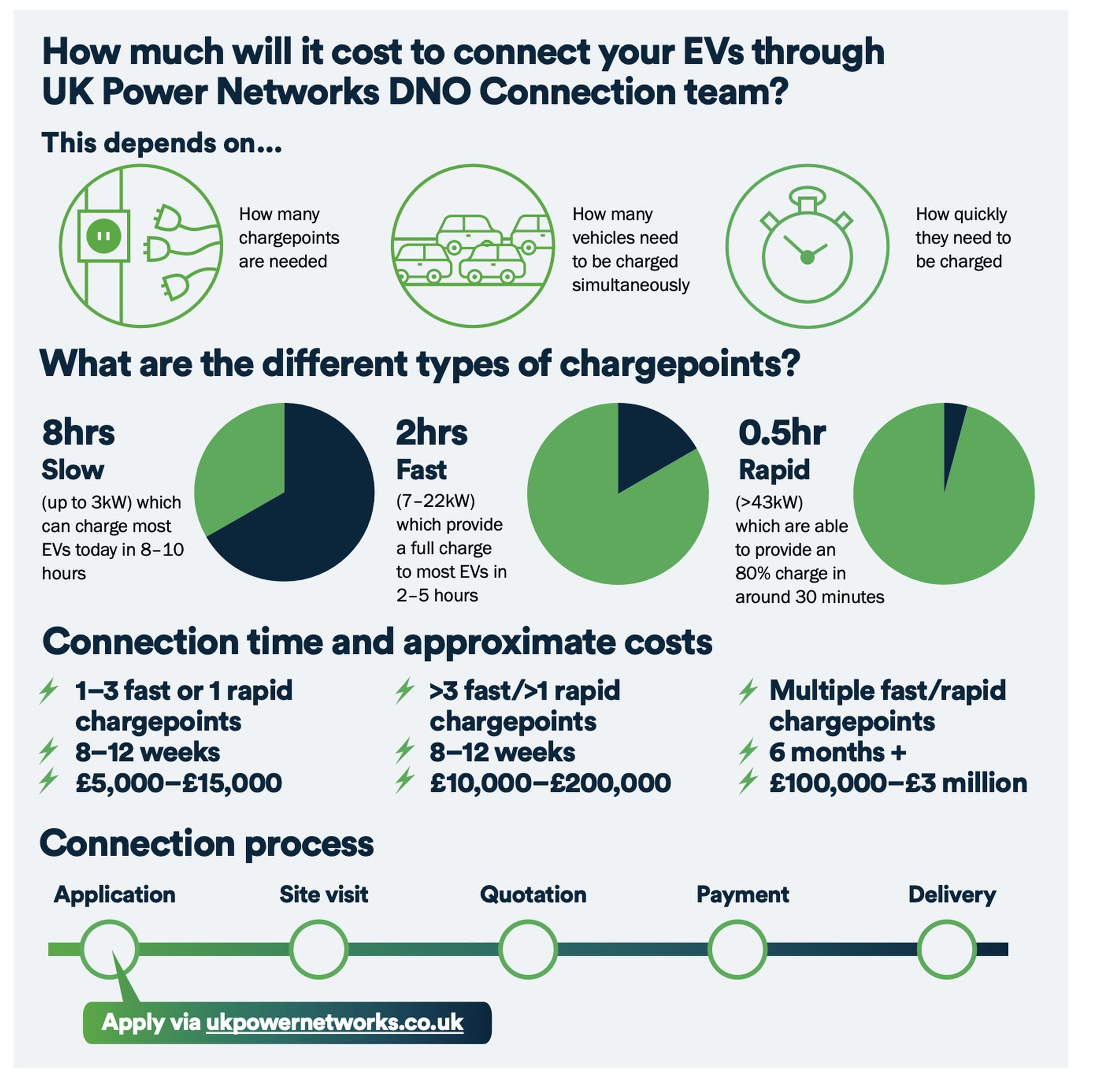
Drawing on UK Power Networks' expertise, the guide demystifies the grid connection process, explains different chargepoint types and their costs, and introduces tools like ChargePoint Navigator to support data-driven site selection. It provides clear guidance on working with your local Distribution Network Operator or Distribution System Operator to ensure efficient installations.
It will guide you in building effective coalitions and ensuring accessibility
The guide addresses key challenges including managing political sensitivities, translating influencing work into local government structures, and building cross-party support. It emphasises the importance of accessible charging design, including PAS 1899 standards, to ensure EV infrastructure serves all residents, including disabled people who are expected to rely heavily on public charging.

TransportXtra is part of Landor LINKS

© 2026 TransportXtra | Landor LINKS Ltd | All Rights Reserved
Subscriptions, Magazines & Online Access Enquires
[Frequently Asked Questions]
Email: subs.ltt@landor.co.uk | Tel: +44 (0) 20 7091 7959
Shop & Accounts Enquires
Email: accounts@landor.co.uk | Tel: +44 (0) 20 7091 7855
Advertising Sales & Recruitment Enquires
Email: daniel@landor.co.uk | Tel: +44 (0) 20 7091 7861
Events & Conference Enquires
Email: conferences@landor.co.uk | Tel: +44 (0) 20 7091 7865
Press Releases & Editorial Enquires
Email: info@transportxtra.com | Tel: +44 (0) 20 7091 7875
Privacy Policy | Terms and Conditions | Advertise
Web design london by Brainiac Media 2020
