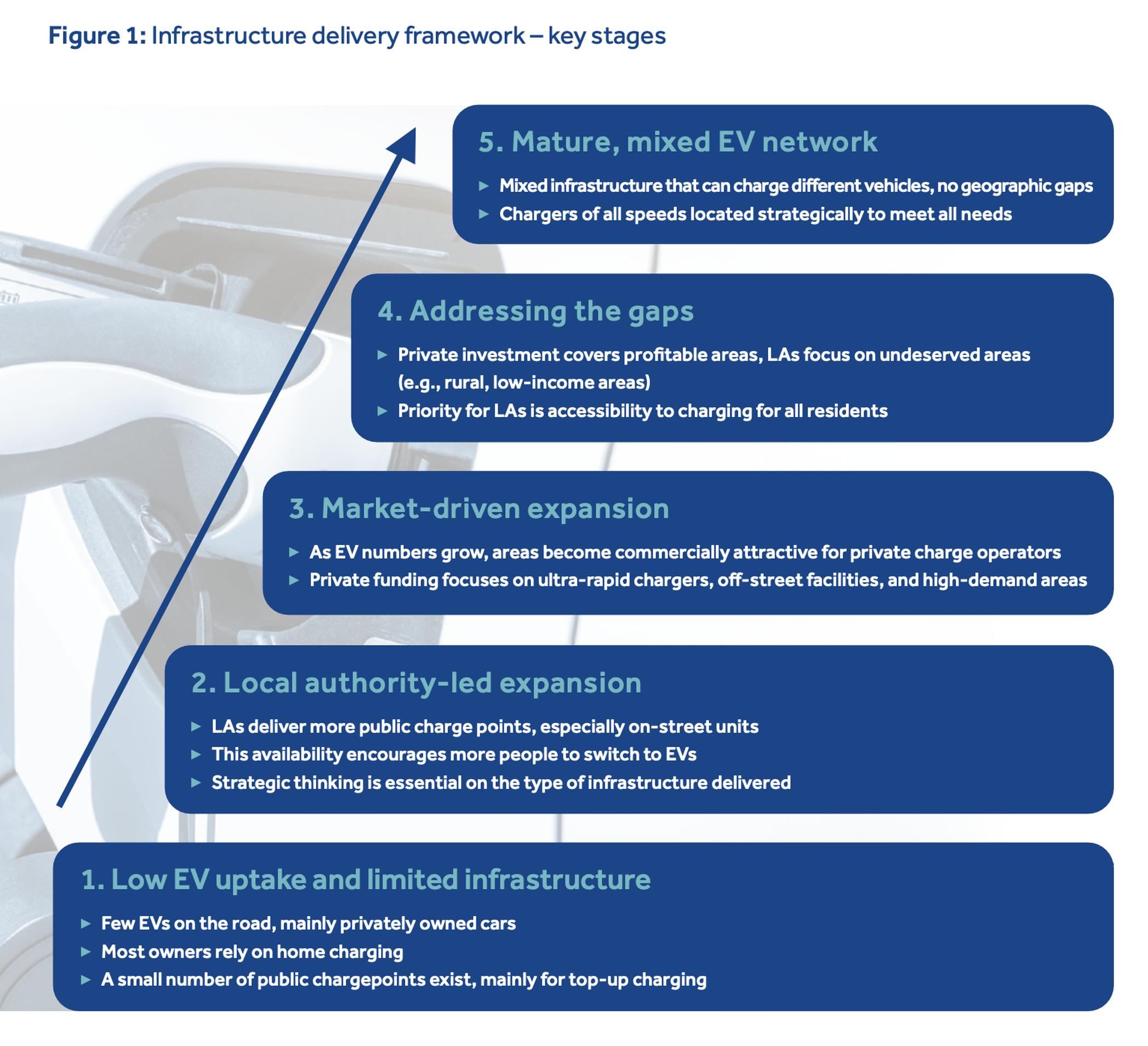
Local authorities are central to a successful transition to electric vehicle, so the Chartered Institution of Highways & Transportation (CIHT) has published guidance to help councils plan, deliver and maintain public EV charging networks that are reliable, accessible and fit for a net zero future.
As government policy accelerates the transition away from petrol and diesel vehicles by 2035, local authorities have a critical role in ensuring communities have access to convenient, safe and dependable places to charge electric vehicles—particularly for residents without off-street parking.
Rolling out Electric Vehicle Charging Infrastructure: Advice for Local Authorities provides practical, evidence-based advice to support councils in meeting this challenge. It draws on national evidence, expert workshops and extensive engagement with local authorities, industry partners and user groups, offering clear direction on strategy, planning, delivery and long-term operation.
CIHT is a membership organisation representing over 14,000 people who work in the highways and transportation sector. Sue Percy CBE FCIHT, chief executive of CIHT said: “The transition to electric vehicles is not just about technology – it is about creating a charging network that is reliable, accessible and designed for everyone. Local authorities are at the heart of making that happen. This report provides the clarity, evidence and practical guidance needed to deliver charging infrastructure at pace and at scale.”
The report emphasises that local authorities are central to a successful transition to electric vehicles. Early public provision of charging infrastructure can unlock private investment, build public confidence and support wider EV uptake. It also stresses that EV charging should be treated as a public service, with accessibility and inclusivity embedded from the outset, meeting – and where possible exceeding – PAS 1899 standards.
CIHT highlights the importance of strategic, data-driven planning aligned with wider transport, energy, planning and climate objectives. Robust feasibility assessments, early engagement with communities and distribution network operators (DNOs), and strong cross-departmental collaboration within councils are identified as key factors in successful delivery.
The guidance also addresses ongoing challenges, including grid capacity constraints, power upgrade delays and the need for future-proofed procurement. It calls on councils to ensure contracts clearly define responsibilities, maintenance expectations, interoperability requirements and handover arrangements as technology evolves.
Peter Molyneux FCIHT, chair of CIHT’s Board of Trustees, added: “A comprehensive and integrated public charging network is essential to supporting zero-emission mobility. We hope this guidance helps local authorities make confident, long-term decisions that benefit communities for decades to come."
Local authorities are central to a successful transition
Local authorities set the conditions for EV uptake by enabling public charging provision in the places people live, work and travel. Early public sector leadership can unlock private investment, build user confidence and accelerate EV adoption.
Infrastructure must be reliable, accessible and inclusive
The report makes clear that EV charging infrastructure should be treated as a public service. Accessibility must be embedded from the outset—meeting, and wherever possible exceeding, PAS 1899 standards—and ensuring charging provision does not create new barriers or inequalities.
Strategic, data-driven planning is essential
A coherent charging strategy aligned with wider transport, energy, planning and climate objectives is critical. Decisions on site selection, charger type, accessibility and grid capacity should be underpinned by robust feasibility assessments.
Early engagement improves delivery
Proactive engagement with communities, early coordination with distribution network operators (DNOs), and strong cross-departmental collaboration within councils are vital to reducing delays and managing risk.
Grid constraints require long-term coordination
Power upgrades and grid connection bottlenecks remain a significant barrier to delivery. Early engagement with DNOs, realistic understanding of timescales and planning for future demand are essential to avoid cost escalation and warranty risks.
Future-proofing and procurement matter
As EV charging technology evolves rapidly, councils must ensure contracts clearly define responsibilities, ownership, maintenance expectations, handover provisions and interoperability requirements, including Open Charge Point Protocol (OCPP) compliance.
The report sets out 12 priority recommendations to strengthen local authority delivery of EV charging infrastructure:

TransportXtra is part of Landor LINKS

© 2026 TransportXtra | Landor LINKS Ltd | All Rights Reserved
Subscriptions, Magazines & Online Access Enquires
[Frequently Asked Questions]
Email: subs.ltt@landor.co.uk | Tel: +44 (0) 20 7091 7959
Shop & Accounts Enquires
Email: accounts@landor.co.uk | Tel: +44 (0) 20 7091 7855
Advertising Sales & Recruitment Enquires
Email: daniel@landor.co.uk | Tel: +44 (0) 20 7091 7861
Events & Conference Enquires
Email: conferences@landor.co.uk | Tel: +44 (0) 20 7091 7865
Press Releases & Editorial Enquires
Email: info@transportxtra.com | Tel: +44 (0) 20 7091 7875
Privacy Policy | Terms and Conditions | Advertise
Web design london by Brainiac Media 2020
