

Every single day across the UK, tens of millions of people park. Outside homes, shops, workplaces, airports, schools, hospitals – it just happens. Quietly. Seamlessly. Effortlessly. And almost every one of those moments ends without incident.
People park, go about their day, and never think twice about it. That’s what success looks like in our sector: a brilliantly forgettable experience. Because when parking works, it disappears. It’s only when something goes wrong that people notice – when a charge is issued, or a space isn’t available. That’s when the sector suddenly becomes visible.
People often think our story begins at the moment of a parking charge. But that’s not the story – that’s the exception. The real story is the millions of successful parking events every day that keep this country moving. Think about it – a parent on the school run, a nurse arriving for an early shift, a delivery driver trying to stay on schedule. Each of them depends on being able to park quickly, safely, and fairly.
They probably don’t think about who maintains that space, who keeps it safe, or who ensures it’s there tomorrow – but that’s what this community does. It’s the quiet infrastructure of daily life, and it works because of the people in this room.
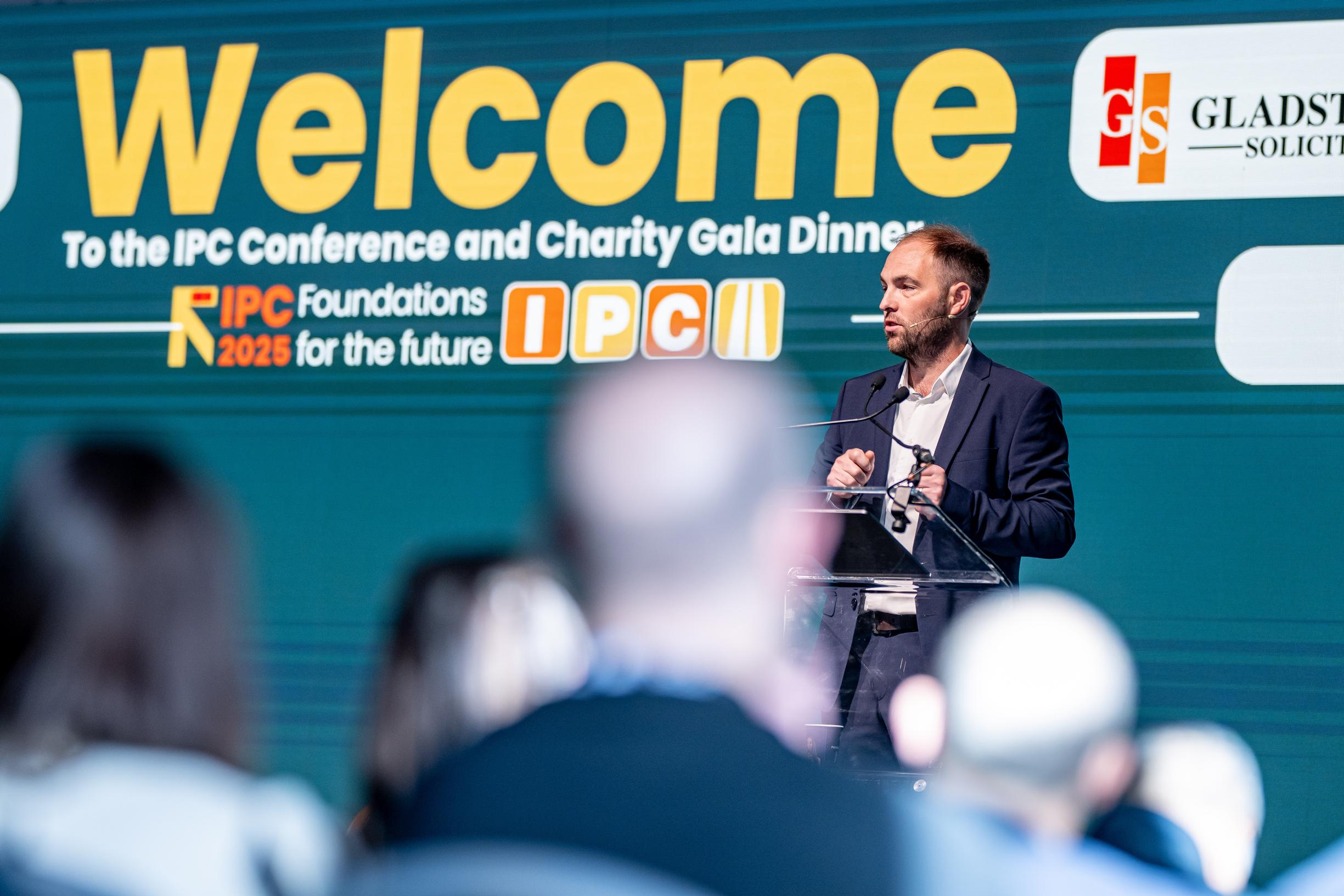
The theme for this year’s International Parking Community (IPC) conference was “Foundations for the future”. It isn’t just a slogan, it’s a statement of direction. It reminds us that the work that we do today builds the confidence, the structure, and the credibility that allow our sector to thrive tomorrow.
Last year, we laid important foundations – not least the launch of the Sector Single Code, which went live in October 2024. It was a milestone: a single rulebook for the private parking sector. It gave confidence in signage, reduced duplication, and demonstrated that we are a responsible, self-regulating industry capable of taking balanced, evidence-led decisions. But the code was never the destination. It was the foundation. This year, we’ve been building on it with data, collaboration, and a renewed focus on fairness.
We’ve spent much of the past year working closely with government officials and responding in depth to the latest consultation on the government-backed Code of Practice. This consultation could be the one that finally defines the next decade for our industry. And throughout, we’ve been clear, consistent, and constructive – representing your real-world experience with data and insight, not just opinion.
We’ve spent months in conversation with ministers, advisers, and officials. We’ve provided detailed responses, case studies, and data to show what works – and what doesn’t. What’s been encouraging is the tone of those discussions. There’s recognition now that the private parking sector isn’t the problem – it’s a key part of the solution. We’ve moved from confrontation to collaboration, and that’s progress worth recognising.
We’ve shown that the IPC and its members are ready to engage, ready to adapt, and ready to help government shape a code that genuinely works in practice. But we’ve also been honest – because there are areas of real concern.
One of those concerns is the proposal to significantly reduce the escalation fee – the additional charge applied when a motorist ignores all earlier communication. It might sound like a small tweak, but we know it isn’t.
You can’t tinker with one part of the process and expect the rest to stay the same. The escalation stage isn’t about punishment. It’s about maintaining fairness for the motorists who do the right thing. It’s part of the deterrent structure that encourages compliance and keeps the system balanced. Without it, repeat offenders face fewer consequences, compliance drops, and the costs of enforcement rise for everyone else.
That said, we recognise this is an area where we must also raise our own standards. There needs to be greater consistency and stronger guidance on how escalation is handled. Fairness isn’t just about what the rules say – it’s about how we apply them. And we stand ready to work with government to ensure those standards are clear, robust, and practical.
This year also marked the beginning of a major step forward for the sector – data collection from every Approved Operator Scheme (AOS) member. For the first time, we’re building a comprehensive, evidence-based picture of what’s really happening in parking management across the UK. That data gives us credibility. It allows us to back up what we see on the ground with facts – and it helps government understand the real impact of its policies.
The insights are already telling an important story.
Three years ago, the sector achieved 99.77% compliance. Today, analysing a similar data set, compliance stands at 99.5%. That 0.27% difference might look small, but it’s significant. It tells us that fewer people are being compliant. It tells us that the deterrent effect has weakened. And it starts to prove what many of you have been saying for months and years – repeat offenders are on the rise. These are the motorists who consistently flout the rules, take up Blue Badge bays they don’t need, block access for those who do, and drive up the cost of enforcement for everyone else. Further collection of parking charge data will help show the real impact of these repeat offenders. For the first time, we can measure it. We will be able to quantify it. We can show government the real-world consequences of weakening deterrents.
Behind every data point is a real-world consequence: a motorist who can’t find a space because someone’s parked where they shouldn’t; a business whose customers can’t access them; a hospital patient delayed by congestion. That’s why the data matters. It’s not just numbers – it’s evidence that supports policy, funding, and fairness. For the first time, we can have those discussions with government backed by facts, not assumptions. That’s the power of data. It tells the full story, not just the convenient one.
Data is just one part of the picture. Over the past year, we’ve rolled out:
247advice.co.uk is something to strengthen the foundations of professional practice. We are delighted the government latched onto it in their consultation. Each of these initiatives shows what a mature, responsible sector looks like in action. One that doesn’t wait for change – it builds it.
The Independent Appeals Service is also evolving. We have welcomed Dave Finney as the new IAS’s lead adjudicator. He already driving improvements in software, efficiency, and consistency. He’s also looking at how the service can evolve. To ensure independence and transparency are beyond question. That means better experiences for operators and motorists alike. Because fairness isn’t just about the outcome. It’s about confidence in the process.
Whatever the new code brings, the IPC and its members will continue leading on fairness, professionalism, and standards. We’ll support members with training, audits, and practical guidance. We’ll engage government with evidence, not noise. And we’ll prove that this sector is a responsible, self-regulating community that delivers real value to society every day. Because parking isn’t about rules – it’s about reliability, accessibility, and trust. The foundations we’ve built aren’t just for our businesses. They’re for every motorist, every community, every space that depends on us to keep the UK moving. Let’s keep building, together.
Let’s take a step back and look at what this all adds up to. Every day, there are over 68 million parking events across the UK. And even with the challenges we’ve discussed, 99.5% happen without issue. That’s not a broken system. Parking is a sector that works. Quietly. Reliably. Consistently.
We don’t often get applause for what goes right, but that’s because when parking works, it disappears. Our challenge is to protect that success, keep improving, and make sure that government policy supports, not weakens, what already works for the vast majority.
Let’s take a moment to recognise the people behind this progress. From front line patrol teams to control room operators, from policy staff to system designers and appeals officers –this sector works because of you.
It’s easy to forget that we’re managing one of the largest pieces of infrastructure in the UK, and we do it with integrity, innovation, and purpose. That’s something to be proud of.
Will Hurley is chief executive of the IPC
www.theipc.info
The IPC annual conference featured a charity auction and awards
The International Parking Community’s annual conference took place at The Emirates Old Trafford in Manchester on 13 November. The event covered: the sector single code, signage terms and entrance signage, specifics on consideration and grace periods, the new government code and the future plans for the Independent Appeals Service.
The evening’s gala dinner featured live entertainment, including a mirror man, stilt walkers, singers, feather girls, drummers, a live band, and a DJ.
Gary Carr, director of Empira, hosted a charity auction, which raised £25,000 for Ollie’s Army, which campaigns to find a cure for Batten’s disease.
The IPC Awards
The annual IPC Awards were hosted by Lee Burton, director of Wise Parking, and Chris Naylor, the IPC’s head of membership and relations. The recipients were:

TransportXtra is part of Landor LINKS

© 2026 TransportXtra | Landor LINKS Ltd | All Rights Reserved
Subscriptions, Magazines & Online Access Enquires
[Frequently Asked Questions]
Email: subs.ltt@landor.co.uk | Tel: +44 (0) 20 7091 7959
Shop & Accounts Enquires
Email: accounts@landor.co.uk | Tel: +44 (0) 20 7091 7855
Advertising Sales & Recruitment Enquires
Email: daniel@landor.co.uk | Tel: +44 (0) 20 7091 7861
Events & Conference Enquires
Email: conferences@landor.co.uk | Tel: +44 (0) 20 7091 7865
Press Releases & Editorial Enquires
Email: info@transportxtra.com | Tel: +44 (0) 20 7091 7875
Privacy Policy | Terms and Conditions | Advertise
Web design london by Brainiac Media 2020
