
Since we last spoke, I became chair of the Transport Planning Society; and this may seem as unlikely to you as it has sometimes seemed to me. It’s not that I’m not a transport planner: I am. It’s that the design of streets, which is my joy, can seem like a single brush-stroke on transport planning’s huge canvas. But then I remind myself that streets are where the vast majority of transport planning effort becomes real. Therefore, it’s of immediate professional and personal concern to me that planning for transport, as distinct from simply providing for it, appears to be an increasingly quaint notion to key decision-makers.
The TPS is an organisation for which I have a lot of respect and no little affection. This is principally because its primary purpose is to be a resource to its members; and it speaks with authority on behalf of the transport planning profession only because it consists of transport planning professionals (around 1,200 of them at the latest count). It sees itself as a ‘membership organisation’ rather than an ‘industry body’ and, as such, is wonderfully free of self-importance; while yet being full of the importance of transport planning to society. And it is each of these three words comprising the TPS’s name that I want to explore this month.
Firstly: Transport. While this is plainly about the movement of people and goods, the danger of such a description is that it makes transport sound like a dry, technical exercise. Transport is, in fact, about how people go about their lives, commerce goes about its business, and the relationship between the two. I need transport to get me to and from places; and I also need transport to get stuff to and from me. Viewed this way, transport is rightly seen as a means to an end. When it’s seen as an end in itself, we lose sight of the vital connection between transport and quality of life. And we start to make mistakes.
At root, these mistakes stem from a top-down approach to transport, when the right approach is bottom-up. So, for example, we destroy parts of cities in order to implement ‘transport solutions’; having lost sight of the fact that the purpose of transport is to support city life, not harm it. We’re humans, not sharks: transport isn’t about keeping moving, whatever the cost. So, if we’re going to break some eggs, we need to be really sure that an omelette is what we need. Transport should be a blessing, not a curse.
Failure to grasp this higher purpose for transport leads to the kind of muddled thinking, exemplified by a recent interview with Michael Dugher, the shadow transport secretary. I happened to like much of what he said about railways: that “the only people who have no voice in the running of our railways are the passengers” and that how franchising has been undertaken is “complete bollocks!” On the other hand, that same description could be applied to his statement that “politicians spend most of their time talking to the minority of people who don’t travel by road”. Yet another MP’s attempt to appear as ‘the motorists’ friend’.
When challenged on the relationship between transport and the environment, Dugher spoke warmly of “the development of green cars”, adding that there is a case for urging people to “use their cars less. Quite a number of journeys that people make are less than a mile. There is a lot of evidence that if people switched a proportion of their journeys you’d have a huge influence in terms of environmental benefits.” However, while identifying that “there have got to be viable alternatives”, his take on why cycling, for example, isn’t seen as an attractive option was chiefly that people worry they’ll get their bike stolen.
I don’t mean to pick on Mr Dugher: he probably means well. I’m just using that interview to make the case that transport provision should result from rational planning, not opinion or electioneering.
Speaking of which, as many of you will be only too painfully aware, the approach to parking provision pursued by the communities and local government secretary, Eric Pickles, is at odds not only with rational planning, but also often with simple logic. It is not, however, at odds with the generation of what he sees as voter-friendly headlines. Earlier this month, Eric and the transport secretary, Patrick McLoughlin, launched “new parking measures that put common sense back in the driving seat” (geddit?) under the headline “Government delivers on parking promises to help local shops”. I’m afraid that the first statement is all but a lie (‘popular opinion’ would be more honest than ‘common sense’), and that the evidence that the parking measures proposed will actually help local shops is purely anecdotal. Yet this is how transport is so often ‘planned’.
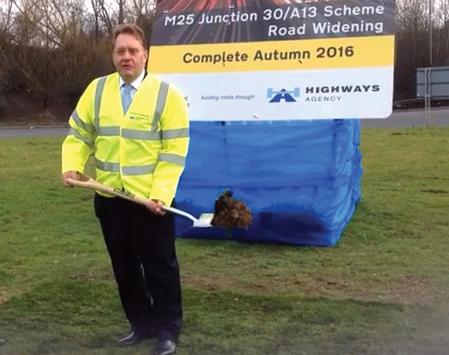
After all, who needs actual transport planning, when it’s politically more expedient simply to assert that a particular transport thing will “deliver a fairer deal for motorists and help boost the high street” (or the economy, or whatever other benefit you care to claim)? Just the other day, indeed, roads minister John Hayes cut the first sod on an M25 widening scheme while bemoaning the current “misery caused by traffic and congestion” and trumpeting the positive effect the works will have on “a part of the world that is bursting with opportunity”. If we keep ‘planning’ like this, his successor will be back to widen the road still further in around a decade.
Transport planning mustn’t be about what we think people want to hear, or what we think they want. Or even, necessarily, about what they do want (gasp!). It has to be about a rational assessment of how best, in transport terms, to achieve or support agreed and desirable outcomes, which may be to do with any or all of housing, health, jobs, the environment, education, social inclusion, etc. Accordingly, we need to consider that vexed issue of ‘the greater good’: of what society needs, rather than what individuals might prefer.
Anyone tempted, at this point, to throw Margaret Thatcher’s “there’s no such thing as society” at me should check the context of that quote in the 1987 issue of Women’s Own magazine in she was interviewed. To understand, as we should, that ‘society’ is ‘the aggregate of people living together in a more or less ordered community’, is the source of understanding that transport planning is a vital endeavour that must be directed towards the benefit of the community, not the appeasement of the electorate or the conciliation of vested interest.
The transport provision that our society depends upon should be based on thoughtful planning by people with the necessary range of appropriate skills and experience. That’s real common sense. And it’s a conviction upon which the Transport Planning Society is founded.

TransportXtra is part of Landor LINKS

© 2026 TransportXtra | Landor LINKS Ltd | All Rights Reserved
Subscriptions, Magazines & Online Access Enquires
[Frequently Asked Questions]
Email: subs.ltt@landor.co.uk | Tel: +44 (0) 20 7091 7959
Shop & Accounts Enquires
Email: accounts@landor.co.uk | Tel: +44 (0) 20 7091 7855
Advertising Sales & Recruitment Enquires
Email: daniel@landor.co.uk | Tel: +44 (0) 20 7091 7861
Events & Conference Enquires
Email: conferences@landor.co.uk | Tel: +44 (0) 20 7091 7865
Press Releases & Editorial Enquires
Email: info@transportxtra.com | Tel: +44 (0) 20 7091 7875
Privacy Policy | Terms and Conditions | Advertise
Web design london by Brainiac Media 2020

John Dales
John Dales MSC BSC MCIHT CMILT Director, Urban Mov
John Dales is a streets design adviser to local authorities around the UK, a member of several design review panels, and one of the London mayor’s design advocates. He is a past chair of the Transport Planning Society, a former trustee of Living Streets, and a committee member of the Parliamentary Advisory Council for Transport Safety. He is director of transport planning and street design consultancy Urban Movement.
j.dales@urbanmovement.co.uk
+44 (0)7768 377 150
www.johndales.com