
Climate change is already impacting on transport in the UK, causing economic losses, damage to assets and restricting access to essential services, states a new report from the Climate Change Committee (CCC).
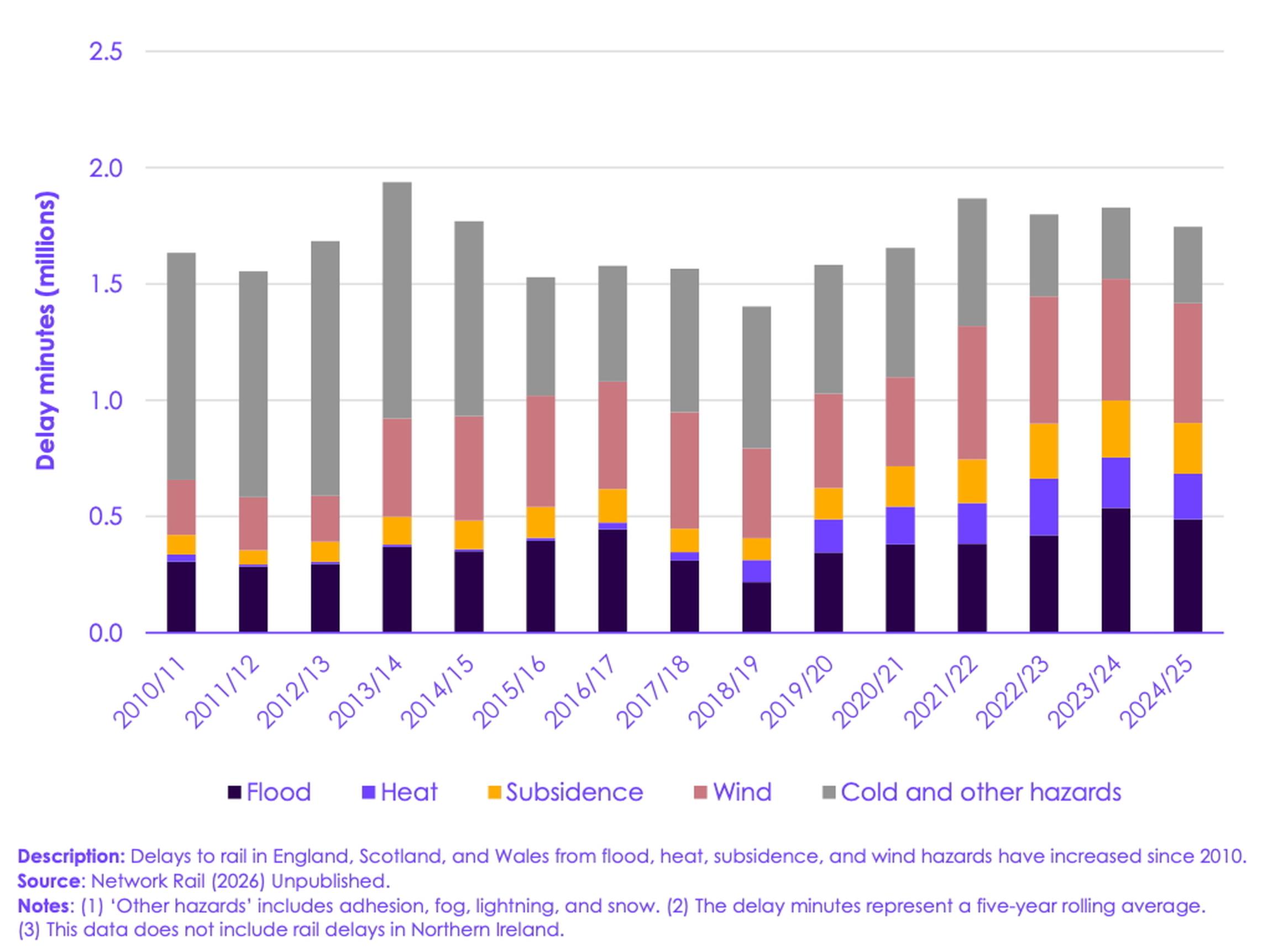
There has been a 50% increase in adverse weather impacts over the past five years compared with the previous ten, and a shift from cold weather hazards to flood, heat, and subsidence.
Find out about how projects and innovations combatting climate change at Climate Resilient Streets 2026
CCC found that 2023-2024 was the worst year of flooding impacts on the railway, with disruption from extreme weather to rail services in Northern Ireland in 2023-2024 reaching almost four times the three-year average.
Extreme weather accounted for 10% of Network Rail attributed delay minutes across Great Britain in 2024-2025, with a higher proportion in Scotland, the statutory body found.
The percentage of the rail network in England at risk of flooding could rise from 37% today to 54% by 2050, the report says.
On the roads, meanwhile, delays on England’s trunk roads from flooding have more than doubled since 2015-16.
Road repair costs related to floods and heavy precipitation in the UK could reach £500m per year by the 2040s (at 2025 prices), according to the report.
Alongside, this, the percentage of the road network in England in areas at risk of flooding could rise from 38% today to 46% by 2050.
“The ability of transport systems to absorb impacts will be considerably diminished, resulting in more frequent and longer periods of transport services being unavailable across all modes,” CCC warns.
“Increasing sections of transport infrastructure could become unviable due to flood exposure and increased frequency of storm surges. For example, projected sea level rise of up to 1m in the South East of England by 2100 implies potentially re-siting or abandoning coastal transport infrastructure.”
Drainage, including engineered drains and sustainable drainage systems (SuDs), are key to reducing risks from flooding and landslides across all modes, says the report.
National Highways is updating the drainage standard, which will increase capacity of new drains by up to 35%, it points out.
Meanwhile, Network Rail has budgeted £108m per year for upgrading drains to improve climate resilience across the rail network between 2024 and 2029 (at 2025 prices).
Alongside flood risk, extreme heat will be an increasing challenge, the committee adds. For example, railway disruption from tracks buckling and overhead power line damage is expected to increase from one day per year in the present climate to over 14 days per year at 4ºC for England, the research shows.
“The number of days where high temperatures affect road tarmac (above 26ºC) is expected to increase from eight per year to nearly 50.”
Trunk road operators and Network Rail have set targets to reduce disruption in the current regulatory periods. “However, there has been no assessment of the cost-effectiveness of reducing disruption as risks from climate change continue to increase over time,” CCC says.
“It is unlikely to be cost-effective to reduce or even maintain current levels of disruption across all road and rail routes. For lower priority routes, it will be necessary to accept increased disruption, and potentially even some permanent route closures. This will require engaging transport users to manage and agree expectations.”
The committee calls for an assessment to identify which routes are highest priority, considering different factors such as volume of traffic and access to key sites or services.
To address the growing impacts of climate change, CCC has set out a comprehensive package of solutions.
It identifies better cooling, flood protection and a more secure water supply as the most critical priorities to protect the UK from the three biggest climate risks – heat, flooding and drought.
The report highlights innovations such as heat-resistant bitumen, which increases the strength and flexibility of high-traffic asphalt.
On the railway, overhead power lines can be replaced with ‘auto-tensioning’ cables to prevent sagging, while expansion gaps and laying rail on reinforced concrete slabs can prevent buckling, the committee says.
It suggests that ventilation and air conditioning, and materials such as solar film, can be used to cool buildings, for example airport terminals while shading at bus shelters, train stations, and along walking and cycling routes can reduce surface temperatures during extreme heat.
A range of proposals drawn up by the CCC would require investment of around £11bn a year,?split broadly evenly between public and private funding.
“Without adaptation the cost of climate change to public welfare is predicted to rise to between 1-5% of UK GDP by 2050 under a 2°C global warming level, equivalent to £60-£260bn per year,” it warns.

TransportXtra is part of Landor LINKS

© 2026 TransportXtra | Landor LINKS Ltd | All Rights Reserved
Subscriptions, Magazines & Online Access Enquires
[Frequently Asked Questions]
Email: subs.ltt@landor.co.uk | Tel: +44 (0) 20 7091 7959
Shop & Accounts Enquires
Email: accounts@landor.co.uk | Tel: +44 (0) 20 7091 7855
Advertising Sales & Recruitment Enquires
Email: daniel@landor.co.uk | Tel: +44 (0) 20 7091 7861
Events & Conference Enquires
Email: conferences@landor.co.uk | Tel: +44 (0) 20 7091 7865
Press Releases & Editorial Enquires
Email: info@transportxtra.com | Tel: +44 (0) 20 7091 7875
Privacy Policy | Terms and Conditions | Advertise
Web design london by Brainiac Media 2020
