
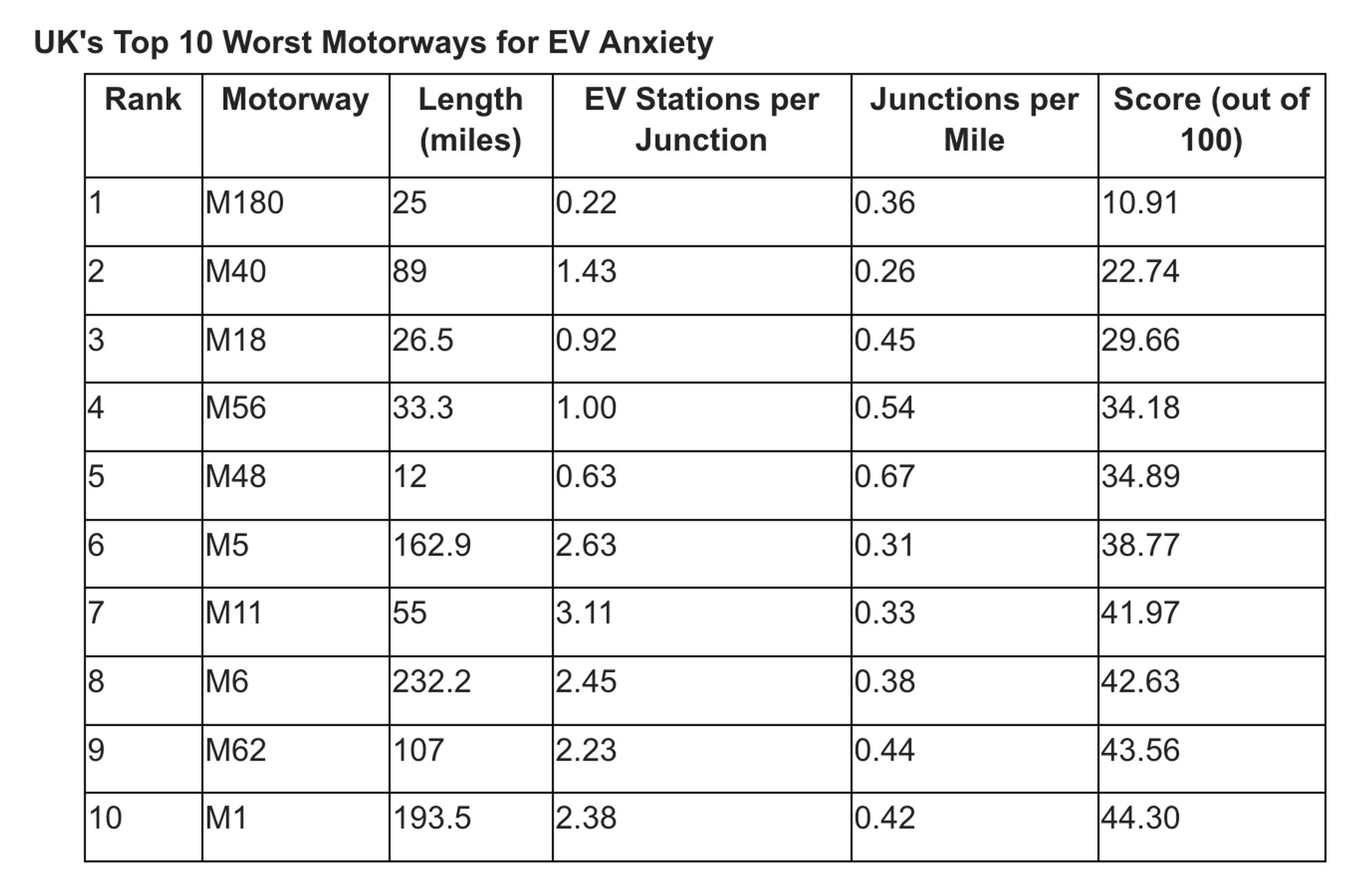
The M180 in Lincolnshire has been identified as the UK's worst motorway for electric vehicle charging access, creating significant anxiety for EV drivers.
The study, conducted by EV chargepoint supplier Simpson & Partners, analysed 35 UK motorways to determine which roads present the biggest challenges for electric vehicle owners.
Researchers examined two key factors: the number of EV charging stations per junction and the density of junctions per mile.
The M180 in Lincolnshire scored just 10.91 out of 100 on the combined index, with a mere 0.22 charging stations per junction. This 25-mile stretch connecting Scunthorpe to the M18 has only two EV charging stations accessible within one mile of its nine junctions.
At the other end of the scale, the M60 Manchester orbital motorway ranks best for EV accessibility with a score of 84.01. It offers 4.57 charging stations per junction and has a high junction density of 1.03 junctions per mile, making it ideal for electric vehicle drivers.
The M65 in Lancashire ranks second best with a score of 80.69. This 26-mile motorway has the highest ratio of charging stations at 5.79 per junction, providing excellent coverage for EV drivers.
The M40, running 89 miles between London and Birmingham, ranked second worst with a score of 22.74. Despite having a higher ratio of 1.43 charging stations per junction, its very low junction density of 0.26 junctions per mile means drivers have fewer opportunities to exit and charge their vehicles.
Yorkshire's M18 takes third place for EV anxiety with a score of 29.66. The 26.5-mile motorway offers just 0.92 charging stations per junction, meaning drivers cannot reliably access charging points at every exit.
The M56 in the North West ranks fourth worst with a score of 34.18. This 33-mile motorway connecting Manchester to North Wales has an average of one charging station per junction but relatively few junctions per mile, limiting charging options for EV drivers.
The M48 in South Wales and South West England completes the top five worst motorways with a score of 34.89. Despite being only 12 miles long, this motorway connecting England and Wales has just 0.63 charging stations per junction.
The M5, spanning 163 miles from Birmingham to Exeter, ranks sixth worst with a score of 38.77. While it offers a respectable 2.63 charging stations per junction, its low junction density of 0.31 junctions per mile means drivers may travel considerable distances between charging opportunities.
The M11 in East England ranks seventh worst for EV anxiety with a score of 41.97. This key route connecting London and Cambridge offers 3.11 charging stations per junction but has only 0.33 junctions per mile.
The M6, Britain's longest motorway at 232 miles, ranks eighth with a score of 42.63. Despite having 218 charging stations across its route, the sheer length of this motorway presents challenges for EV drivers planning longer journeys.
The M62 crossing the Pennines between Liverpool and Hull ranks ninth with a score of 43.56. With 105 charging stations across 47 junctions, it averages 2.23 charging stations per junction.
The M1, one of Britain's busiest motorways connecting London to Leeds, completes the top ten worst list with a score of 44.30. It offers 2.38 charging stations per junction across its 193-mile length.
David Simpson of Simpson & Partners said: “The statistics show that EV drivers face vastly different charging experiences depending on which UK motorway they travel. The M180 has just two charging stations across nine junctions, creating significant anxiety for electric vehicle owners.
“The limited charging infrastructure on some of Britain's major motorways risks becoming a barrier to wider EV adoption. With electric vehicles representing a growing share of new car sales, improving charging accessibility on these key routes must be a priority. However, it’s important to note that the average range of an EV is around 200 miles in ideal conditions, meaning that for many, charging before and after a motorway journey is enough.
“Modern EV charging stations can add significant range in just 20-30 minutes, but they're only helpful if drivers can reach them. Most motorways were designed long before electric vehicles existed, although charging stations are now beginning to be added to service stations at most junctions to increase availability.”

TransportXtra is part of Landor LINKS

© 2026 TransportXtra | Landor LINKS Ltd | All Rights Reserved
Subscriptions, Magazines & Online Access Enquires
[Frequently Asked Questions]
Email: subs.ltt@landor.co.uk | Tel: +44 (0) 20 7091 7959
Shop & Accounts Enquires
Email: accounts@landor.co.uk | Tel: +44 (0) 20 7091 7855
Advertising Sales & Recruitment Enquires
Email: daniel@landor.co.uk | Tel: +44 (0) 20 7091 7861
Events & Conference Enquires
Email: conferences@landor.co.uk | Tel: +44 (0) 20 7091 7865
Press Releases & Editorial Enquires
Email: info@transportxtra.com | Tel: +44 (0) 20 7091 7875
Privacy Policy | Terms and Conditions | Advertise
Web design london by Brainiac Media 2020
