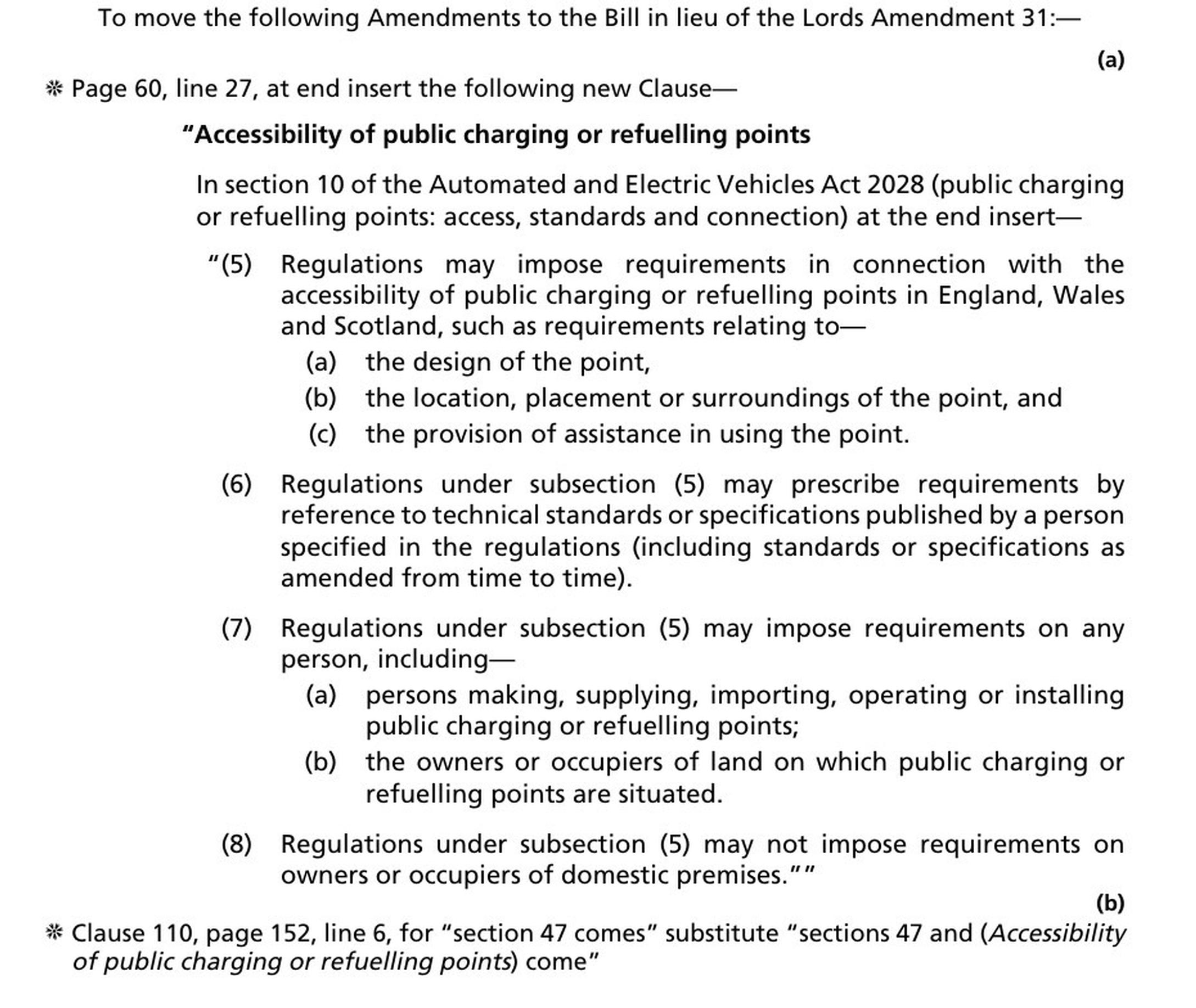
A new amendment made to the Planning and Infrastructure Bill will help ensure that disabled people are not left behind by the transition to EVs. The amendment gives the government powers to mandate public charging standards by law if the accessibility of public chargers does not improve.
All future public chargepoints will need to meet accessibility standards, ensuring they are safe, convenient, and usable for everyone, including drivers with disabilities.
The amendment, first proposed in the House of Lords by Conservative Peer Lord Borwick and now strengthened by the government, will allow ministers to mandate the accessible EV charging standards set by PAS 1899 if voluntary progress across the industry continues to fall short.
PAS 1899 sets out clear requirements such as space to get wheelchairs or mobility aids out of the vehicle, dropped kerbs, easy-to-use charge units, safe cable management, clear lighting and more.
PAS 1899 was first published in 2022 as a voluntary standard, but it is estimated that only three charging sites in the whole of the UK currently fully comply with the standard.
Introducing the change in the House of Commons on 13 November, local government minister Matthew Pennycock said that although the government has been “working closely with the sector to update the current accessibility standards,” he is now “convinced that we should use the Bill to provide further certainty.”
Responding for the Opposition, Conservative MP David Simmonds welcomed the government’s “willingness to embrace the debate about electric vehicle charging.”
This development comes as the Commons and Lords look to agree on final amendments before the legislation becomes law.
As the Planning and Infrastructure Bill moves through its final Parliamentary stages, the new amendment signals a clear direction of travel. Accessible EV charging is no longer optional. With legislative backing and updated standards on the horizon, the UK is one step closer to building a charging network that works for every driver.
The amendment to the Planning and Infrastructure Bill grants the government powers to:
It comes as the government releases a BSi report recommending revisions to the existing UK standard to make it easier to deliver accessible charging that meets drivers’ needs. The report recommends revisions to the existing PAS 1899 framework, which sets out detailed accessibility requirements for public EV chargepoints – including minimum parking bay sizes suitable for wheelchair users, placement of bollards, and the positioning and orientation of payment terminals. The recommendations follow a year-long review and consultation by government with industry stakeholders and consumer and disability groups to identify improvements that would make delivery of the standard easier and more consistent.
Lord Borwick, who originally tabled the amendment, said: “People have congratulated me on this change in the law, but that is not right. It’s a change in charging systems to make them accessible, not a change in the law, that deserves congratulation. This amendment means we can finally ensure that as we move to electric driving, accessibility will not be an afterthought but a core design requirement of the public network.”
In a poll, a full quarter of Motability Scheme customers – providing specially adapted vehicles to drivers with disabilities – said they would not use the current public charging infrastructure over accessibility concerns.
Lisa Jones, chief operating officer of the Motability Foundation, said: “It has been the Motability Foundation’s position for some time that the PAS 1899 standard should made mandatory by law, so we’re very pleased to see this amendment has been passed. We estimate that 1.35 million disabled drivers in the UK will need to use public EV chargers by 2035, so it’s absolutely vital that chargepoints are being made accessible.
“We are now working with Government on plans for an updated version of PAS 1899. We want to provide a standard that is achievable and can be used by all chargepoint operators to meet the accessibility needs of disabled people. We will continue to engage with all providers of public charging as part of this process. This will also ensure the standard is in a position to be mandated by law if that step is required.”
Disabled Motoring UK has welcomed the news. DMUK chief executive Graham Footer commented: “DMUK is pleased to see this important development which is a positive step forward for disabled motorists who require accessible public electric vehicle charging. DMUK wants to see the electric vehicle industry move faster on the provision of accessible public charging and provide adequate accessible charging at every charging site. Failing to do so will mean a lot of expensive retrofitting in the future.”
Louise Collins, director at the independent watchdog Transport Focus, said: “This is an important step forward for disabled drivers who often face considerable challenges in accessing public EV chargepoints. Knowing the government has the power to mandate accessibility standards should encourage the industry to move faster and gives confidence that action will be taken if progress is too slow. We need to see a clear and ambitious timescale for the industry to work to including a minimum number of accessible chargepoints. Failing to set out a clear plan now risks leaving disabled drivers behind today and a major, expensive retrofit job in the future.”
A recent watchdog Transport Focus – Plugging the gap: The need to improve the EV charging experience for disabled drivers – sets out what needs to change to address the situation and to improve the provision and experience for EV users.
The government’s amendment was welcomed by EV drivers’ association EVA England. Vicky Edmonds, chief executive of EVA England, said: “This is huge progress for all drivers, especially those with disabilities. For the first time, we have the government’s assurance that accessibility won’t be left to chance. These enabling powers will also incentivise greater action by industry to roll out accessible charging.
“I would like to thank Lord Borwick and Sir Jeremy Wright for championing this cause and ensuring its inclusion in the Bill, and to thank the Government for expanding upon Lord Borwick’s amendment to provide essential future safeguards for the safety, reliability and user-friendliness of public EV charging. EVA England has long supported this ambition, and we’re proud to see such decisive action taken to ensure the public charging network works for everyone.”
EVA England’s latest survey revealed 47% of all drivers, with and without disabilities, reported accessibility issues using the current infrastructure. EVA England also found that over half (51%) of drivers with disabilities find heavy charging cables at faster charging points hard or extremely hard to use.
TransportXtra is part of Landor LINKS

© 2026 TransportXtra | Landor LINKS Ltd | All Rights Reserved
Subscriptions, Magazines & Online Access Enquires
[Frequently Asked Questions]
Email: subs.ltt@landor.co.uk | Tel: +44 (0) 20 7091 7959
Shop & Accounts Enquires
Email: accounts@landor.co.uk | Tel: +44 (0) 20 7091 7855
Advertising Sales & Recruitment Enquires
Email: daniel@landor.co.uk | Tel: +44 (0) 20 7091 7861
Events & Conference Enquires
Email: conferences@landor.co.uk | Tel: +44 (0) 20 7091 7865
Press Releases & Editorial Enquires
Email: info@transportxtra.com | Tel: +44 (0) 20 7091 7875
Privacy Policy | Terms and Conditions | Advertise
Web design london by Brainiac Media 2020