
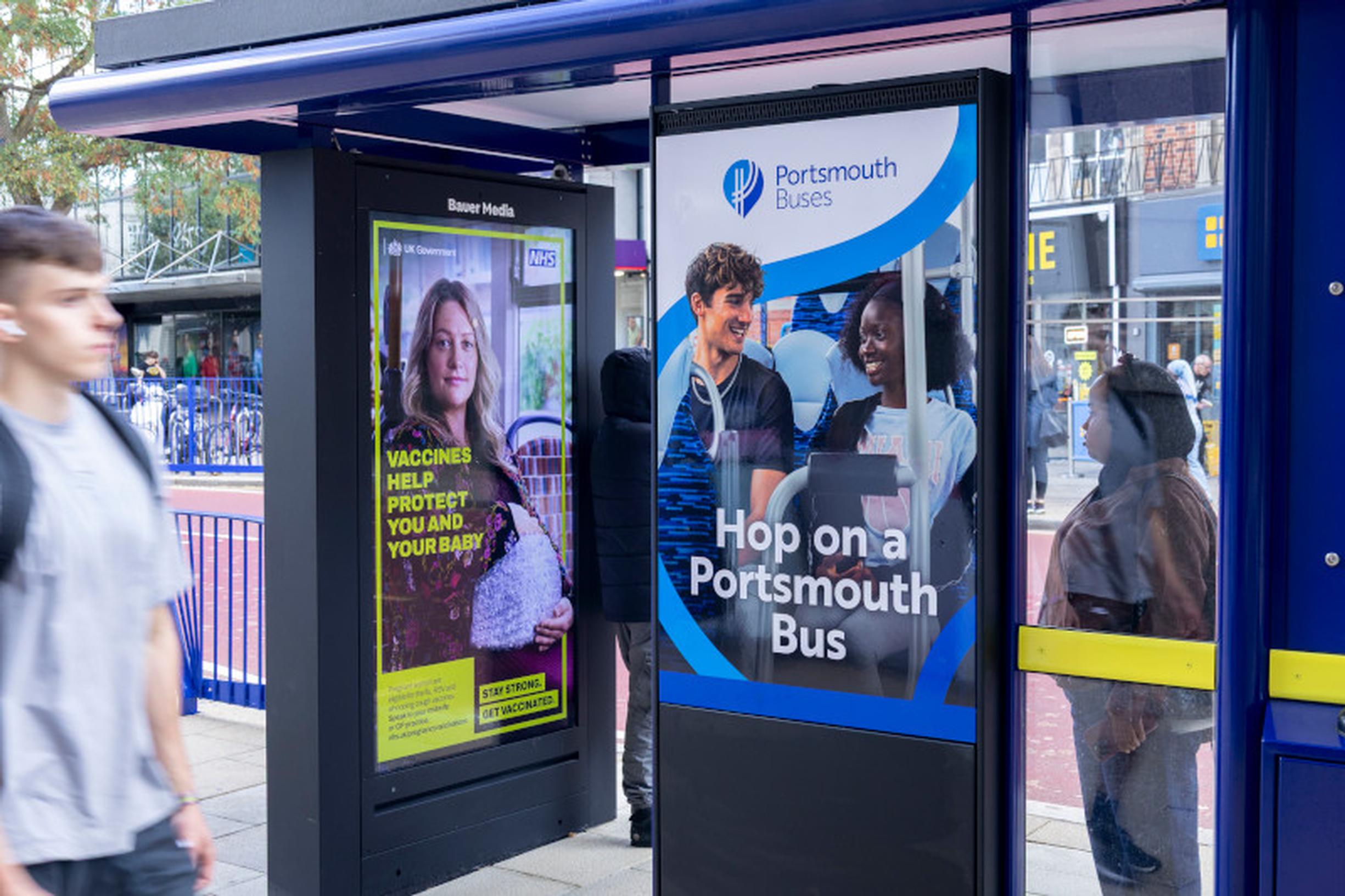
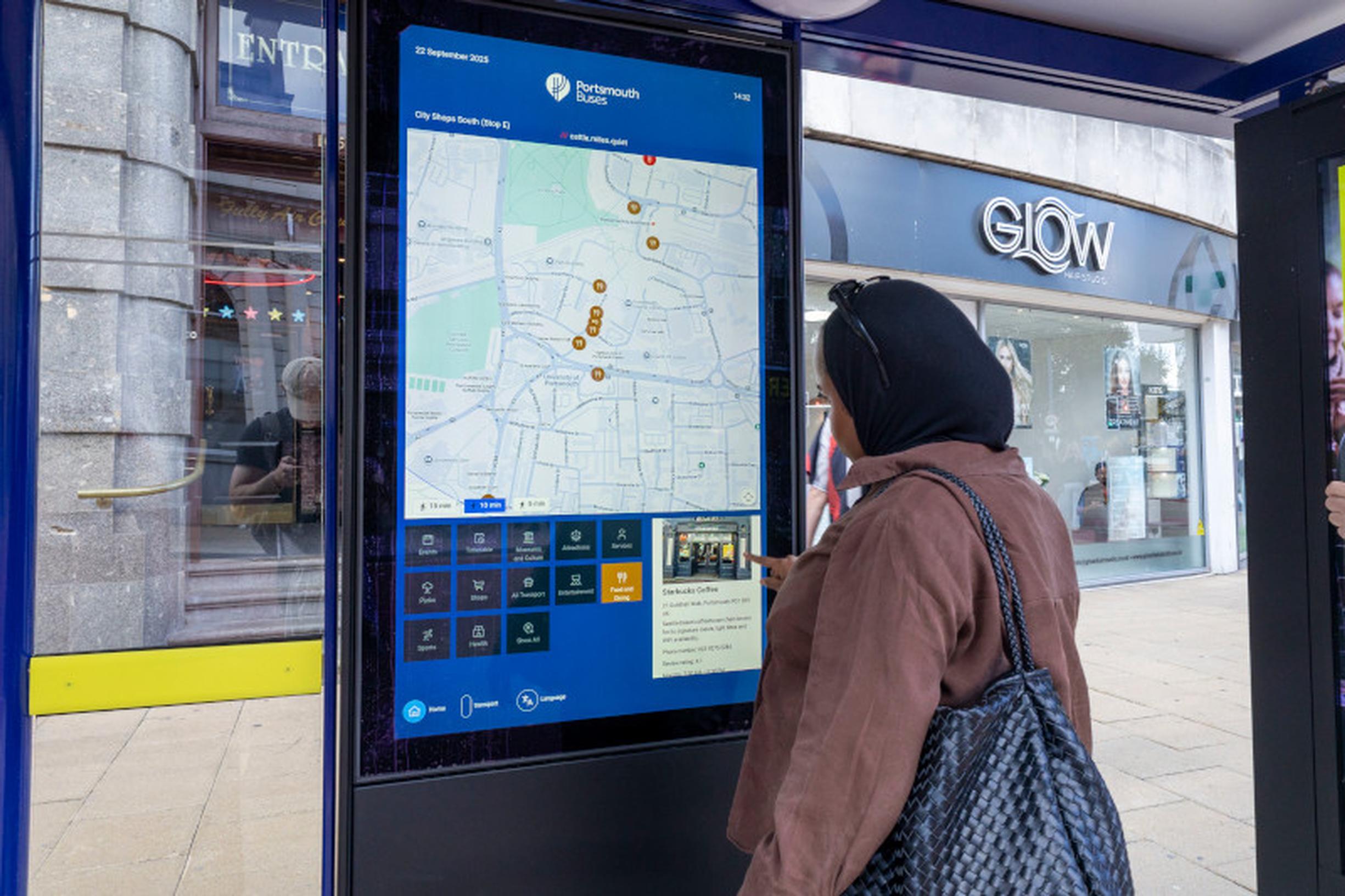
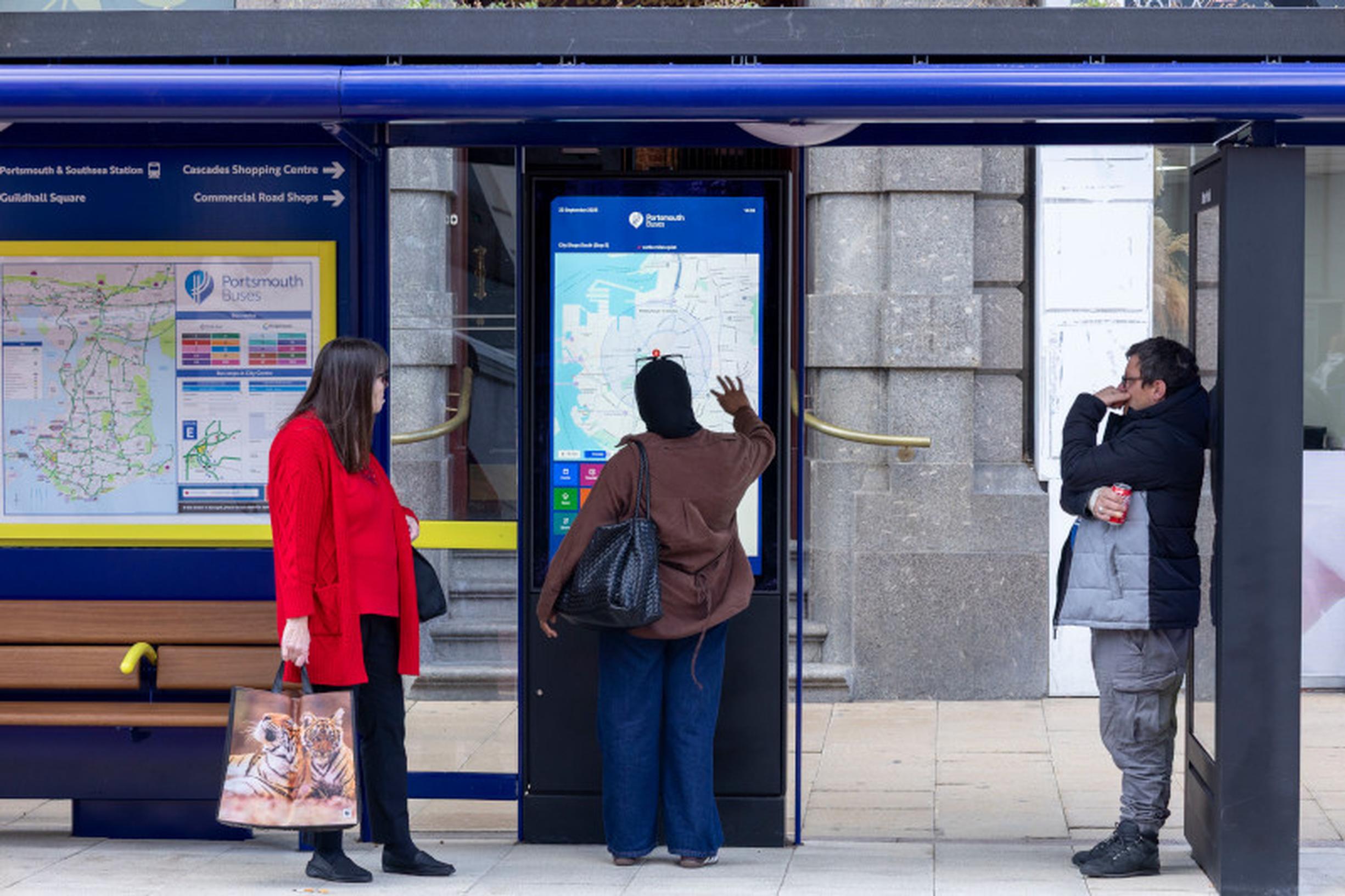
There is a bus stop on Commercial Road in Portsmouth that could easily belong in a Scandinavian city. It features a Living Roof, real-time departure information, free Wi-Fi, a touch-screen wayfinding display, wooden seating with ergonomic armrests, motion-activated lighting, and a defibrillator registered on the national emergency network. It is clean, well-maintained, and modern.
This is the result of a two-year collaboration between Portsmouth City Council and Bauer Media Outdoor, which has upgraded 30 shelters across the city, with more planned, attracting the attention of local authorities throughout the UK.
Initially, the partnership wasn’t solely about replacing outdated shelters, but a deeper challenge regarding the role bus infrastructure plays in daily journeys.
It prompted a simple but powerful question: What if a bus stop were treated as infrastructure that genuinely matters, not an afterthought, but a vital part of the network?
Portsmouth’s shelter estate was, by the council’s own assessment, inadequate. Inconsistent passenger information, poor accessibility, and a network perceived as low quality. Demand for upgrades surpassed availability.
The £48m Bus Service Improvement Plan (BSIP) gave the council funds to invest in infrastructure that improves the passenger experience, prioritising shelters based on their impact.
Research from Campaign for Better Transport highlights this clearly. Only half of bus stops in the UK have a shelter; fewer than four in ten have seating; only 16% provide real-time information. Yet 56% of passengers say live arrival updates would make them more likely to use the bus. The current infrastructure falls far short of passenger expectations — and that gap reduces patronage.
Rail has long benefited from national standards for station infrastructure. Bus stops lack an equivalent. Campaign for Better Transport is working with the Department for Transport and the British Standards Institution on a formal Bus Stop Standard, and Portsmouth[Dvorak, E1] serves as the proof of concept.
Stand at one of Portsmouth’s new Super Stops, and you’ll notice the difference immediately. The shelter, with full end panels that block the wind, offers even, bright lighting, bright enough to read a timetable or lip-read a companion without squinting. The wooden seating has been designed to accommodate a variety of body types, not just the average, with priority spaces, grab handles, and audio announcements for passengers who need them.
Look up, and you’ll see a Living Roof planted with 13 native wildflowers and five sedum species verified under Natural England’s Biodiversity Metric 3.0, built in partnership with the Royal Society of Wildlife Trusts. Look around, and you’ll find real-time departure information, a local area map, a bus service map, and at the busier stops, a 55-inch interactive Smart Bay displaying MapsLive: live departures, walking routes, cycle hire, wheelchair access, and local destinations, all shareable to your phone via QR code.
The design was shaped by research involving 3,200 bus users and accessibility organisations, including Scope and the Thomas Pocklington Trust. Passengers said they wanted information, comfort, and a sense of safety. The shelters deliver all three, including What3Words location codes for precise emergency location sharing, Strut Safe walk-home numbers for nighttime travellers, and defibrillators at seven sites registered on The Circuit, allowing ambulance call handlers to direct bystanders within seconds.
Speaking at the Landor LINKS webinar in March, Neil Chapman, Product Design Director for Europe and UK at Bauer Media Outdoor, was clear that Portsmouth is about more than hardware. “Infrastructure success isn’t about the shelter alone,” he told delegates. “It’s about strategy, governance, lifecycle thinking and partnership. You design with the end user in mind — or better still, you design with the user. You plan for maintenance before installation. And you measure the long-term impact, not just the short-term delivery.”
“Too often infrastructure is designed and delivered, and only later is maintenance considered,” Chapman said. “The reality is infrastructure is around for ten, fifteen, twenty years. Design choices affect maintenance frequency, energy consumption, accessibility compliance and the total cost of ownership.”
Sarah Mead, Head of Council and Corporate Partnerships, described the Portsmouth collaboration as a genuine reset in how Bauer Media Outdoor approaches council partnerships. “This is a best-in-class example of how partnership should work,” she told the audience. Portsmouth challenged us from the very start. Defibrillators on shelters and connected transport with e-scooters or bikes were not even in scope before we embarked on this project.”
“Portsmouth challenged us from the very start. Defibrillators on shelters and connected transport with e-scooters or bikes were not even in scope before we embarked on this project," said Mead.
The Revive programme, which refurbishes structurally sound shelters rather than replacing them, cutting carbon emissions by 94% per shelter, was itself a product of that early dialogue. When Bauer Media shared the concept at their first face-to-face meeting in 2024, the council immediately saw the potential. An audit of the full estate followed, resulting in a proposal to revive 251 of the city’s 300 shelters. “Portsmouth residents were not only acquiring 27 brand new state-of-the-art Super Stops,” Mead said. “They were getting the rest of the estate reimagined.”
The next phase involves four custom Super Stops integrating Voi e-bike and e-scooter docks, boosting first-last mile links. Knowing the commercial model is key: 46p of each pound of Out of Home ad spend returns to the public via rent, rates, innovation, and community or environmental projects. Infrastructure investment and ad revenue are linked.
Nationally, the impact is notable. BSIP funding, combined with strong commercial partnerships and passenger-centric design, can transform behaviour. Chapman said: “When collaboration succeeds, it can raise standards network-wide, not just at flagship sites. Small improvements across a network, create transformational change.” Portsmouth shows it can be done.

TransportXtra is part of Landor LINKS

© 2026 TransportXtra | Landor LINKS Ltd | All Rights Reserved
Subscriptions, Magazines & Online Access Enquires
[Frequently Asked Questions]
Email: subs.ltt@landor.co.uk | Tel: +44 (0) 20 7091 7959
Shop & Accounts Enquires
Email: accounts@landor.co.uk | Tel: +44 (0) 20 7091 7855
Advertising Sales & Recruitment Enquires
Email: daniel@landor.co.uk | Tel: +44 (0) 20 7091 7861
Events & Conference Enquires
Email: conferences@landor.co.uk | Tel: +44 (0) 20 7091 7865
Press Releases & Editorial Enquires
Email: info@transportxtra.com | Tel: +44 (0) 20 7091 7875
Privacy Policy | Terms and Conditions | Advertise
Web design london by Brainiac Media 2020
