
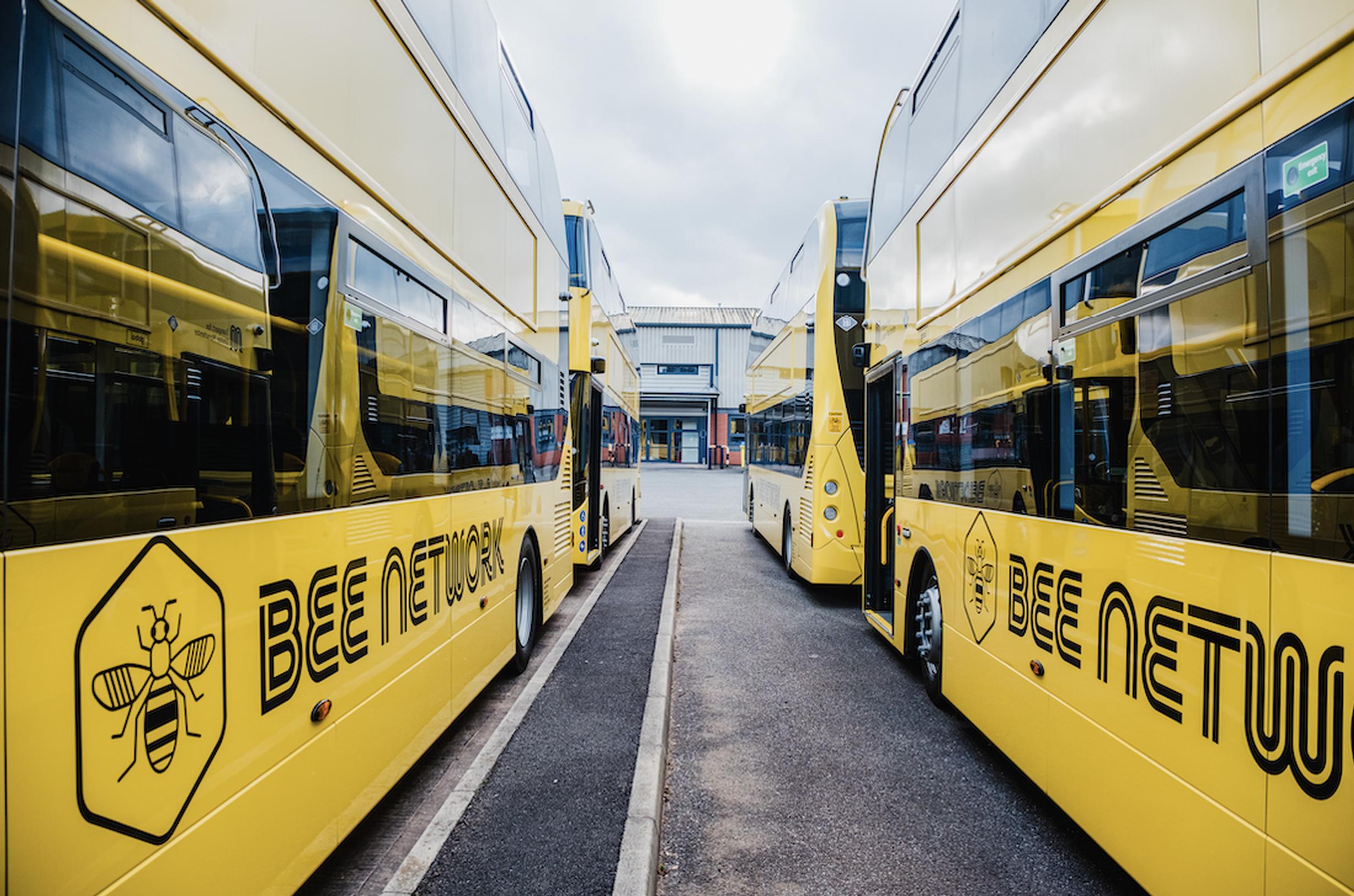
A £65m funding boost will bring 220 more electric buses to the Manchester’s streets and the development of tram-trains.
Almost £60m will be invested to switching a further 13% of the bus fleet from diesel to fully electric. The first buses are expected to be in service by the end of 2026.
Nearly 350 electric buses – around one in five – currently serve communities in Greater Manchester, compared to a national average of just one in 10.
The city recently saw introduction 12 new electric vehicles on the Manchester city centre Free Bus routes. Replacing older diesels, free bus journeys around the city are now quieter, cleaner and increasing in popularity, with a 10% rise in passenger numbers in the last year.
The Bee Network Committee also endorsed exciting plans to connect communities with new tram and tram-train services. Members approved £5.7m to progress with the next phase of work on the Oldham-Rochdale-Heywood-Bury Tram-Train ‘pathfinder’ scheme to connect Atom Valley.
The funding will enable Transport for Greater Manchester (TfGM) to progress plans for the tram-train route, as well as explore options to improve the tram fleet. Work will identify new ‘next generation’ vehicles for the existing Metrolink network as well as similar models that can also run on rail infrastructure too. The aim is for such new fleet to also boost capacity on the network, which is also seeing passenger numbers grow.
Funding was also agreed to deliver a new Travel Hub in Tyldsley, with work set to start in the New Year. It will provide an extra 99 parking spaces, including electric vehicle charging stations and accessible spaces close to the Leigh Guided Busway.
Vernon Everitt, transport commissioner for Greater Manchester, said: “The Bee Network is making public transport more affordable, frequent and cleaner and these further steps will deliver more improvements for the people and businesses of Greater Manchester.
“We are accelerating investment to introduce even more electric buses to add to those which already comprise 20% of our vehicles, marking another significant step towards the goal of a fully zero-emission bus fleet by 2030.
“Major improvements lie ahead for the tram network too, as we look at modern tram-train technology to connect further parts of Greater Manchester directly to the Metrolink network. This will make journeys by public transport faster and more convenient and further build an integrated transport network for our growing city-region.”
The investment is all part of the Greater Manchester Strategy (GMS), the city region’s vision for the next decade. The GMS pledges to continue to develop the Bee Network as a transport system for a global city region, so that by 2030, 90% of the population live within 400m – a five-minute walk or wheeling distance – of a bus or tram that comes at least every 30 minutes and night buses play a key role in this.
The funding approved at the latest Bee Network Committee meeting is part of the £1.07 billion City Region Sustainable Transport Settlement, which helps fund Greater Manchester's pipeline of transport infrastructure projects.
TransportXtra is part of Landor LINKS

© 2026 TransportXtra | Landor LINKS Ltd | All Rights Reserved
Subscriptions, Magazines & Online Access Enquires
[Frequently Asked Questions]
Email: subs.ltt@landor.co.uk | Tel: +44 (0) 20 7091 7959
Shop & Accounts Enquires
Email: accounts@landor.co.uk | Tel: +44 (0) 20 7091 7855
Advertising Sales & Recruitment Enquires
Email: daniel@landor.co.uk | Tel: +44 (0) 20 7091 7861
Events & Conference Enquires
Email: conferences@landor.co.uk | Tel: +44 (0) 20 7091 7865
Press Releases & Editorial Enquires
Email: info@transportxtra.com | Tel: +44 (0) 20 7091 7875
Privacy Policy | Terms and Conditions | Advertise
Web design london by Brainiac Media 2020
