
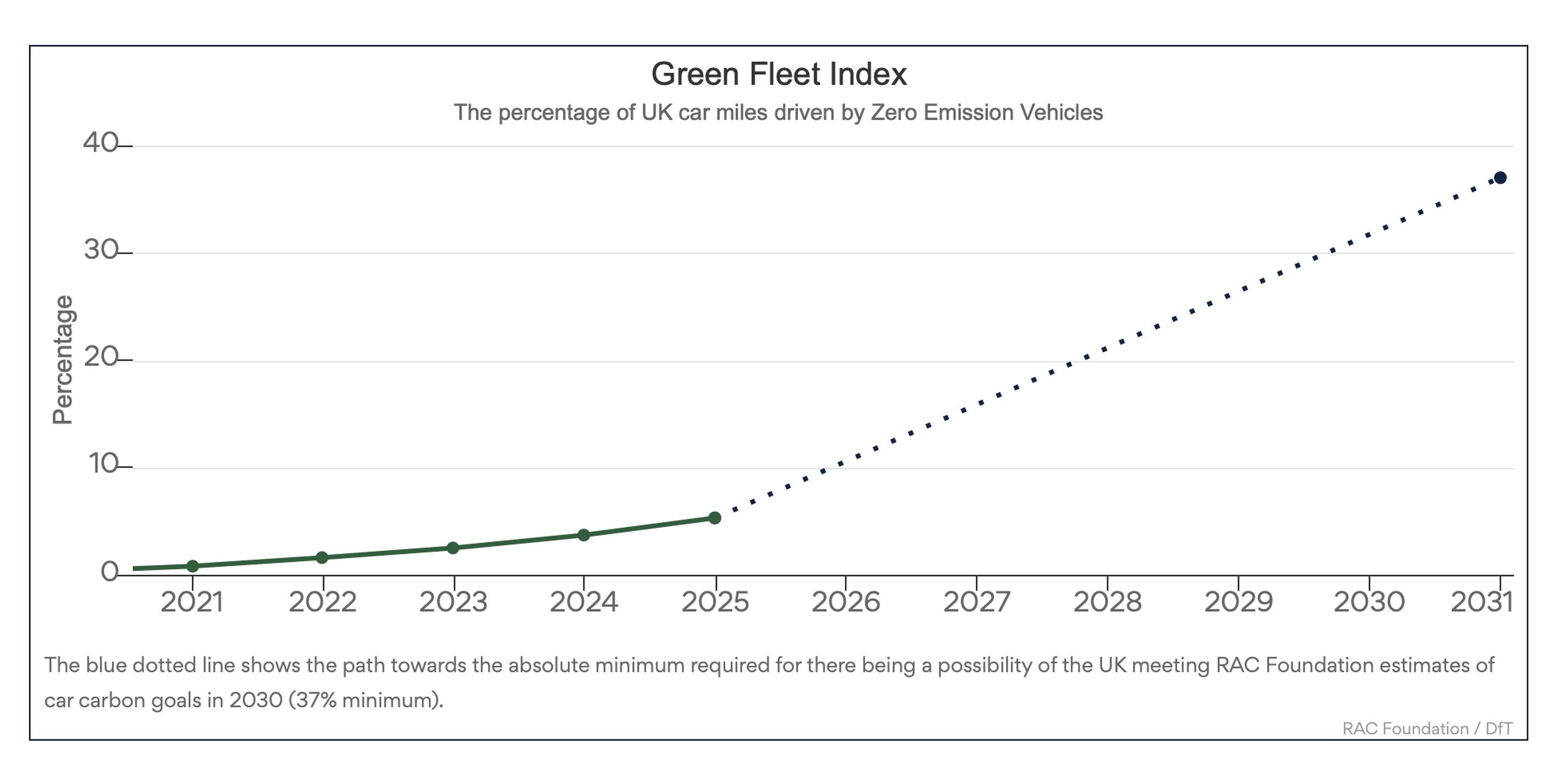
More than one in twenty car miles in the UK is now driven by a zero-emission car.
Analysis by the RAC Foundation shows that at the end of 2024 zero-emission cars (almost universally pure battery-electrics, but also including a tiny number of vehicles with hydrogen fuel cells) comprised just 3.8% of the national car fleet. However, between them they undertook 5.3% of all car mileage.
The total percentage of zero-emission mileage will have been higher still when the distance covered by hybrid cars running on their batteries rather than internal combustion engines is factored in.
The RAC Foundation research contributes to its Green Fleet Index which tracks progress towards what the foundation estimates is the minimum proportion (37%) of zero tailpipe emission car mileage necessary by the end of 2030 to meet targets for carbon reduction from cars without the need to reduce the number of miles driven.
The RAC Foundation analysis also shows that in their early years on the road pure battery-electric cars appear now to be covering almost the same number of miles annually as relatively new diesels, the traditional high-mileage work horses.
In 2024, it is estimated that pure battery-electric cars less than three years old were driven an average of 10,054 miles. This compares with an average of 10,728 miles for diesels less than three years old.
The foundation based its calculations on data from more than 1.2 million MOT tests. Most of these tests will have been taken by vehicles approaching their third anniversary of being on the road, the point at which almost all cars need to have a valid MOT.
However, a small proportion (about 5%) of these tests will have been taken by cars – such as taxis and emergency vehicles – which need to pass a test earlier.
The study also shows that plug-in hybrids under three years old averaged an estimated 9,367 miles last year, whilst new petrol cars were only driven an average of 7,585 miles.
The average annual mileage for all cars under three years old in 2024 was 8,460 miles.
Ten years ago, a new battery-electric car was covering less than half (49%) the miles of a new diesel. Today it is doing almost the same number of miles (94% the distance of a diesel).
According to the SMMT, 24.8% of new cars registered in the UK in June 2025 were pure battery-electric vehicles (BEVs) whilst just 5.6% were diesels. Plug-in hybrids accounted for 11.2%. Petrol cars had the biggest share of the market at 46%.
Steve Gooding, director of the RAC Foundation, said: “Until recently new car buyers, often fleets and businesses, have looked to diesels when they’ve needed something capable of racking up the big miles whilst still offering reasonable fuel economy. Now it seems that fully electric cars are starting to take over where the diesel left off, providing a practical alternative in terms of range and cost per mile, and because of the attractive tax breaks they come with.
“The world where many saw the electric vehicle as being a second-car option, handy only for short trips, is changing rapidly to one where the battery-electric car is being bought to be a workhorse, adopted by fleet buyers and used by those whose jobs see them driving far further each year than the average motorist.
“Given this shift in buying patterns, the fact that new cars generally have tended to run up more miles than older ones and that most electric cars on the road are relatively young, it might not be so surprising that our analysis shows battery-powered vehicles account for a disproportionately large number of miles in use. That’s good news for helping us meet our carbon reduction targets in a week when the government has also reinstated grants to make new electric models more affordable.”
TransportXtra is part of Landor LINKS

© 2026 TransportXtra | Landor LINKS Ltd | All Rights Reserved
Subscriptions, Magazines & Online Access Enquires
[Frequently Asked Questions]
Email: subs.ltt@landor.co.uk | Tel: +44 (0) 20 7091 7959
Shop & Accounts Enquires
Email: accounts@landor.co.uk | Tel: +44 (0) 20 7091 7855
Advertising Sales & Recruitment Enquires
Email: daniel@landor.co.uk | Tel: +44 (0) 20 7091 7861
Events & Conference Enquires
Email: conferences@landor.co.uk | Tel: +44 (0) 20 7091 7865
Press Releases & Editorial Enquires
Email: info@transportxtra.com | Tel: +44 (0) 20 7091 7875
Privacy Policy | Terms and Conditions | Advertise
Web design london by Brainiac Media 2020