
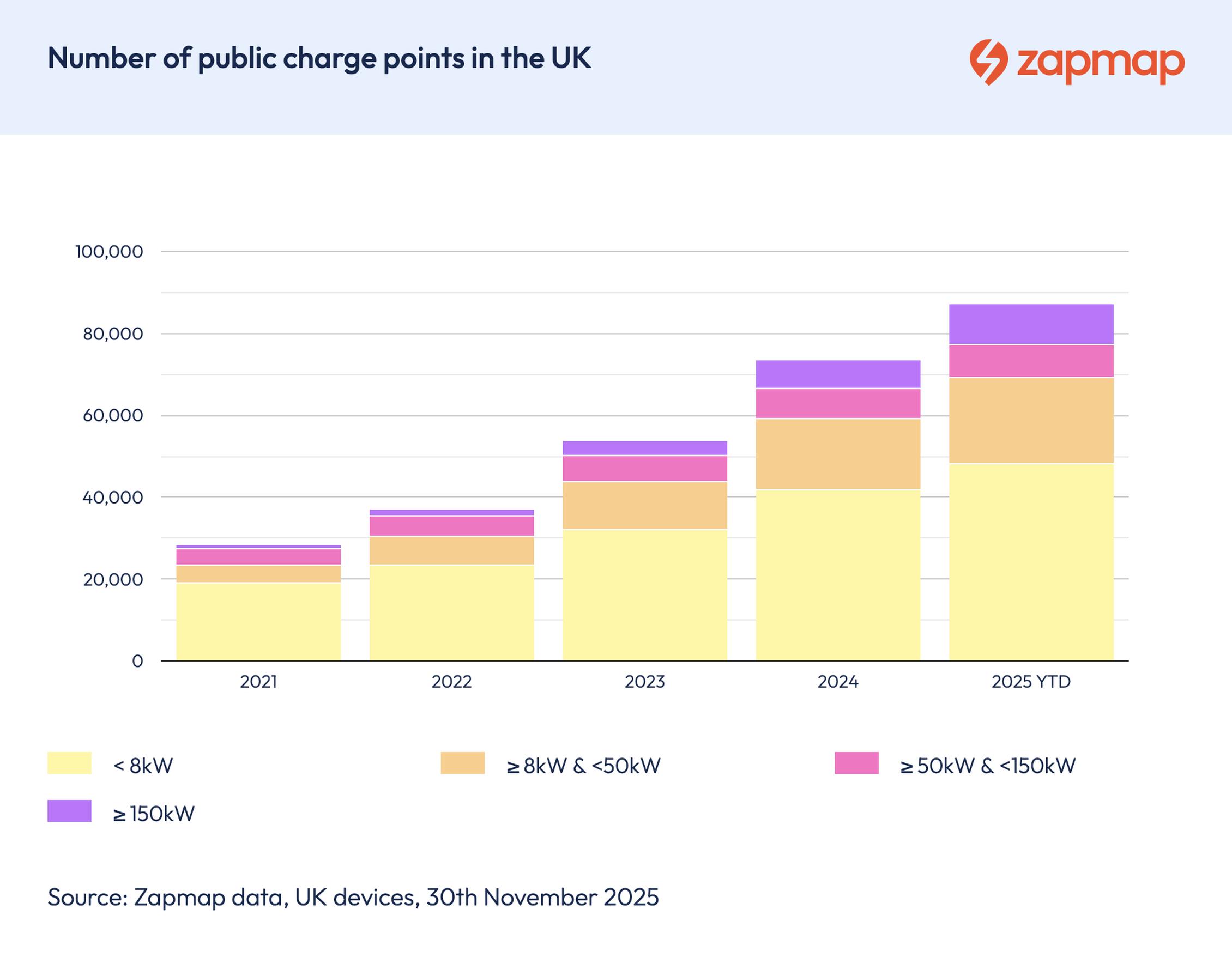
There are now over 87,000 public chargepoints for electric vehicles across the UK, according to the latest data from EV charging mapping company Zapmap.
The Zapmap Insights team analyses Zapmap database of charging points to track the growth and composition of the UK's charging infrastructure and provides a series of graphs, which are updated monthly.
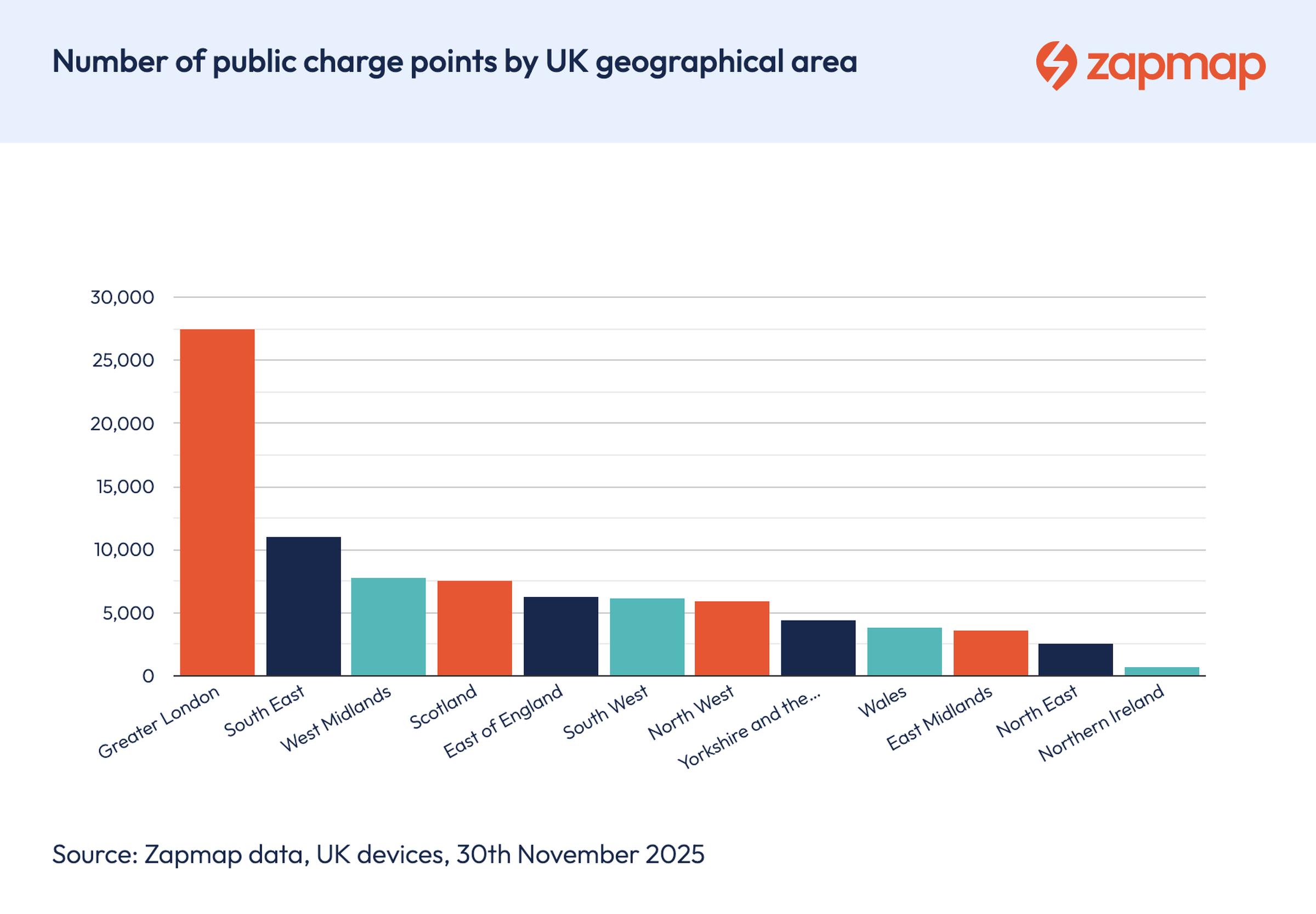
Jade Edwards, head of Insights at Zapmap, said: “While charging infrastructure growth throughout this year is lower than we saw in 2024, there continues to be strong growth in high-powered charging for longer journeys, and it’s heartening to see the strong regional growth taking place in areas outside of London and the South-East. Increasing numbers of LEVI tenders are being awarded each month and as these translate into local charging provision, we’re likely to see a continuing positive impact on regional disparities.”
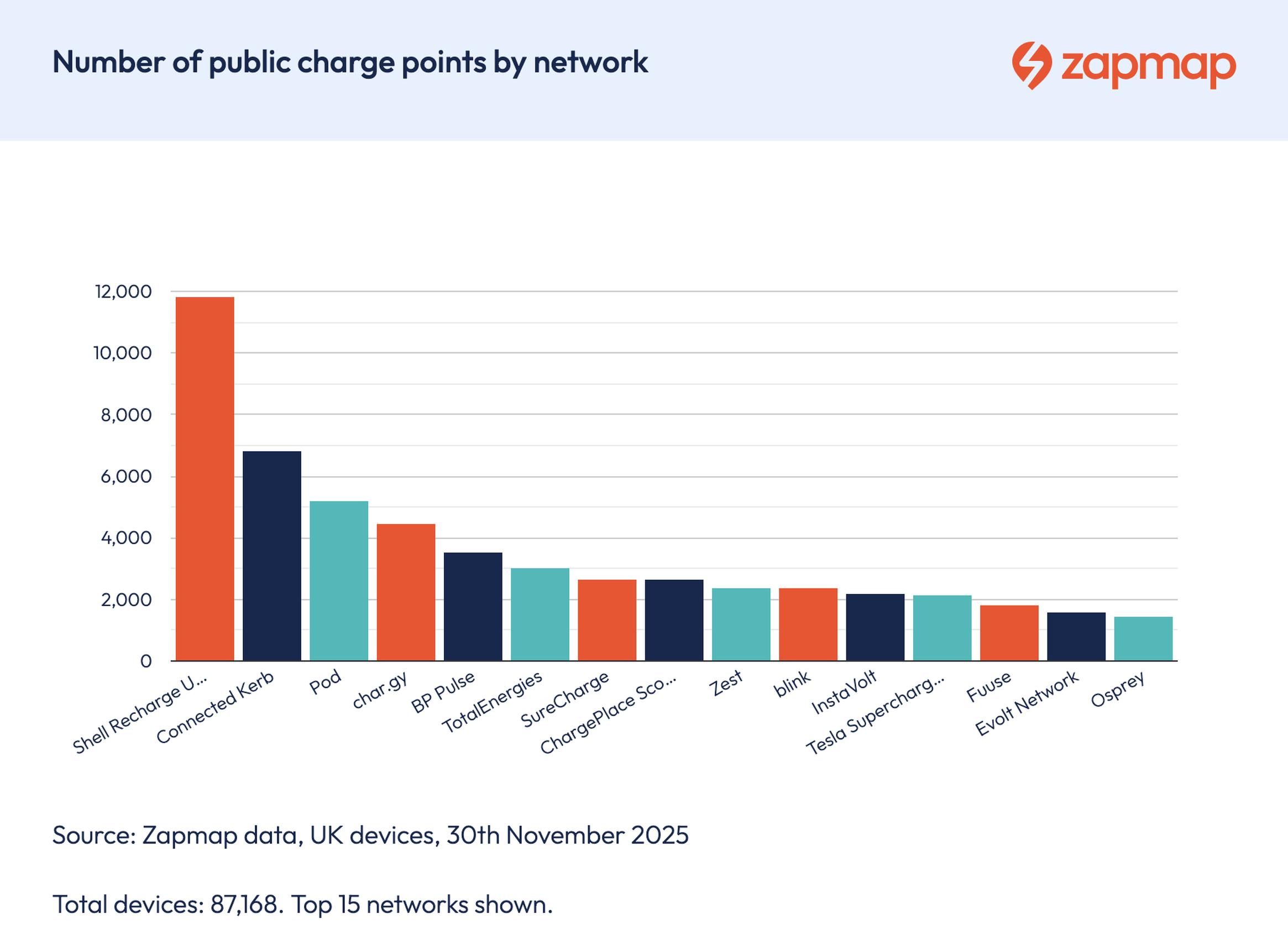
The Zapmap Insights team reports that at the end of November 2025, there were 87,168 electric vehicle charging points across the UK, across 44,326 charging locations, 116,016 chargepoints and 121,364 connectors.
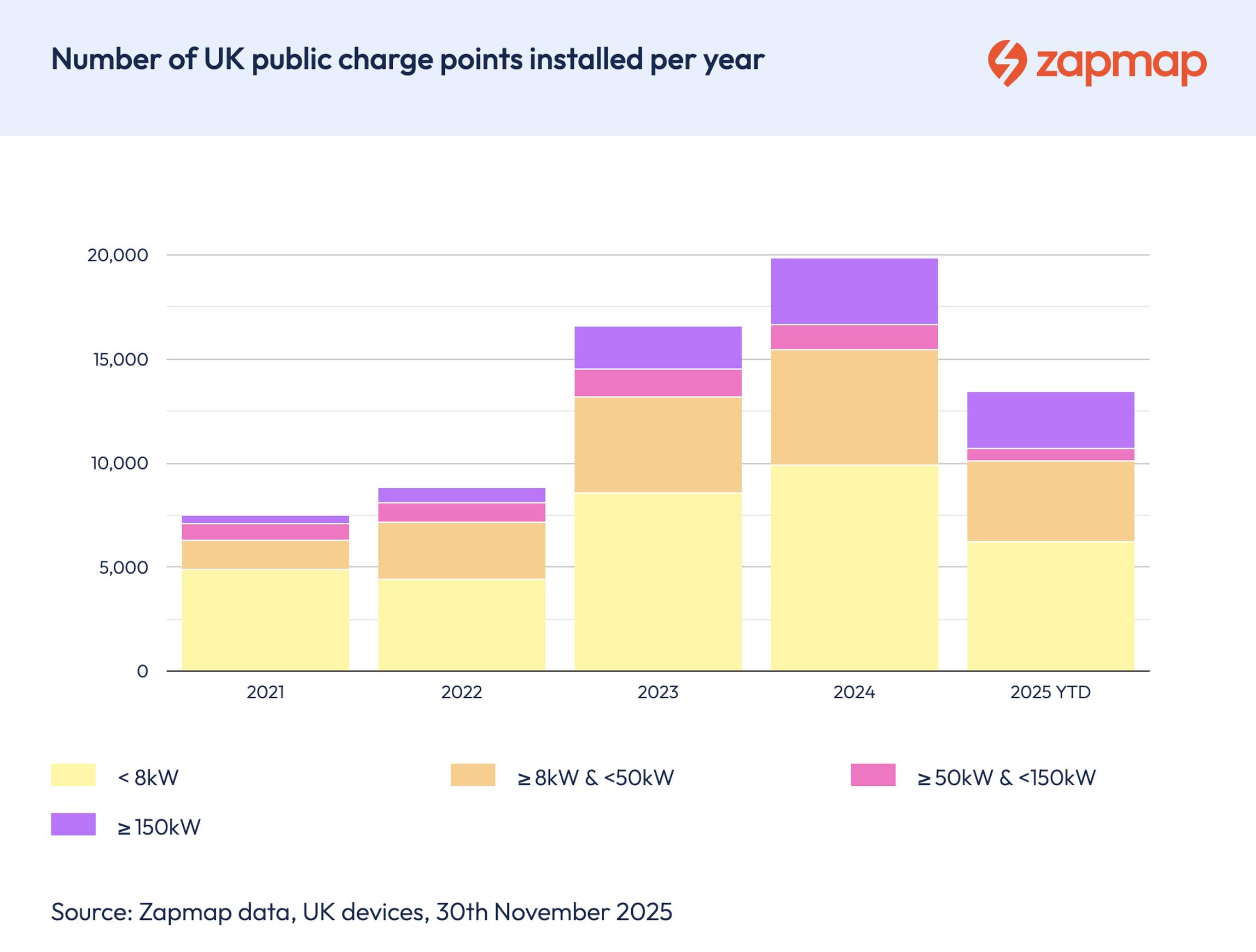
November saw 370 net new charging devices added to the Zapmap database. This number takes into account that every month some devices are decommissioned by chargepoint operators.
The number of public chargepoints in the UK has grown from 28,460 at the end of 2021 to 53,865 at the end of 2023 and more than 73,000 by the end of 2024. Since November 2024 the public network has grown by 18%.
A total 13,469 chargepoints have been added to the UK public network so far during 2025. The power group with the most chargepoints added was Slow – less than 8kW – with 6,220 added since the beginning of the year. Low powered devices are typically found on-street, in car parks, hotels or other destinations.
For the Rapid and Ultra-rapid chargers, the key trend is the shift towards higher powered 150kW+ Ultra-rapid chargers. While Rapid and Ultra-rapid chargers only make up around 20% of total devices, they account for around 60% of the total capacity.
At the end of November 2025 there were 751 Rapid charging hubs across the UK, which are open to all EVs. Zapmap defines a charging hub as a charging location with at least six Rapid (50kW-149kW) or Ultra-rapid (150kW+) chargers. At the end of 2024 there were 537, so the number of charging hubs available across the UK has increased by 40% since the end of 2024.
The charging network with the most chargepoints is Shell Recharge ubitricity, with its network of lamppost chargers. Next up is Connected Kerb, which has an extensive network of on-street chargers across the UK. In third place is Pod, a network of destination chargers found mainly in retail car parks, particularly supermarkets.
The region showing the highest growth over the past 12 months continues to be Wales, at over 27% YoY, while the North West has shown the highest YoY growth in high-powered charging provision at 38%.
In addition to these open charging hubs there are 71 charging hub locations only available to Tesla drivers. Tesla has already opened up many locations to all EVs, and is expected to continue to do so over the coming months.
There are currently 22 live LEVI (Local Electric Vehicle Infrastructure) tenders and this month, announcements of secured funding have come from: Southend-on-Sea Council, which has received £1.4m of funding and will work with Zest to install 3,000 chargepoints; and North Lincolnshire Council, which is working with Believ to deliver 470 on-street charge points, partially funded through LEVI.
Melanie Shufflebotham, founder and chief operating officer of, Zapmap, said: “The dominant news for the EV charging industry this month was of course the budget, with measures being somewhat mixed, combining full exemption on business rates for charging sites, additional government investment and an extension of the EV Car Grant with plans for a future EV road levy.
“In reality, those EV drivers who do the majority of their charging at home (currently c. 80%) will continue to be better off driving electric. However, we know how significant perception is to those considering making the switch and we continue to welcome industry and government discussion around ways of reducing the burden on charge point operators in order to lower public charging costs. This would help to move us towards a more equitable charging landscape, especially in light of the goals of incentives such as LEVI funding.”
TransportXtra is part of Landor LINKS

© 2026 TransportXtra | Landor LINKS Ltd | All Rights Reserved
Subscriptions, Magazines & Online Access Enquires
[Frequently Asked Questions]
Email: subs.ltt@landor.co.uk | Tel: +44 (0) 20 7091 7959
Shop & Accounts Enquires
Email: accounts@landor.co.uk | Tel: +44 (0) 20 7091 7855
Advertising Sales & Recruitment Enquires
Email: daniel@landor.co.uk | Tel: +44 (0) 20 7091 7861
Events & Conference Enquires
Email: conferences@landor.co.uk | Tel: +44 (0) 20 7091 7865
Press Releases & Editorial Enquires
Email: info@transportxtra.com | Tel: +44 (0) 20 7091 7875
Privacy Policy | Terms and Conditions | Advertise
Web design london by Brainiac Media 2020