
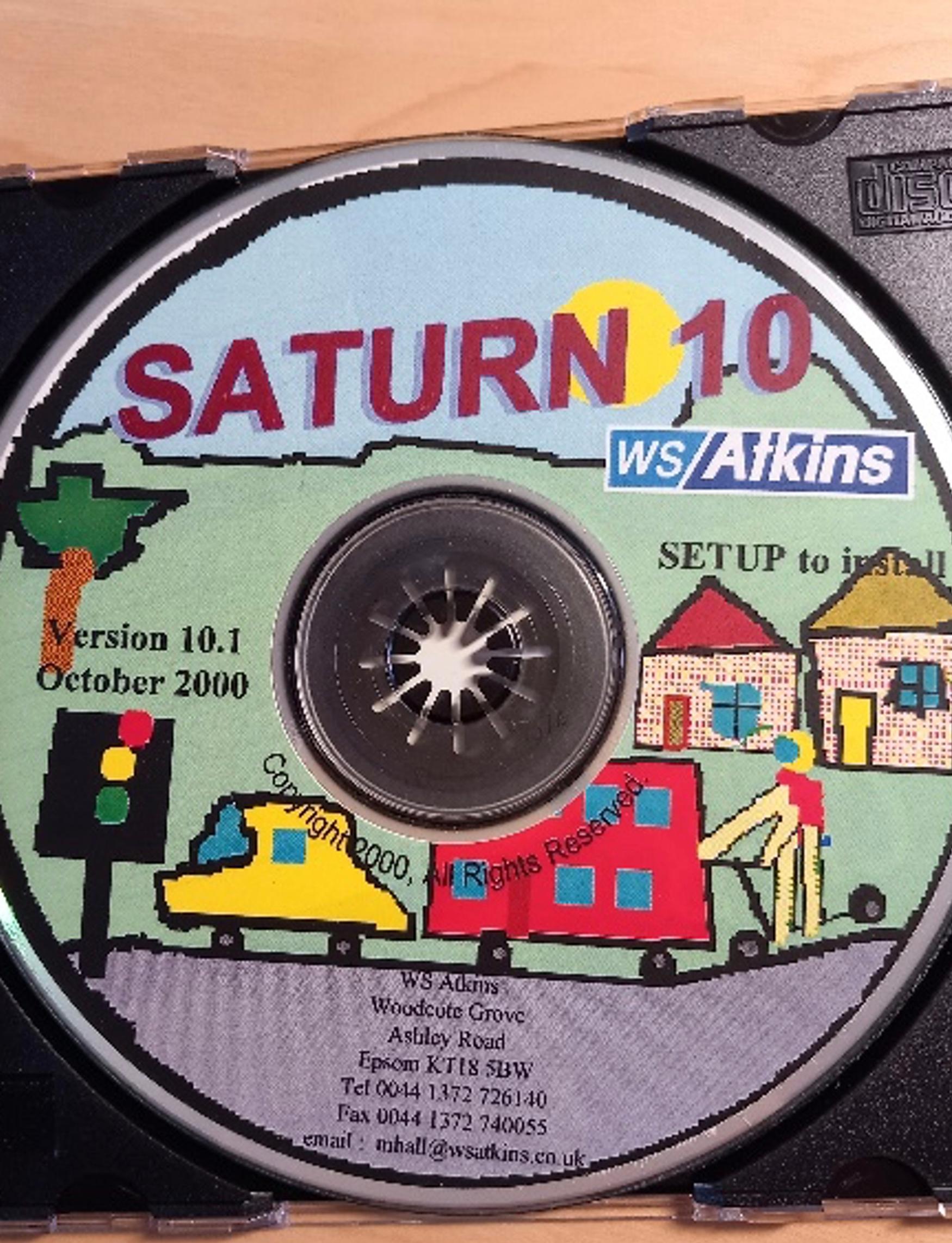
Whilst most people driving on Britain’s roads have never heard of SATURN - short for Simulation and Assignment of Traffic to Urban Road Networks – this software has informed decisions on everything from motorway upgrades to major urban regeneration schemes.
With global transport planning and engineering company AtkinsRéalis as its steward, its influence stretches across the UK and overseas to over 80 organisations, forming part of the evidence base behind billions of pounds of public and private sector investment.
SATURN began life with the award of a Science Research Council (SRC) grant to ITS Leeds, at a time when traffic modelling was still in its infancy. Computers were slow, data was sparse, and many transport decisions were based on simplified assumptions about how traffic behaved.
At a time when cities such as Leeds, Birmingham and Manchester were experiencing unprecedented congestion. Dr Van Vliet’s insight was both simple and revolutionary: congestion is not something you assume - it is something that emerges from how traffic interacts with roads and junctions.
SATURN was therefore designed to combine network assignment with explicit simulation of junction delays and blocking?back, allowing planners to see congestion propagate through a network rather than sit unrealistically on isolated links.
Early applications focused on urban trunk roads and relief road schemes, particularly in Yorkshire, helping local authorities test whether new links would genuinely relieve city?centre congestion or simply redistribute it.
I cut my teeth on SATURN and recall there were few alternatives. Its longevity is not accidental, with clear theoretical foundations, auditability, transparency and a continuous development path linking research to real?world delivery
As the national road programme slowed in the early 1980s, SATURN matured into a reliable decision?support tool.
While most major motorway decisions of the decade had been conceived earlier, SATURN increasingly supported Urban tie?ins to strategic roads, local network impacts around motorway junctions and traffic management and corridor planning.
The addition of Atkins (now AtkinsRéalis) to the SATURN team in 1982 built in the practical and professional application and experience to the academic rigour, enabling the software to continue to evolve and deliver for its users.
With value for money appraisal remaining a key aspect of scheme assessment, and the DfT’s update of Values of Time in its Cost Benefit Analysis (COBA) tool, SATURN enabled users to extract key scheme wide metrics to feed into this key appraisal.
The late 1980s, early 1990s saw a period of exceptionally rapid traffic growth caused by a combination of economic recovery and major scheme completions such as the M25.
SATURN was in regular use by UK consultancies, local authorities and, the then, Highways Agency, enabling the assessment of major road schemes identified in DfT’s “Roads to Prosperity” programme such as the Western Orbital Route and Birmingham Northern Relief Road.
The publication of the SACTRA Report (1994) on induced traffic marked a turning point in UK transport policy. Transport Planning studies were required to address how new capacity might create new demand, a key theme in 1990s transport appraisal research.
In response, SATURN evolved. By the late 1990s, it introduced elastic assignment, allowing traffic volumes to respond to changes in generalised cost within the assignment process. This enabled modellers to reflect suppressed and induced traffic effects in a controlled, transparent way – a crucial step forward for scheme appraisal, as well as linking with other emerging tools to easily enable full variable demand modelling to be undertaken.
SATURN models began to underpin the appraisal of major highway schemes and relief roads across England, aligning practice more closely with emerging DMRB and early WebTAG expectations.
The 1998 White Paper, "A New Deal for Transport: Better for Everyone," produced a shift towards integrated transport policies rather than purely constructing new roads. The emphasis on public transport and integrated solutions, born in the late 1990s, set the foundation for transport policies that lasted over the following decades.
By the early 2000s, SATURN had become a workhorse of national infrastructure planning, playing a pivotal role in the assessment of numerous highway schemes and in the development of the DfT’s Multi Modal Studies programme across England, coupling with public transport and variable demand models, enabling integrated packages of schemes to be developed.
Transport Innovation Fund (TIF) bids, such as that for Transport for Greater Manchester, were also underpinned by SATURN models, whilst, following the release of the DfT’s New Approach to Trunk Road Appraisal (NATA) in 1998, and the creation of Transport User Benefit Appraisal (TUBA) tool in 2000, SATURN was further enhanced to enable direct integration with this tool to provide the key inputs to scheme appraisal.
With SATURN remaining the bedrock of many English Local Authority transport models across this decade, in 2016 it was also chosen for the Regional Transport Models (RTMs), developed by Highways England (now National Highways), built to maximise efficiency, consistency and reduce costs compared to the development of stand-alone models for individual schemes.
With Smart Motorway schemes becoming a pilar of the RIS1 programme, these RTM’s and other SATURN models were key to their assessment and helped understand their impacts in terms of capacity and journey times for schemes on the M25, M1 and M4.
Following legal action by ClientEarth, the UK Supreme Court ordered the government to act on illegal levels of nitrogen dioxide, resulting in a further change in transport planning to consider Demand Management, Clean Air Zones and Ultra Low Emission Zones (ULEZ). Saturn responded to this change in direction through the introduction of Area Charging functionalities.
Further software developments including multi core processing and “spider” network compression significantly reduced model run times and provided more robust convergence without sacrificing transparency.
The Climate Crisis is and will continue to be the main driver of Transport Policy in the 2020’s and beyond as we attempt to reduce transport related carbon emissions and minimise the impact of Global Warming on future generations.
We are starting to understand that electrification of our vehicle fleet is part and not the full solution to the climate crisis and new approaches to reduce the travel frequency and distance will be required. SATURN has been adapted to be used in conjunction with other tools to establish Carbon baselines and assess climate emergency strategies.
As we move into a ‘Vision and Validate’ era of transport planning, SATURN continues to be a key highway modelling tool with over 80 organisations, from national and local government to private sector consultants, using it in the UK and across the world. T
The software continues to underpin national, regional and local decisions and combined local authority transport strategies, evolving further to reflect transport policy that emphasises efficiency, resilience and decarbonisation. SATURN continues to provide a trusted platform for understanding how networks behave and how interventions will perform in practice despite the uncertain future for the world.
Mike Batheram, AtkinsRéalis Market Director – Local Transport, said: “Some 35 years ago, as a graduate trainee, I cut my teeth on SATURN and recall there were few alternatives. Its longevity is not accidental, with clear theoretical foundations, auditability, transparency and a continuous development path linking research to real?world delivery.”
In addition, what makes SATURN’s story truly unusual is the continued involvement of its creator. Half a century after writing its original algorithms, Dr Van Vliet remains a fundamental part of SATURN’s evolution as part of a wider team of developers who write the core codebase, as well as advising on the development direction and contributing to the wider thinking behind traffic assignment and congestion modelling.
The future of transport planning and modelling to address the issues of a unstable world is undecided, however, in an industry where software tools frequently appear and disappear, SATURN’s continuity has been invaluable and unique. To celebrate this incredible achievement, please join Dr Van Vliet and the SATURN and AtkinsRéalis teams at the after conference networking reception at Modelling World on 18th June in Leeds as we look forward to the next chapter of this revolutionary transport modelling software.
Duncan Irons is a director at AtkinsRealis

TransportXtra is part of Landor LINKS

© 2026 TransportXtra | Landor LINKS Ltd | All Rights Reserved
Subscriptions, Magazines & Online Access Enquires
[Frequently Asked Questions]
Email: subs.ltt@landor.co.uk | Tel: +44 (0) 20 7091 7959
Shop & Accounts Enquires
Email: accounts@landor.co.uk | Tel: +44 (0) 20 7091 7855
Advertising Sales & Recruitment Enquires
Email: daniel@landor.co.uk | Tel: +44 (0) 20 7091 7861
Events & Conference Enquires
Email: conferences@landor.co.uk | Tel: +44 (0) 20 7091 7865
Press Releases & Editorial Enquires
Email: info@transportxtra.com | Tel: +44 (0) 20 7091 7875
Privacy Policy | Terms and Conditions | Advertise
Web design london by Brainiac Media 2020
