
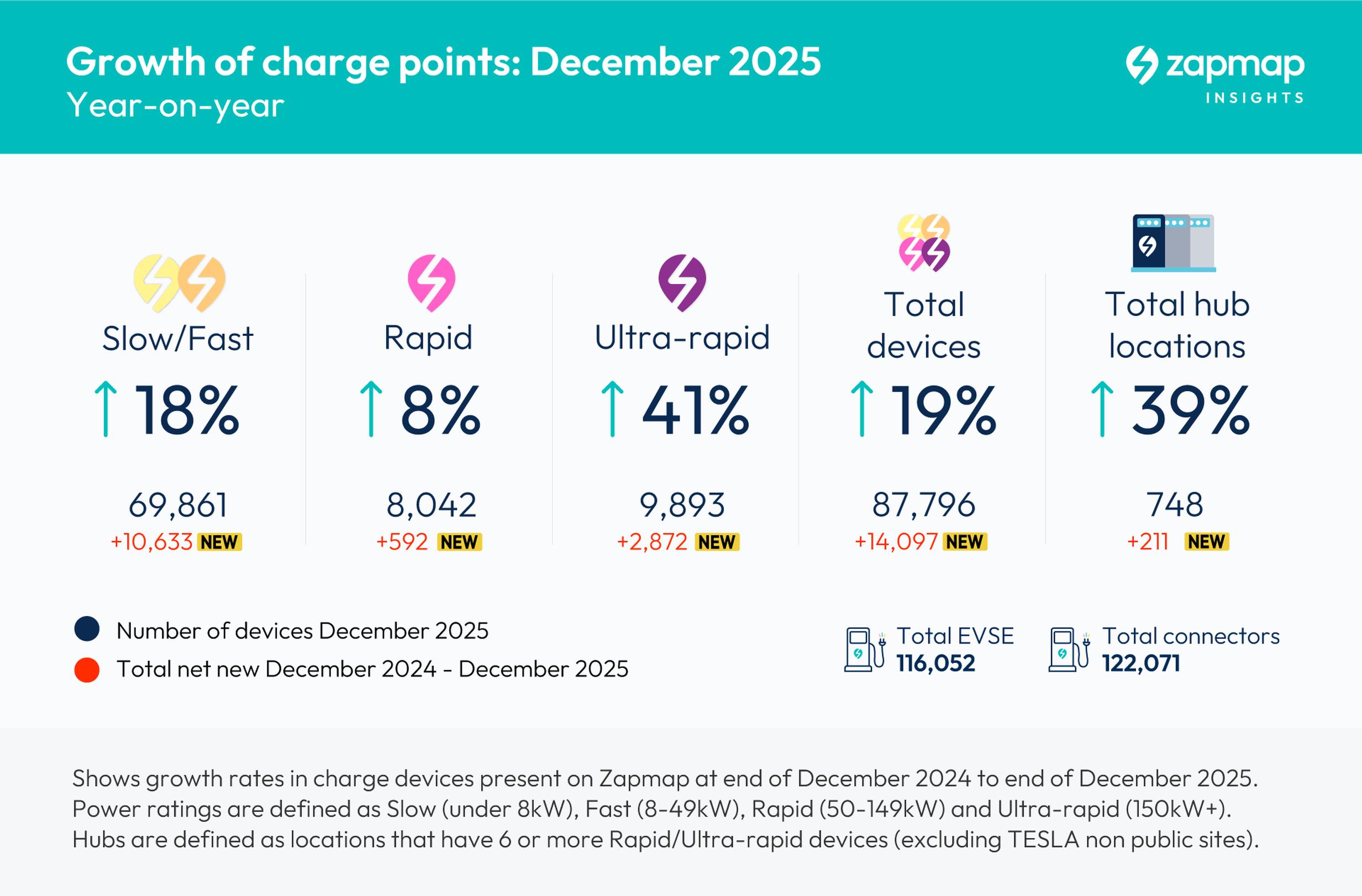
There has been 19% year on year increase across the board in the number of EV chargepoints available in Britain.
These are among the headline figures from the Zapmap, which has published new statistics on public chargepoint installations throughout 2025. The figures taken from the Zapmap database at the end of December 2025 show 14,097 new chargepoints were installed throughout 2025.
The EV charging infrastructure now encompasses 87,796 devices (116,052 EVSEs) at 45,033 locations spanning en-route, destination and on-street charging. The new installations represent a year-on-year increase of 19%.
The highest growth continues to be seen in ultra-rapid devices delivering charging speeds of 150kW and above, as well as in charging hubs typically located along the strategic road network and designed for drivers looking to recharge their vehicle as quickly as possible on longer journeys. There are now 9,893 chargers in this power band, 41% more than in December 2024.
The Zapmap figures reveal that 211 additional charging hubs have opened since the start of the year. The number of charging hubs across the country (defined as six or more rapid or ultra-rapid devices at a single location) now stands at 748, an increase of 39% over the past 12 months.
Zapmap’s statistics show strong regional growth taking place outside of London and the South-East throughout 2025, especially with regard to rapid/ultra-rapid (50kW+) chargers: the North West has seen impressive year-on-year growth of more than 35% in these high-powered chargers, with the East of England, Wales and Northern Ireland all recording around 29% growth in this power band (albeit Northern Ireland starting from a low base).
Destination charging, where people charge when stopped, rather than stopping to charge, coverss several use cases, and for those cases with a sub-four hour dwell time, such as gyms and supermarkets, whilst <50kW remains the majority there is a trend towards installing more rapid- and ultra-rapid chargepoints in these locations.
Developments over the past quarter include:
Many destination chargers are still low powered <50kW chargepoints and provide charging for longer stops and top-ups, such as in car parks and at tourist attractions. Combined with on-street charging, also predominantly <50kW, there are 69,861 chargepoints in this category representing just under 80% of the total.
On-street charging devices, designed for overnight or full-day charging, are aimed at drivers who wish to charge close to home but do not have off-street parking – this category is likely to become increasingly significant as more drivers make the transition to electric vehicles. These chargepoints have seen 7,659 new additions in 2025 bringing the total to 33,177.
London continues to lead the way on both EV adoption and on-street charging, with the majority of these chargers (24,026) located in Greater London. The growth in on-street provision throughout both Greater London and the rest of the UK is very comparable at around 30% year-on-year for both.
The latter half of 2025 saw many announcements around the award of LEVI (Local Electric Vehicle Infrastructure) contracts, designed to deliver local charging, typically on-street, especially in areas where charging at home is not an option.
With the tender and commercial contract process for these awards taking longer than initially expected, Zapmap says it is yet to see these announcements translating into a significant impact on the figures.
Announcements of LEVI awards in the last three months of 2025 included:
Zapmap’s new charging statistics come alongside news from the Society of Motor Manufacturers & Traders (SMMT) confirming another year of record sales of new pure-electric cars in 2025. 473,348 pure-electric cars were sold in the UK last year, more than 23% of all new cars sold in 2025, up from 19% in 2024. This brings the total number of pure-electric cars on the UK's roads to 1,834,150, up from 1,360,802 at the end of 2024, representing a 35% growth in the parc.
Zapmap’s annual driver survey, released last month, showed an average satisfaction rating of 88% for drivers of electric cars, with fewer than 3% saying they would return to a petrol or diesel car. Whilst around 80% of EV drivers charge at home, from the c.1.3 million home chargers installed in driveways, 51% of EV drivers use the public network at least once per month, reflecting the continued importance of public infrastructure.
While there remain some concerns, average satisfaction with the public charging infrastructure has increased to 69%, with 60% of respondents believing that the public charging infrastructure has improved over the past year.
In parallel, Zapmap data also reveals that by the end of 2025, nearly 4 million successful charge sessions were completed in a month, compared to c. 2.5 million at the same point last year. This reflects both the improvement in reliability, growing familiarity and the growth in the charging infrastructure over the last 12 months.
Melanie Shufflebotham, co-founder and chief operating officer at Zapmap, said: “While overall charging infrastructure installations are lower than 2024 — a record-breaking year — this year has been marked by targeted areas of focus with both public and private sectors giving thought to shaping the EV market to best meet driver needs.
“The growth in ultra-rapid charging in particular is not only providing convenience and confidence to existing EV drivers but also, due to their typically visible locations, assuring the next wave of drivers looking to make the switch that the infrastructure is there where it’s needed most.
“As we move into 2026, we look forward to LEVI fund awards translating from contracts into near-home charging provision, to increase equitable access for those without access to off-street parking. As the government’s dedicated innovation fund to address concerns around timely access to grid connections takes effect, we can expect to see benefits to the charging infrastructure both in congested, high-demand areas and rural areas with limited grid infrastructure.”
Vicky Read, chief executive of chargepoint operator trade association ChargeUK, said: “A year in which EV sales accounted for a quarter of all vehicle registrations whilst the charging infrastructure grew by a fifth can only be described as hugely positive. But the overall chargepoint number only gives us a part of the picture — our sector is focussed on installing the right kind of charging in the right places. Which is why the roll-out of ultra-rapid charging is especially pleasing to see. The widespread coverage across key UK roads means that EV drivers can take long journeys with increasing confidence.
“The slower roll-out of on-street charging is largely accounted for by the delays to the government’s LEVI funding scheme, but we are anticipating to see lots more volume on that front in 2026 into 2027 — with a stated aim to deliver 100,000 local low power chargers for those who cannot charge at home.
“As we enter the government’s review into the cost of public charging in the first half of this year we hope to see action taken to reduce the cost burdens on chargepoint operators, which will both help to unlock further investment to speed up deployment and bring down driver prices. Clear and stable EV policy, including no further wavering on EV sales targets, will also continue to be critical.”
TransportXtra is part of Landor LINKS

© 2026 TransportXtra | Landor LINKS Ltd | All Rights Reserved
Subscriptions, Magazines & Online Access Enquires
[Frequently Asked Questions]
Email: subs.ltt@landor.co.uk | Tel: +44 (0) 20 7091 7959
Shop & Accounts Enquires
Email: accounts@landor.co.uk | Tel: +44 (0) 20 7091 7855
Advertising Sales & Recruitment Enquires
Email: daniel@landor.co.uk | Tel: +44 (0) 20 7091 7861
Events & Conference Enquires
Email: conferences@landor.co.uk | Tel: +44 (0) 20 7091 7865
Press Releases & Editorial Enquires
Email: info@transportxtra.com | Tel: +44 (0) 20 7091 7875
Privacy Policy | Terms and Conditions | Advertise
Web design london by Brainiac Media 2020