
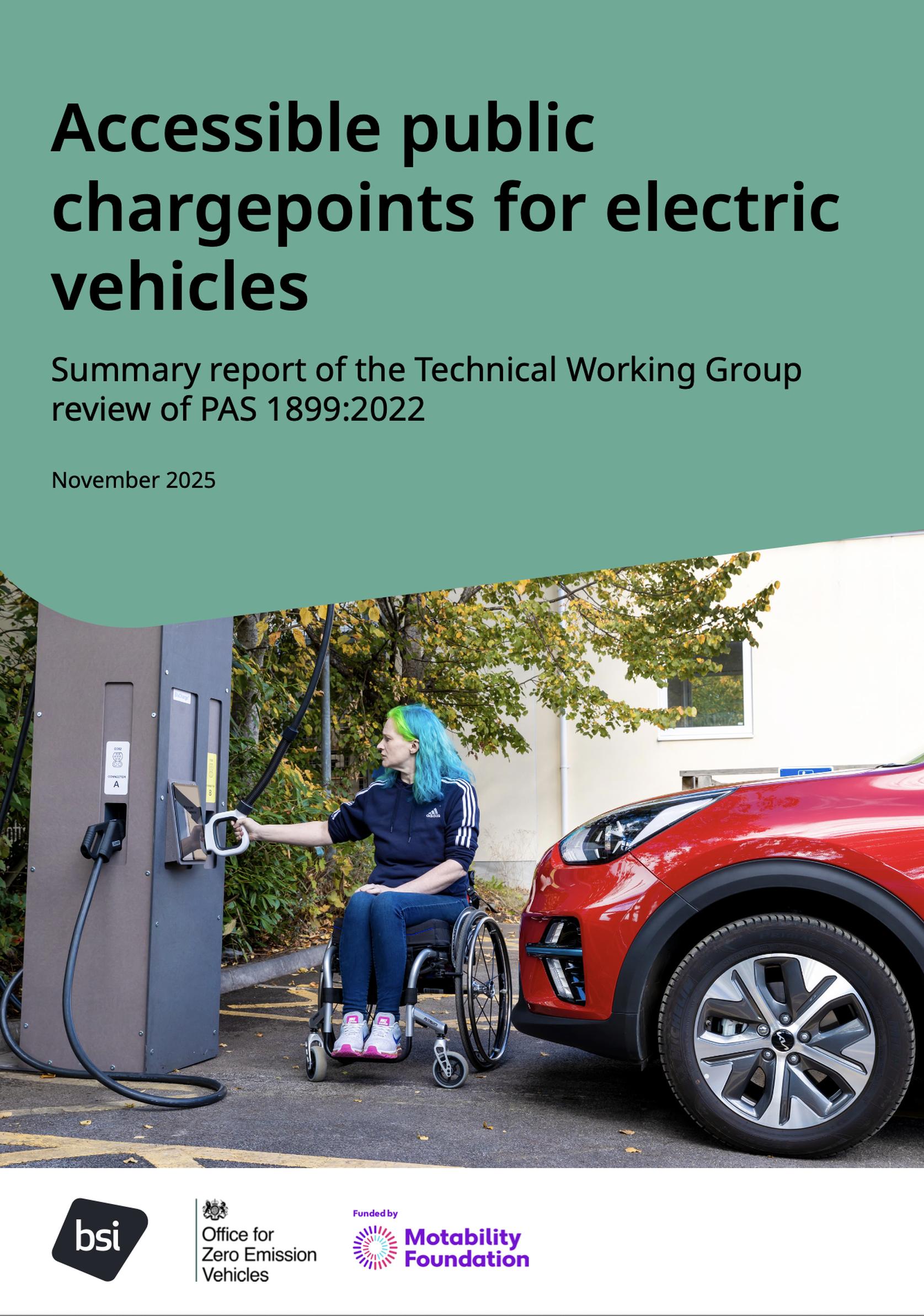
A design specification for creating accessible electric vehicle chargepoints needs to be revised, a working group drawn from across the disability, energy, transport policy and parking sectors has recommended.
The BSI has published a report that recommends revisions to the existing UK standard for electric vehicle chargepoints – PAS 1899:2022 – to make it easier to deliver accessible charging that meets disabled drivers’ needs.
The report recommends revisions to the existing PAS 1899 framework, which sets out detailed accessibility requirements for public EV chargepoints – including minimum parking bay sizes suitable for wheelchair users, placement of bollards, and the positioning and orientation of payment terminals.
The working group considered, and then rejected, the idea developing PAS 1899 to become a British Standard. The group feels PAS development process is faster than the British Standard development process and the revised PAS would remain free of charge, unlike a British Standard.
There was a feeling that PAS 1899 should be split into parts, one addressing on-street chargepoints and the other off-street chargepoints. Existing guidance for on-street designated accessible bays should be replaced by core minimum requirements to ensure high standards of accessibility. This will also be done for existing guidance for off-street designated accessible bays. For other types of on-street chargepoints, PAS 1899 ought to take an amended approach that reflects the variability of the local environment.
The future provision of open data on the accessibility features of each chargepoint will also enable drivers to locate the chargepoints that best meet their needs.
The expert panel felt the should be focused updates to PAS 1899 technical clauses, specifically regarding component heights, connector forces, cable weights, and bollard placement. The group said this will ensure that the chargepoints built to these specifications achieve high standards of accessibility while being more achievable for industry to implement in practice.
The report was sponsored by Motability Foundation and the Office for Zero Emission Vehicles (OZEV), and the working group chaired by consultancy SYSTRA. Group members included Disabled Motoring UK, British Parking Association, Cenex, ChargeSafe, ChargeUK, EVA England, DfI Northern Ireland, Transport Scotland and Transport for Wales.
The recommendations follow a year-long review and consultation by government with industry stakeholders and consumer and disability groups to identify improvements that would make delivery of the standard easier and more consistent.
PAS 1899:2022, Electric vehicles – Accessible charging – Specification is a standard that specifies requirements for the provision of accessible public chargepoints for electric vehicles (EVs). It aims to improve the accessibility of public charging infrastructure for all potential users, including disabled people and older people.
The development of the standard was co-sponsored by Motability Foundation and the Office for Zero Emission Vehicles (OZEV) and was published in October 2022.
It was the first standard of its kind, developed in close collaboration with a wide range of stakeholders and represented a positive step towards making EV charging infrastructure accessible for all drivers, including disabled people.
PAS 1899 aims to improve the accessibility of public charging infrastructure by:
PAS standards typically undergo a review after two years to assess whether and how they might be updated to improve their implementation. As such, Motability Foundation and OZEV initiated a review in February 2024, including to consider challenges stakeholders had raised regarding implementation of the standard.
The review involved establishing a PAS 1899 Technical Working Group (TWG) to examine the emerging evidence of challenges to implementation, and to provide advice on whether and how to update PAS 1899 to improve its effectiveness and implementation. The TWG included a broad range of stakeholders, including consumer and consumer and disabled people’s groups, central and local government and a range of industry bodies, reflecting a strong shared commitment across the sector to deliver more accessible charging infrastructure.
This report summarises the work of the PAS 1899 TWG, including:
The review found that disabled drivers continue to face challenges in accessing public chargepoints. There is a need, therefore, for PAS 1899 to have a clear set of accessibility requirements that could be implemented by the sector. The review process demonstrated strong commitment from across the sector to achieving this goal.
The review identified that the main barriers to the uptake of PAS 1899 were challenges in interpreting and implementing the PAS by those responsible for procuring and installing chargepoints. Some of the key challenges included:
The TWG’s recommendations reveal a strong consensus that implementing these recommendations would ensure that stakeholders, including site owners and industry, would be able to adopt the revised requirements with greater clarity and speed to deliver infrastructure that is accessible to all.
The review identified that the main barriers to the uptake of PAS 1899 are the challenges in interpreting and implementing the PAS by those responsible for procuring and installing chargepoints. There was strong support in the PAS 1899 TWG that the PAS should be updated to ensure both a high level of accessibility for drivers and that it is deliverable in practice by industry and the wider sector.
Should PAS 1899 be revised?
Yes. Based on the evidence collected during the review, updating PAS 1899 would give the opportunity to clarify points of uncertainty and facilitate improved implementation.
Should PAS 1899 be further developed to become a British Standard?
No, the document should remain a PAS. The TWG saw limited benefits in further developing PAS 1899 to become a British Standard. The PAS development process is faster than the British Standard development process and the revised PAS would remain free of charge, unlike a British Standard.
Should PAS 1899 technical clauses be updated?
There should be focused updates to PAS 1899 technical clauses, specifically regarding component heights, connector forces, cable weights, and bollard placement. This will ensure that the chargepoints built to these specifications achieve high standards of accessibility while being more achievable for industry to implement in practice. Where necessary, the technical clause updates should be informed by further testing to ensure both accessibility and feasibility from an industry perspective. Where appropriate, alignment with wider accessibility standards should also be considered.
How should PAS 1899 be revised to ensure better availability of assistance at public chargepoints?
PAS 1899 requirements on the availability of assistance should be updated following further engagement with the sector. This will support the improved provision of physical assistance where it is needed, while ensuring that this is feasible to deliver in practice. Further work should be undertaken with site owners, chargepoint operator (CPO) representatives and accessibility organisations to agree how to update the availability of assistance requirements.
Virtual assistance will also continue to be provided at all public chargepoints through a free-to-use helpline in line with the requirements of the Public
Charge Point Regulations 2023. In addition, the future provision of open data on the accessibility of chargepoints will support drivers in finding chargepoints that best meet their needs.
How should PAS 1899 be revised to support the delivery of accessible on-street public chargepoints?
PAS 1899 should be split into parts, one addressing on-street chargepoints and the other addressing off-street chargepoints. Existing guidance for on-street designated accessible bays will be replaced by core minimum requirements to ensure high standards of accessibility. This will also be done for existing guidance for off-street designated accessible bays. For other types of on-street chargepoints, PAS 1899 will take an amended approach that reflects the variability of the local environment. This will include a smaller set of core minimum requirements applicable to all on-street chargepoints, together with guidance on issues that are likely to be more site specific. The future provision of open data on the accessibility features of each chargepoint will also enable drivers to locate the chargepoints that best meet their needs.
How should PAS 1899 be revised to account for chargepoint innovations?
Consideration of chargepoint innovations will form part of the PAS 1899 revision process. These include lamppost chargers, chargers that sit flush with the pavement surface, wireless chargers and other charging solutions that are either being trialled or yet to be widely adopted.
How can we support better understanding of the requirements in PAS 1899?
The structure and drafting of PAS 1899 should be revised to improve understanding by stakeholders. As part of this, PAS 1899 should be split into two different parts, one focused on on-street chargepoints, and the other focused on off-street chargepoints.
PAS 1899 should also be updated to reflect feedback from stakeholders, including the addition of further diagrams to aid understanding, and ensuring that the distinction between requirements and guidance is clear.
How can we support better understanding of roles and responsibilities in delivering PAS 1899?
Easy-to-understand supplementary guidance should be developed alongside PAS 1899. It was agreed that this would support improved implementation and uptake of the standard. It would also support greater clarity on roles and responsibilities in delivering and complying with PAS 1899. The proposed division of the PAS into two parts, one on on-street chargepoints and the other on off-street chargepoints, would help with this.
How can we improve the data that are available on the accessibility features of each public chargepoint?
An accessible chargepoint data standard should be developed by the time the revised PAS is issued. This standard would enable chargepoint operators (CPOs) to share data on the accessibility-related features of their chargepoints and the surrounding built environment in a consistent manner. The data standard is being co-sponsored by Motability Foundation and OZEV, and is being developed by the EV Roaming Foundation, which manages the Open Charge Point Interface
(OCPI) standard. It is proposed that the use of the data standard should be a requirement of PAS 1899.
How should issues that fall outside the PAS 1899 revision process be addressed?
Motability Foundation and OZEV should engage with stakeholders on issues identified that fall outside the remit of the TWG and the PAS 1899 revision. The TWG identified several issues that fall outside their remit [e.g. vehicle original equipment manufacturers (OEMs) having standardised locations for charging ports or two charging ports on vehicles; spacing of general parking bays; cross-pavement charging; the proportion of charging bays in a car park or on-street that should be designated accessible]. Motability Foundation and OZEV should continue to engage with stakeholders on these issues as appropriate.
How can we support alignment between PAS 1899 and similar accessibility standards internationally?
BSi, OZEV and Motability Foundation will monitor and interact with European standards work while the PAS 1899 revision process proceeds. The European standards bodies, CEN and CENELEC, are considering jointly developing an accessible chargepoint standard; however, this is likely to take between three and five years. The TWG agreed that the PAS revision process should be kicked off immediately, whilst BSI, OZEV and Motability Foundation monitor and feed into any longer-term European standards work.

TransportXtra is part of Landor LINKS

© 2026 TransportXtra | Landor LINKS Ltd | All Rights Reserved
Subscriptions, Magazines & Online Access Enquires
[Frequently Asked Questions]
Email: subs.ltt@landor.co.uk | Tel: +44 (0) 20 7091 7959
Shop & Accounts Enquires
Email: accounts@landor.co.uk | Tel: +44 (0) 20 7091 7855
Advertising Sales & Recruitment Enquires
Email: daniel@landor.co.uk | Tel: +44 (0) 20 7091 7861
Events & Conference Enquires
Email: conferences@landor.co.uk | Tel: +44 (0) 20 7091 7865
Press Releases & Editorial Enquires
Email: info@transportxtra.com | Tel: +44 (0) 20 7091 7875
Privacy Policy | Terms and Conditions | Advertise
Web design london by Brainiac Media 2020
