
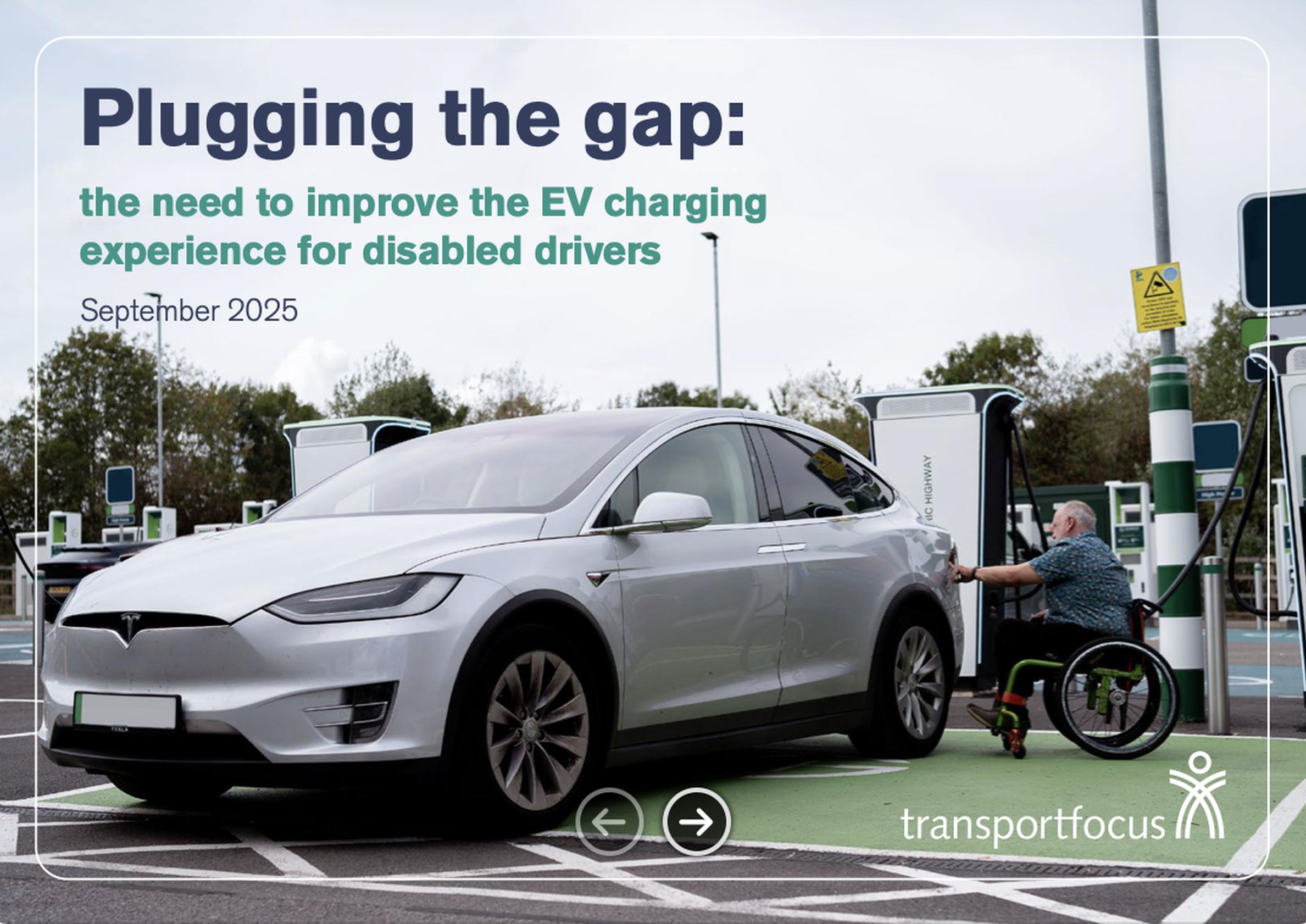
England’s electric vehicle charging infrastructure is overlooking disabled drivers, a new report has found.
Independent watchdog Transport Focus is calling for the government to outline its plan for how, and when, an accessible EV charging infrastructure will be delivered.
Disabled users need confidence in the charging network, particularly as a significant proportion of their homes are not suited to the installation of a home charger.
Despite the government’s transition to zero-emission vehicles and ZEV mandate, there are no chargers on England’s motorways and major ‘A’ roads that have been accredited with the voluntary standards for accessible charging.
Guidelines introduced in 2022 to provide an accessibility standard for chargepoints are not a compulsory requirement and EV drivers still report encountering significant barriers such as small bays preventing them getting out of the vehicle, raised kerbs, plinths and bollards in front of chargepoints, poor locations of charge points in relation to other motorway service facilities. They can also find it difficult to handle equipment.
Transport Focus is calling for:
Louise Collins, director of Transport Focus, said: “Disabled motorists should be able to feel secure in the knowledge that they can easily charge their electric vehicle independently on the country’s motorway network. If we don’t tackle this swiftly then some disabled people could be left behind, unable to drive electric vehicles and potentially excluded from the road network altogether.
“The time to act is now and we need confidence that there is a plan that will genuinely deliver this. We are working with government to explore the role regulation could play in a longer-term solution with mandatory standards and for chargepoint providers to deliver more immediate improvements.”
Graham Footer, chief executive of Disabled Motoring UK, said: “We are expecting disabled people to transition to, and use, EVs without a charging infrastructure that supports them. We need a robust plan that meets users’ needs and gives them the confidence to travel in their EV. A clearer framework, supported by regulation, would help chargepoint providers prioritise accessibility.”
Paul Comer, director of EV implementation at Roadchef, said: “We recognise that a consistent, nationwide approach, supported by a stronger regulatory framework, could help accelerate progress and give customers greater confidence.”
While there are some positive examples of chargepoint operators trying to bridge accessibility gaps this lacks the consistency required to allow disabled people to travel with confidence knowing they’ll be able to charge.
To meet PAS 1899:2022 accessibility standards charging bays should meet specific size requirements, have hatching around each bay to allow accessibility for vehicles adapted to disabled users, and all plinths and bollards be removed to allow level access.
Transport Focus said it will work collaboratively with the industry to ensure that changes are both practical and sustainable.
Plugging the gap – the need to improve the EV charging experience for disabled drivers

TransportXtra is part of Landor LINKS

© 2026 TransportXtra | Landor LINKS Ltd | All Rights Reserved
Subscriptions, Magazines & Online Access Enquires
[Frequently Asked Questions]
Email: subs.ltt@landor.co.uk | Tel: +44 (0) 20 7091 7959
Shop & Accounts Enquires
Email: accounts@landor.co.uk | Tel: +44 (0) 20 7091 7855
Advertising Sales & Recruitment Enquires
Email: daniel@landor.co.uk | Tel: +44 (0) 20 7091 7861
Events & Conference Enquires
Email: conferences@landor.co.uk | Tel: +44 (0) 20 7091 7865
Press Releases & Editorial Enquires
Email: info@transportxtra.com | Tel: +44 (0) 20 7091 7875
Privacy Policy | Terms and Conditions | Advertise
Web design london by Brainiac Media 2020
