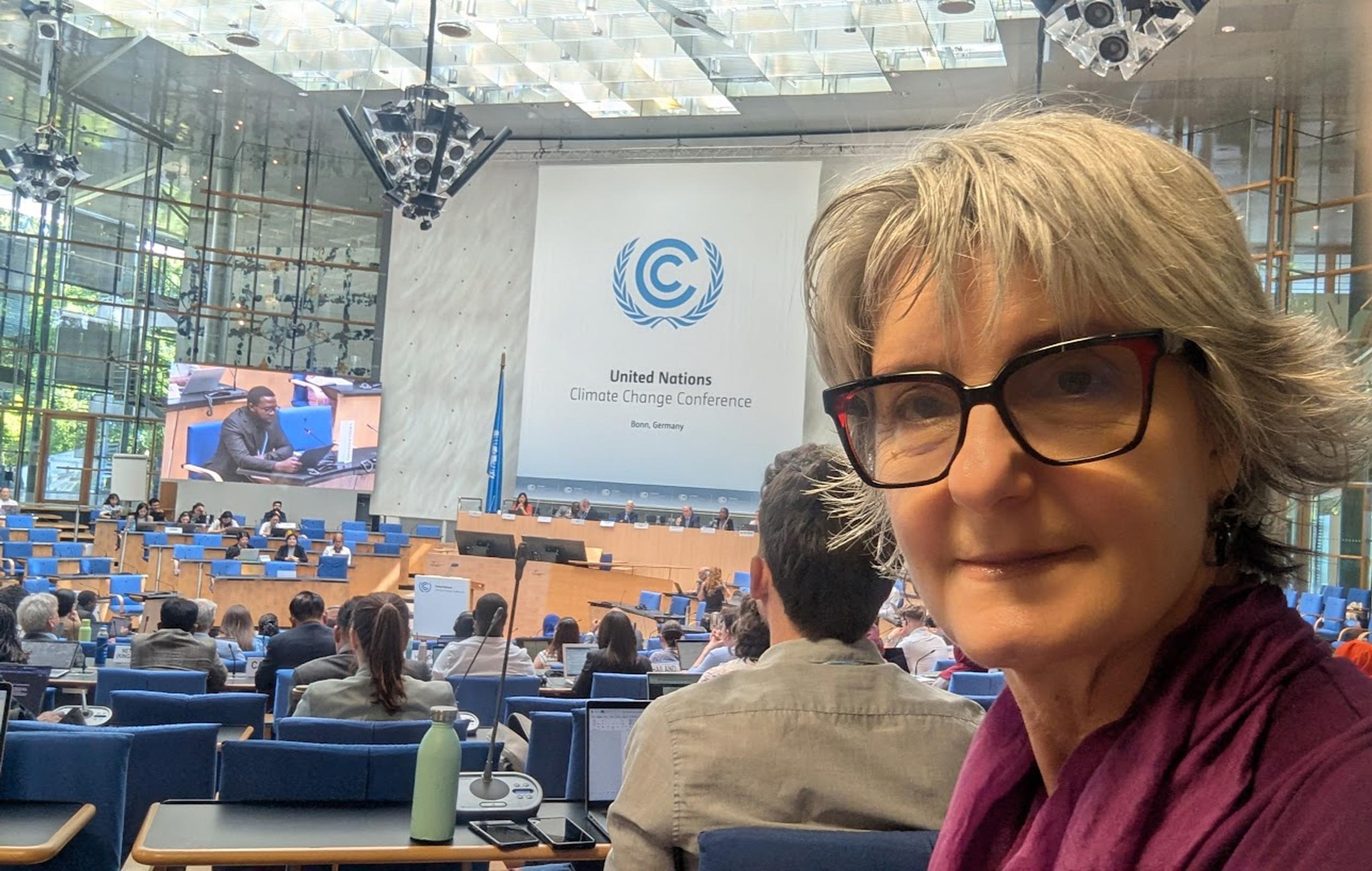
1. International climate diplomacy in choppy waters – but climate action is working
Assessing success at a UN climate conference is never straightforward. COP30 in Belém, Brazil was no exception. With nearly every country in the world present – except a handful, notably the United States – and required to reach unanimous consensus, ambition is necessarily constrained by the slowest mover. If you are curious about the complexity of COPs, listen to Tim Harford’s Cautionary Tale podcast on the theatre play Kyoto, retelling the story of one of the foundational COPs – which was shown in London earlier in the year 1.
Yet, beneath the strained diplomacy, COP30 demonstrated that climate action is not stalling. In fact, it is decidedly working.
COP30 first, and the G20 immediately after, showed that multilateralism still functions –even without the United States involved. Countries found some common ground on a series of decisions, including strengthening the global Loss and Damage system and launching a new Just Transition Mechanism.
And, very importantly, the global emissions trajectory continues to improve. A decade ago, the world was heading for around 4°C or more of warming; today, current commitments and policy implementation bring us closer to 2.7°C. This is still well above the 1.5°C limit, and but the direction of travel demonstrates that climate agreements, initiatives, policies, and market dynamics are undeniably making real change – whatever the politics of international positioning.
COP30 also confirmed a shift in who is driving momentum. The private sector has become an engine of decarbonisation, leading on renewable energy deployment, clean technologies, and innovation at a speed that in many cases outpaces national policy. Meanwhile, most cities are already implementing climate strategies – many of them more ambitious than their national governments.
Moreover, those governments that signed up to initiatives to include cities in their mitigation strategies are decarbonising faster than others. For transport planners, whose work is embedded in local systems and long-term delivery pipelines, this dispersal of climate leadership is particularly significant.
Implementation is increasingly happening through local initiatives first (like active travel, improved walking and public transport) combined with engagement for behavioural change, only backed by national climate policies after the facts: in the UK this is a bigger and bigger a challenge – as local budgets are controlled centrally and this limits the possibility of action.
2. The approach of the Brazilian Presidency was a success
The Brazilian COP30 Presidency took a deliberate approach: separating the official negotiations – which were always likely to fall short of the ambition required and stuck in acrimonious finance talks – from the action-oriented implementation agenda. This “Mutirão” approach (roughly, a collective effort or mutual aid campaign) elevated practical delivery, justice and equity, and engagement with a multitude of possible actors – with the objective of creating a ‘granary of implementable solutions’.
This helped most western countries, historically responsible for climate change, to be focused not on yet another agreement, but on practical implementation. This was the hook that allowed them to stand their ground in times of political and financial difficulties.
The Presidency’s leadership was widely recognised and praised, not least by city leaders, represented by the Local Governments and Municipal Authorities (LGMA) Constituency. Brazil appointed three Special Envoys to embed the urban agenda throughout the process, and created space for local governments, planners, and delivery agencies to demonstrate what implementation actually looks like in territories.
3. The voice of cities and regions is louder than ever
If COP30 will be remembered for anything, it is the visibility and influence of local and regional governments. Thousands of mayors, governors and local leaders travelled to Brazil, participating in the Local Leaders Forum in Rio and the Cities & Regions Hub in Belém. Their message was consistent: implementation lives in territories, and national progress depends on empowering local deliverers.
A new analysis of 2025 climate pledges – the Nationally Determined Contributions or NDCs submitted ahead of COP30 – found that the inclusion of urban content in climate strategies has nearly doubled. This reflects an increasing grasp of urban risk, infrastructure exposure, and the role of cities in mitigation and adaptation. This is essential, given that cities contain most future population growth, trillions of pounds in vulnerable assets, and many of the world’s highest-emitting sectors, including transport.
Cities and regions argued strongly for an official way to contribute to climate assessments and negotiations as well as clearer pathways to climate finance – but this is still to come. The Intergovernmental Panel on Climate Change, the IPCC, the scientific arm of the UN on climate, is due to deliver its report on cities in 2027. It is expected to include science, policies and practical assessment methods for decarbonisation in cities. It is hoped that influence and finance will follow.
In addition in Bélem, global indicators for adaptation were discussed and partly agreed: these will guide action in settlements to prepare for the impact of climate events and will attract climate finance.
For the transport sector, both agendas – decarbonisation and preparation for climate events ¬– matter enormously. From talking about methodologies and reducing the need to travel, transport planners need to actually help reformatting cities and new development, planning New Towns without cars, transitioning to zero-emission technologies and more. Whether implementing congestion reduction measures, strengthening resilience of rail infrastructure, or accelerating modal shift, most climate-critical transport actions are delivered locally – and not just in new development. Yet local authorities are still fragmented, under-resourced or under ambitious – partly because of lack to climate-centred finance for transport, while national frameworks do not yet consistently integrate place-based transitions.
4. What this means for transport and infrastructure
The outcomes of COP30 provide several important lessons for UK transport.
• First, the implementation agenda is gaining primacy. With negotiations unable to deliver transformative breakthroughs, practical delivery – policy, investment, infrastructure and innovation – becomes the main arena of climate ambition. Transport planners are already focused on sustainable transport systems. Now the transport community must help drive national climate performance through local action.
• Second, climate collaboration is emerging as a global norm. The Brazilian Presidency’s approach highlighted the necessity of shared responsibility across levels of government, developers, investors and communities. The UK, with its complex mix of devolved, mayoral, and local authorities, has no option but to try and accelerate this model – provided it is also accompanied by long-term funding.
• Third, cities are outpacing nations. This dynamic – seen clearly at COP30 ¬–should embolden local transport authorities. City-led clean air zones, low-emission mobility strategies, 15-minute city policies, and integrated public transport systems are now central pillars of climate action. For professional planners, the opportunity lies in designing systems that not only cut emissions but also improve equity, affordability and access.
• Finally, infrastructure resilience has moved up the agenda. With climate impacts intensifying, infrastructure systems must adapt. Flood-resilient rail corridors, heat-tolerant roads, redundancy in energy supply for transport systems, and nature-based solutions in mobility corridors all represent front-line climate adaptation.
5. Climate costs and climate finance: where COP30 fell short
Perhaps the clearest gap in the COP30 outcomes is finance. While the conference reaffirmed the developed nations’ commitment to triple funding for adaptation to the poorest countries and put forward a US$1.3 trillion trajectory to mobilise global climate finance flows, it did not deliver anywhere near the scale or certainty of finance needed.
The UK scaled back its international climate finance to virtually nothing. The EU reaffirmed their commitment but did not expand it. The US contributions have disappeared. This is all against a backdrop of climate costs for loss and damage within the EU itself projected to rise to 7% of GDP by 2050 in a worst case scenario.
The lack of international climate finance is also accompanied by lack of money domestically, at local level: for development, for retrofitting, for infrastructure and of course also for climate action. This is a critical constraint. The shift to zero-carbon mobility requires capital investment, revenue certainty, and long-term planning. The absence of local finance slows action just when acceleration is needed.
Place-based action
In conclusion, COP30 did not deliver the diplomatic breakthroughs many hoped for. Yet it showcased a world moving decisively towards implementation, with cities, regions, and practical delivery agencies progressively taking a leading role as implementation becomes the focus. For the UK transport sector, the message is clear: climate leadership now rests on credible, place-based action. Transport professionals can help turn incremental progress into transformational change – but they need support from their own personal conviction and values, the right governance and of course investment.
Martina Juvara is Director at Urban Silence
TransportXtra is part of Landor LINKS

© 2026 TransportXtra | Landor LINKS Ltd | All Rights Reserved
Subscriptions, Magazines & Online Access Enquires
[Frequently Asked Questions]
Email: subs.ltt@landor.co.uk | Tel: +44 (0) 20 7091 7959
Shop & Accounts Enquires
Email: accounts@landor.co.uk | Tel: +44 (0) 20 7091 7855
Advertising Sales & Recruitment Enquires
Email: daniel@landor.co.uk | Tel: +44 (0) 20 7091 7861
Events & Conference Enquires
Email: conferences@landor.co.uk | Tel: +44 (0) 20 7091 7865
Press Releases & Editorial Enquires
Email: info@transportxtra.com | Tel: +44 (0) 20 7091 7875
Privacy Policy | Terms and Conditions | Advertise
Web design london by Brainiac Media 2020