
A widening “charging divide” is emerging between electric vehicle drivers who can easily charge at home and those who cannot.
EVA England’s annual survey found most EV drivers are overwhelmingly satisfied with the experience of using an electric car, but those without driveways are facing higher costs, lower confidence and major barriers to switching.
While nearly 9 in 10 (87%) of drivers with driveways found their EV “much cheaper” to run compared to a petrol or diesel car, only half (50%) of drivers without a driveway agreed. EVA England warns the gap risks leaving millions of households behind in the country’s transition to electric vehicles.
The findings come from the association’s annual Steer the Conversation survey, which for the first time included not only electric vehicle (EV) drivers but also hybrid, petrol, and diesel drivers.
In total, 1,668 drivers took part, providing a comprehensive snapshot of how drivers are experiencing and perceiving the UK’s switch to electric, ahead of key government deadlines to end the sale of new petrol and diesel cars by 2030 and hybrids by 2035.
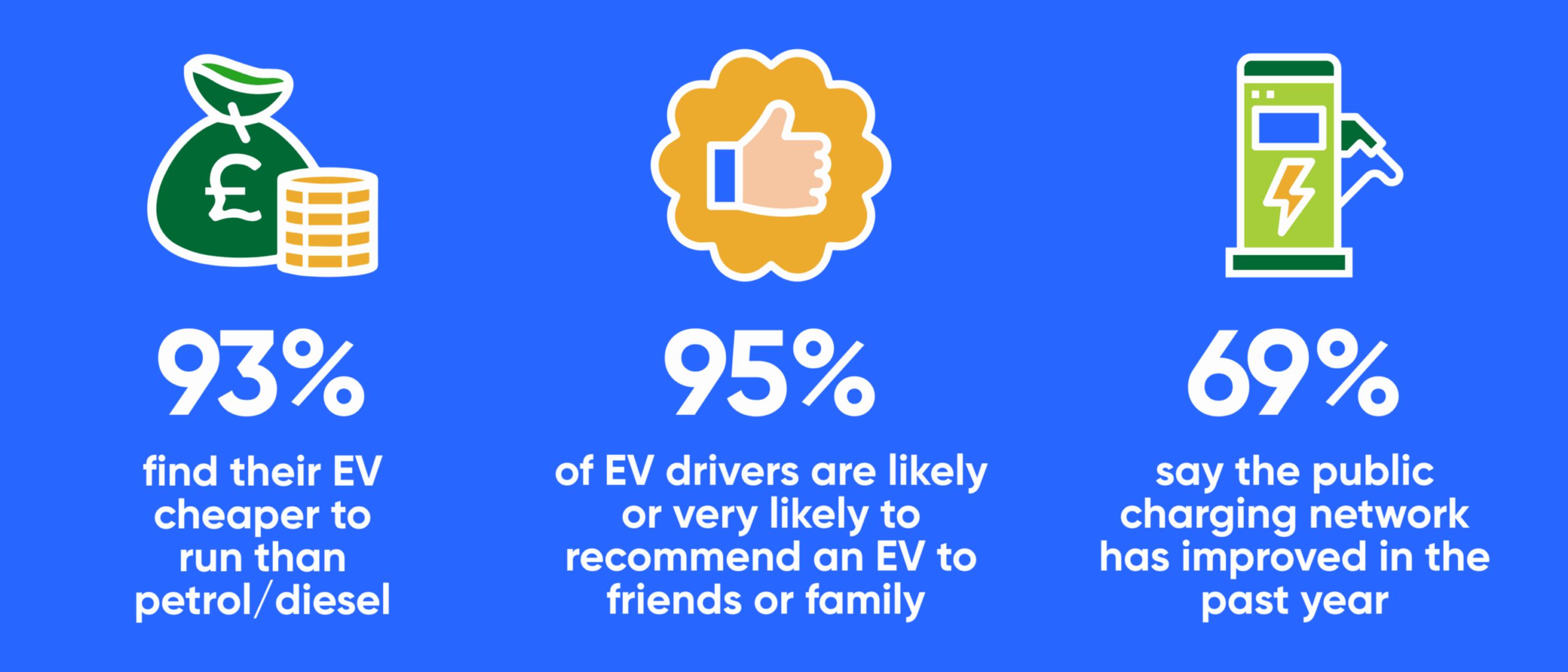
Similar to last year’s survey, EV drivers reported overwhelming satisfaction rates: 95% would recommend an EV to friends and family, and 69% felt the public charging network has improved in the past year. Among petrol and diesel drivers, two-thirds (66%) said they are considering a switch to electric, while 62% of hybrid vehicle drivers said their next purchase would be fully electric.
The data also revealed persistent barriers and some growing inequalities – particularly as the switch to EV increasingly reaches concentrated urban environments (where more drivers don’t have off-street parking) and households on lower incomes.
A full 60% of petrol and diesel drivers without off-street parking, for instance, said they would never consider an EV; versus 43% among those with a driveway.
Access to home charging and the cost savings it provides are a big determinant behind who can afford to go electric. Public charging remains substantially more expensive than home charging, costing up to ten times more: average prices for public charging are 48p per kWh compared to 32p at home, but in some cases can reach 98p per kWh, whilst home charging can be as low as 8p per kWh. Public charging also carries a fourfold VAT penalty, taxed at 20% compared to 5% for domestic electricity.
One EV driver described the situation as deeply unfair: “With the exception of public charging costs, EVs are great to drive. But they still need to vastly improve the infrastructure and drastically reduce cost of public charging, which, currently, is obscene.”
Another said: “An EV makes no financial sense for people who don’t have access to home charging.”
This is an area of particular concern for drivers living in urban environments, where a full quarter (25%) of EV drivers reported not owning a home charger – versus only 8% and 5% of suburban and rural drivers, respectively, reporting the same. Whilst some solutions do exist, such as cross-pavement charging channels that allow a home charger cable to run safely under the pavement, these often face complex approval processes, and can cost the resident around £3,000 and take over a year for approval. Many councils still do not formally allow these installations.
Other key findings from the report:
Misinformation:
Purchasing costs:
Accessibility concerns:
EVA England chief executive Vicky Edmonds said the findings highlight both progress and a pressing challenge. “Drivers are clearly loving their EVs, but these results highlight a growing inequality that can’t be ignored,” she said.
“Those who can charge at home are saving money and driving the change, while those who can’t are facing higher costs and fewer options. The ‘charging divide’ is now one of the biggest barriers to a fair transition.
“If this transition is to be truly fair, affordable and accessible, it must work for every driver, wherever they live and whatever their circumstances. The driver’s voice needs to be at the centre of how we build the electric future.”
While the report acknowledges that the government is taking steps to expand access – including through initiatives such as the £450m Local EV Infrastructure (LEVI) Fund and a £25n programme to help councils improve on-street and at-home charging options – we warn in this report that the pace of progress must accelerate.
The government has also pledged to deliver 300,000 chargepoints by 2030 and to make charging costs fairer and more transparent in collaboration with Ofgem and industry, but our findings say drivers’ lived experiences show that too many households are still being left behind.

TransportXtra is part of Landor LINKS

© 2026 TransportXtra | Landor LINKS Ltd | All Rights Reserved
Subscriptions, Magazines & Online Access Enquires
[Frequently Asked Questions]
Email: subs.ltt@landor.co.uk | Tel: +44 (0) 20 7091 7959
Shop & Accounts Enquires
Email: accounts@landor.co.uk | Tel: +44 (0) 20 7091 7855
Advertising Sales & Recruitment Enquires
Email: daniel@landor.co.uk | Tel: +44 (0) 20 7091 7861
Events & Conference Enquires
Email: conferences@landor.co.uk | Tel: +44 (0) 20 7091 7865
Press Releases & Editorial Enquires
Email: info@transportxtra.com | Tel: +44 (0) 20 7091 7875
Privacy Policy | Terms and Conditions | Advertise
Web design london by Brainiac Media 2020
