
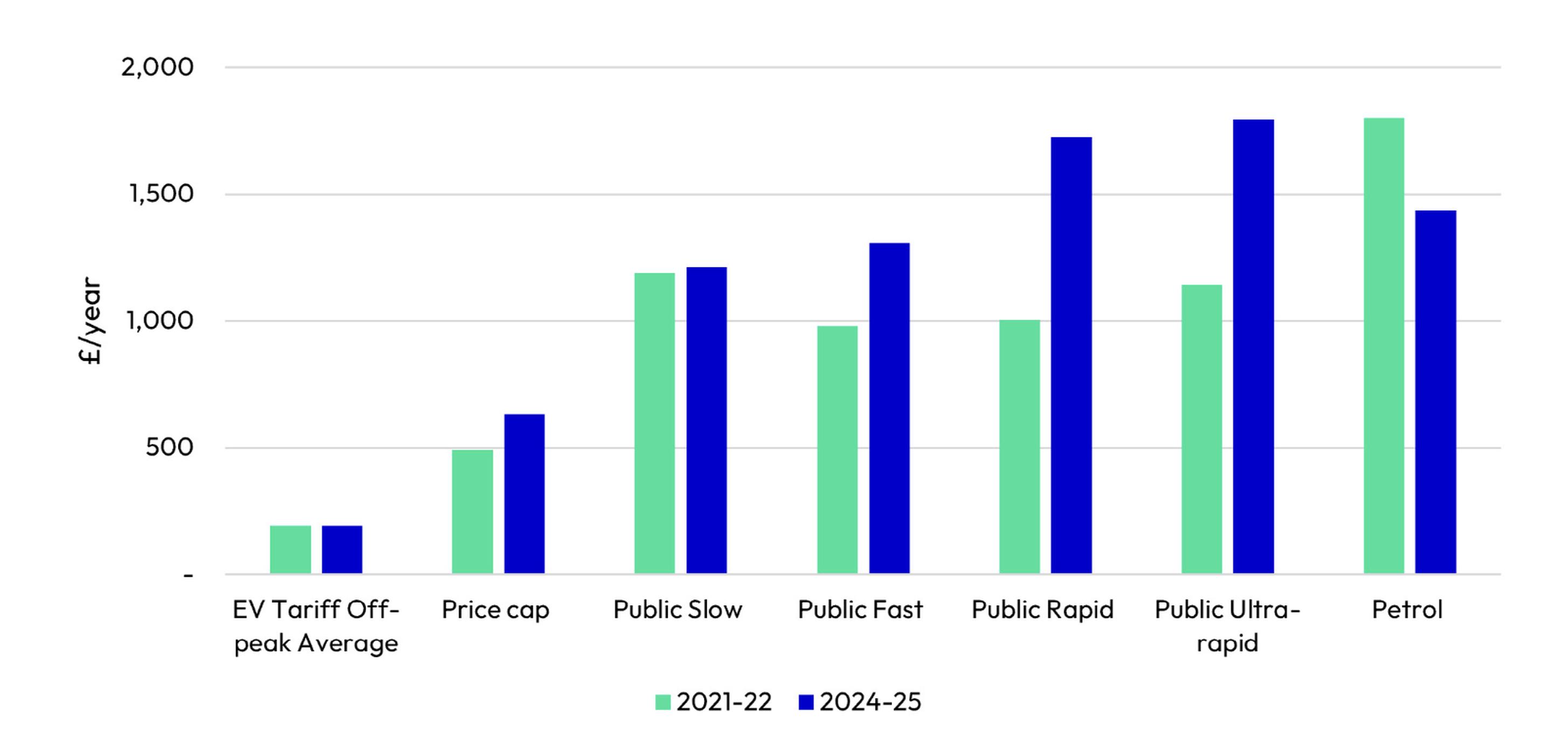
The government is being urged to intervene as research shows the electric vehicle charging sector’s energy bills increased by up to 79% since 2021.
ChargeUK has called on the government to address the industry’s high energy bills, parts of which have risen fourfold in just four years, with cost of charging a key consideration for drivers ahead of the 2030 deadline for phasing out sales of new petrol and diesel cars.
Research by ChargeUK sets out the increases in energy costs facing the companies installing and running the nation’s public EV charging infrastructure.
ChargeUK’s new white paper, Delivering Affordable Charging for All, sets out how this has impacted the prices that drivers pay.
Most drivers can already charge cost-effectively using a blend of home and public chargepoints. However public charging prices having risen by 38% on average since 2021, impacting those who cannot easily access home charging.
Delivering Affordable Charging for All draws on independent analysis by Cornwall Insight to show that a sharp increase in operators’ underlying energy costs (both wholesale energy and fixed charges) is the main cause of average price increases.
Vicky Read, chief executive of ChargeUK, said: “If the government wishes to ensure that cost of charging does not become a barrier to millions more drivers switching to EVs, it needs to take action – to tackle sky-high energy costs, to address the VAT penalty and to introduce EV charging to its existing renewable fuel credit scheme.
“The EV transition is well underway, with a quarter of all new cars sold an EV, and the public charging network hitting 85,000 chargepoints this month. Most drivers can already charge affordably, and the charging sector is innovating to offer additional ways to access cost-effective options. But the public charging sector has been hit by a series of policy and regulatory decisions that have caused our own costs to soar, with an unavoidable impact on some driver prices.”
The white paper sets out a three-point plan for policymakers to enable all drivers to charge affordably:
1. Tackle operators’ prohibitively high energy costs
2. Boost the charging business case
3. Eliminate the VAT penalty on public charging
ChargeUK's Vicky Read added: “Our members are committed to ensuring that all drivers can charge affordably across the mix of charging options available to them. So today we are setting out three deliverable actions for government, which address or compensate for high and rising costs that are outside our control.
“The government has already recognised that affordability is key to this EV transition, and has taken action, launching the Electric Car Grant. We now need ministers to focus on addressing the business costs impacting affordability of charging, so that we create the best possible conditions for drivers to make the switch.”
The full paper can be found here.
The white paper demonstrates that average price increases since 2021 have largely been driven by very significant increases in the sector’s underlying energy costs since the start of the decade. It states that along with other UK businesses, chargepoint operators (CPOs) continue to be exposed to very high wholesale electricity prices, which remain 66% higher than pre-Energy Crisis levels.
However, the sector has also been hit by substantial cost increases following Ofgem’s Targeted Charging Review in 2023 which changed how other elements of the sector’s energy bills are calculated. As a result, standing charges have risen by up to 462% at rapid and ultra-rapid charging sites, and now represent up to 70% of total energy costs, compared to around 15% for comparable businesses. CPOs of slow and fast chargepoints have also been hit by a 389% increase in standing charges.
CPOs also face a heavy and growing burden from government policy levies, which are applied to every unit of electricity consumed. These levies, including the Climate Change Levy, currently add approximately 6p/kWh to CPOs’ bills, despite the fact that the sector is playing a vital role in the decarbonisation of transport, and are set to increase by more than 10% by 2030.
Finally, drivers using public charging infrastructure are subject to VAT at the higher 20% rate, compared to VAT at 5% for home charging, creating unfair additional costs for the one in three households without access to home charging.
Cornwall Insight’s analysis reveals that it is these elevated energy costs, combined with the government’s continued policy of charging VAT on public charging at 20% (versus 5% for home charging), that has put upward pressure on public charging prices.
Jacob Briggs, senior consultant at Cornwall Insight, said: “The UK’s charging network is a real success story, growing fast and helping more drivers than ever make the switch to electric. But our analysis shows that the increase in average public charging prices is a challenge that could slow progress towards an EV-driven future.
“High energy prices, rising network charges and the higher rate of VAT on public charging compared with plugging in at home ultimately means that drivers are paying the price. Unless these cost pressures are tackled by government, we risk turning a good news story into a barrier for millions of drivers who want to go electric.”

TransportXtra is part of Landor LINKS

© 2026 TransportXtra | Landor LINKS Ltd | All Rights Reserved
Subscriptions, Magazines & Online Access Enquires
[Frequently Asked Questions]
Email: subs.ltt@landor.co.uk | Tel: +44 (0) 20 7091 7959
Shop & Accounts Enquires
Email: accounts@landor.co.uk | Tel: +44 (0) 20 7091 7855
Advertising Sales & Recruitment Enquires
Email: daniel@landor.co.uk | Tel: +44 (0) 20 7091 7861
Events & Conference Enquires
Email: conferences@landor.co.uk | Tel: +44 (0) 20 7091 7865
Press Releases & Editorial Enquires
Email: info@transportxtra.com | Tel: +44 (0) 20 7091 7875
Privacy Policy | Terms and Conditions | Advertise
Web design london by Brainiac Media 2020
