
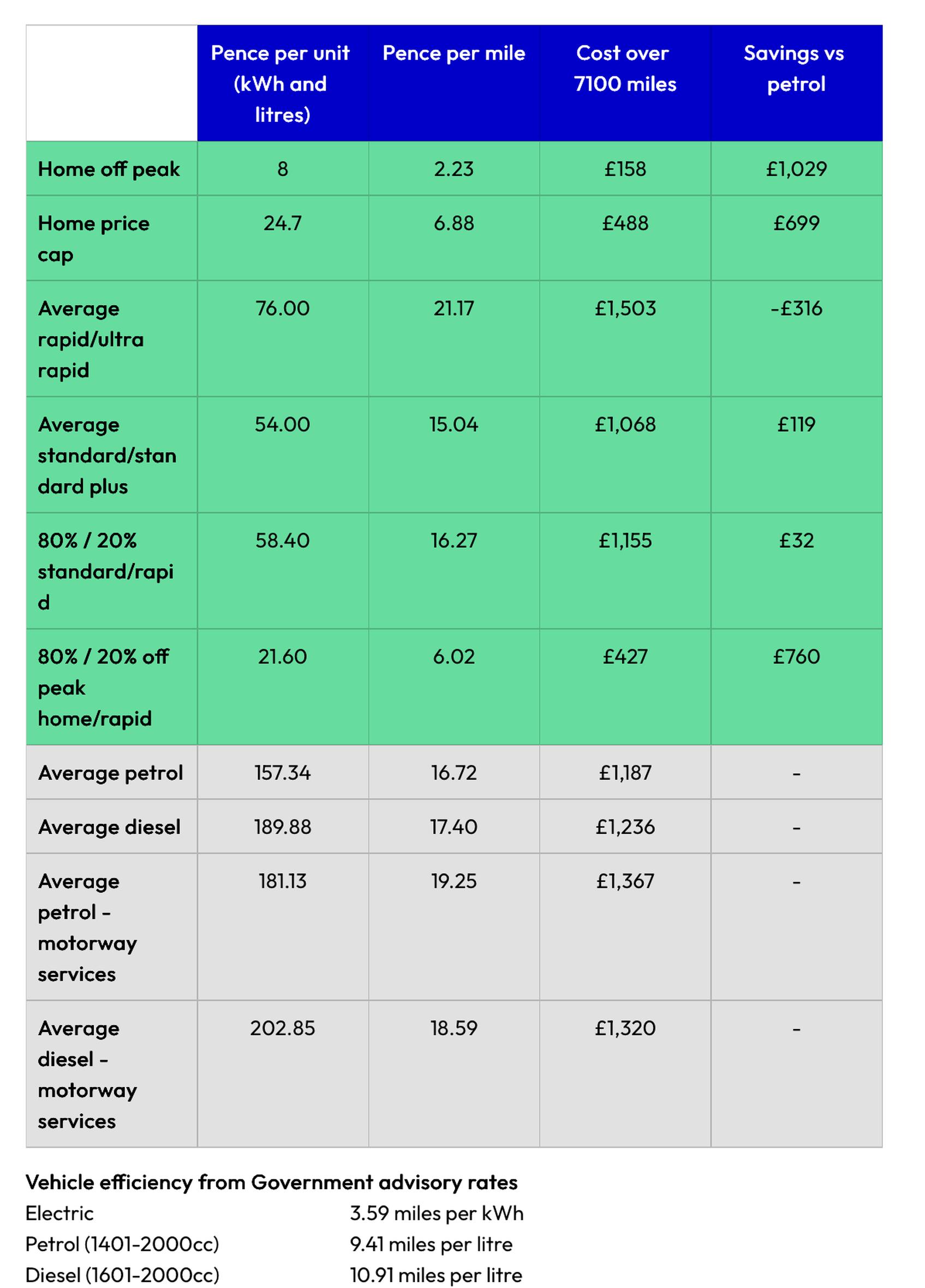
A new snapshot analysis from EV charging industry body ChargeUK has shown that the cost of charging an EV on the public networks is now lower on average than petrol or diesel for the first time in over a year.
Average prices for charging on the public EV charging network rose 38% between 2021 and 2025. However, with petrol prices surging in recent weeks in response to global conflict and public EV charging remaining comparatively stable, the cost of fuelling a petrol or diesel car has surpassed charging an EV on the public network in most scenarios.
The new analysis, based on RAC Fuel Watch and Zapmap Price Index figures, shows that when charging on a standard charger (such as on-street or in a local car park) at the national average cost of 54p per kWh, with typical efficiency, drivers can expect to pay around 15p per mile, compared with a current rate of 17p for a typical petrol car or 17.5p for diesel. Drivers using an 80/20 per cent mix of standard and rapid public charging will pay around 16p per mile. Only those exclusively using public ultra-rapid charging will still pay more than liquid fuel.
As ministers commit to an “era of clean energy security”, ChargeUK is calling on the government to address the policy issues driving up charging prices, so that cheaper EV driving is locked in for the long term, not just in a time of war. The association argues that while petrol prices are heavily influenced by global factors outside of the UK government’s control, public EV charging prices are largely inflated by policy costs that government can address.
ChargeUK’s white paper Delivering Affordable Charging For All, published in September 2025, showed that at the start of the decade charging an EV was more affordable than fuelling a petrol or diesel car regardless of whether drivers charged at home or on the public network.
However, while home charging has remained low cost (as little as 2p per mile today), public EV charging has increased by 38% since 2021—driven largely by policy changes including skyrocketing standing charges.
In response to this paper, in the November budget the government committed to a review of the public cost of EV charging, which is now underway, and the charging industry hopes to see tangible outcomes from it. This is running alongside the recent Tax Tribunal ruling that the 20% VAT on public EV charging should be 5%, equal to home charging, which HMRC has now applied to appeal—a decision ChargeUK has called “disjointed and disappointing”.
The new analysis also shows that based on today’s prices, EV drivers who are reliant on public charging would be likely to pay more than petrol and diesel again after the introduction of the government’s 3p per mile eVED tax in 2028.
ChargeUK represents over 40 companies operating more than two thirds of the UK’s public EV charging infrastructure.
Vicky Read, chief executive, ChargeUK: “While this is not how we wanted to see the gap between public EV charging and petrol prices closed, it once again demonstrates the urgent need to make driving an EV more affordable for all. Following news that new electric cars are now cheaper than petrol, the cost of public charging is now the final hurdle for mass EV adoption.”
“We need to see government take control of the situation to ensure the numbers stack up not just in a time of global crisis, but for the long term. The cost pressures currently pushing up public EV charging prices are largely within the government’s grasp, whereas the global pressures pushing up petrol and diesel prices are not.”
“By using the cost of charging review to address skyrocketing chargepoint standing charges, eliminating the VAT penalty on public charging and adding renewable electricity to its renewable transport credit scheme, government can help reduce public EV charging prices—saving money for millions of drivers, making an EV viable for millions more, doubling down on electrification and helping automakers meet their EV sales quotas just as interest in going electric grows.”
Ian Plummer, chief customer officer, Autotrader: “Cheaper running costs have long been a key incentive to make the switch to electric, and we’ve seen a significant uptick in consumers looking at EVs on our platform following recent petrol price hikes, so we know there’s growing awareness of just how much you can save.
“Our analysis also shows the average price of a new EV, including discounts and government grants, has fallen below petrol for the first time ever. With the upfront price often being the biggest barrier to electric adoption, this is a key milestone in the UK’s transition and should hopefully signal the growing affordability of electric cars. While there’s lots to be positive about, interest spikes and growing new-car affordability don’t mean the transition is sorted. If the government is serious about a fair and accessible transition, it should do all it can to make public charging as affordable as possible.”
Melanie Shufflebotham, co-founder and COO, Zapmap: “At Zapmap we’ve been tracking the cost of charging on the public network since November 2023, using typical use-case scenarios. This shows that the vast majority of drivers choosing electric will enjoy total cost of ownership savings.
“We’re now seeing that for EV drivers with a typical 80/20 split between home and public charging, the cost saving of charging their EV compared to fuelling a petrol or diesel car is at the highest level since May 2024. However, in the UK we still have the highest public charging costs in Europe, and we welcome all measures to tackle this to help progress the transition to sustainable transport.”
Simon Williams, head of policy, RAC: "While the dramatic increase in petrol and diesel prices due to the conflict in Iran has understandably sparked increased interest in going electric, it remains the case that public charging costs are higher than they need to be. Issues outside of operators' control such as 20% VAT on public charging, compared to 5% at home, and high standing charges aren't helping. We hope the government will seek to address these issues so more people can make the switch to electric driving and charge affordably away from home."
The analysis is based on the latest prices from RAC Fuel Watch and the Zapmap Price Index, using the government’s efficiency figures for advisory fuel rates. A typical EV driver mix of 80% charging on an off-peak home energy tariff and 20% on ultra-rapid chargers can expect to run their vehicle for around 6p a mile.
Charging on a standard public charger at the national average cost of 54p per kWh, with typical efficiency, drivers can expect to pay around 15p per mile, compared with a current rate of 17p for a typical petrol car or 17.5p for diesel. Drivers using an 80/20% mix of standard and rapid public charging will pay around 16p per mile.
The analysis indicates that the only scenario where an EV driver may pay more than in a fossil fuel vehicle is if they exclusively use rapid and ultra-rapid chargers at the average of 76p per kWh, or 21p a mile. This is broadly equivalent to fuelling at a motorway services petrol station all the time, which would cost 19p a mile for petrol or 18p for diesel.
For average annual mileage of 7,100 miles, this means an EV charged solely on a standard public charger could save a driver £124 a year compared with petrol, or £37 with an 80/20 mix of standard and ultra-rapid.
Meanwhile, drivers exclusively charging on an 8p per kWh off-peak home energy tariff could save over £1,000, or £765 with an 80/20 mix of off-peak home electricity and ultra-rapid charging.

TransportXtra is part of Landor LINKS

© 2026 TransportXtra | Landor LINKS Ltd | All Rights Reserved
Subscriptions, Magazines & Online Access Enquires
[Frequently Asked Questions]
Email: subs.ltt@landor.co.uk | Tel: +44 (0) 20 7091 7959
Shop & Accounts Enquires
Email: accounts@landor.co.uk | Tel: +44 (0) 20 7091 7855
Advertising Sales & Recruitment Enquires
Email: daniel@landor.co.uk | Tel: +44 (0) 20 7091 7861
Events & Conference Enquires
Email: conferences@landor.co.uk | Tel: +44 (0) 20 7091 7865
Press Releases & Editorial Enquires
Email: info@transportxtra.com | Tel: +44 (0) 20 7091 7875
Privacy Policy | Terms and Conditions | Advertise
Web design london by Brainiac Media 2020
