
Across the UK, the evidence base for active travel is strengthening.
Infrastructure once treated as an add-on to larger highway schemes is now understood as a core mode of transport - for the school run, the GP appointment, the short commute to the station.
Active travel schemes now intersect with public health, road safety, local economies and environmental outcomes. That breadth has real consequences for the professionals delivering them.
The scale of potential impact is illustrated by a recent report which estimated that active travel in the Liverpool City Region saves the NHS £53.8 million annually, as reported by TransportXtra.
More than 4,400 serious long-term health conditions were prevented in the last year alone.
Since 2019, the region has built over 93 miles of new or improved walking, wheeling and cycling routes.
Results at that scale are not accidental. They are the product of sustained investment and a workforce capable of designing infrastructure that people actually use.
Delivering high-quality active travel infrastructure is no longer just a matter of applying geometric design standards. The starting point is the user: their journeys, anxieties and physical needs. Kerb heights, crossing times, gradients, surfacing, lighting and wayfinding help determine whether a scheme is used by the many or the few. Details that were once treated as secondary are now central to success.
Active travel sits at the intersection of disciplines that have not traditionally worked closely together: urban design, behavioural science, public health, landscape architecture, transport modelling and highway engineering all have a legitimate claim on the street. A capable professional need not be a deep specialist in all of these. They must, however, understand enough to collaborate effectively and make informed trade-offs.
Inclusive design sits at the centre of this - not as a compliance exercise, but as the baseline condition. Crossings that function for wheelchair users, correctly set-out tactile paving, widths that accommodate mobility scooters and side-by-side walking, adequate rest points and lighting: these determine who can actually access a scheme.
Active travel sits at the intersection of disciplines that have not traditionally worked closely together: urban design, behavioural science, public health, landscape architecture, transport modelling and highway engineering
Many active travel professionals have come to the field from a highway engineering background, and the transition requires a genuine shift in approach. Conventional highway design optimises for motor traffic capacity, speed and delay - metrics that are quantifiable and relatively predictable.
Active travel optimises for comfort, coherence, directness, safety and attractiveness, for people moving at lower speeds and with far greater variation in physical ability and confidence.
The performance metrics are fundamentally different, and they often re-order priorities. A junction that works well for traffic may be unwelcoming to a 12-year-old cyclist.
A staggered pedestrian crossing that recovers green time for vehicles can halve the convenience of walking the same route.
Standards and guidance still matter, but active travel design depends heavily on observed behaviour, user testing and local context.
This aspect has been built in to many of the latest design standards and guidance documents, but a designer should be adding the local context; and adjusting designs based on what people do, not just what standards say they should do.
Flexibility, used responsibly, is key to successful outcomes - and being able to understand the full user impact of a deviation from guidance or departure from standard is critical.
Active travel typically draws on a wider range of disciplines than most highway schemes. Best practice in inclusive design and behaviour change tends to evolve more quickly than established engineering standards. Larger organisations have a role in defining the training and career development pathways that keep professionals current - from university curricula through graduate programmes to ongoing CPD. Without that investment, the gap between policy ambition and delivered quality will persist.
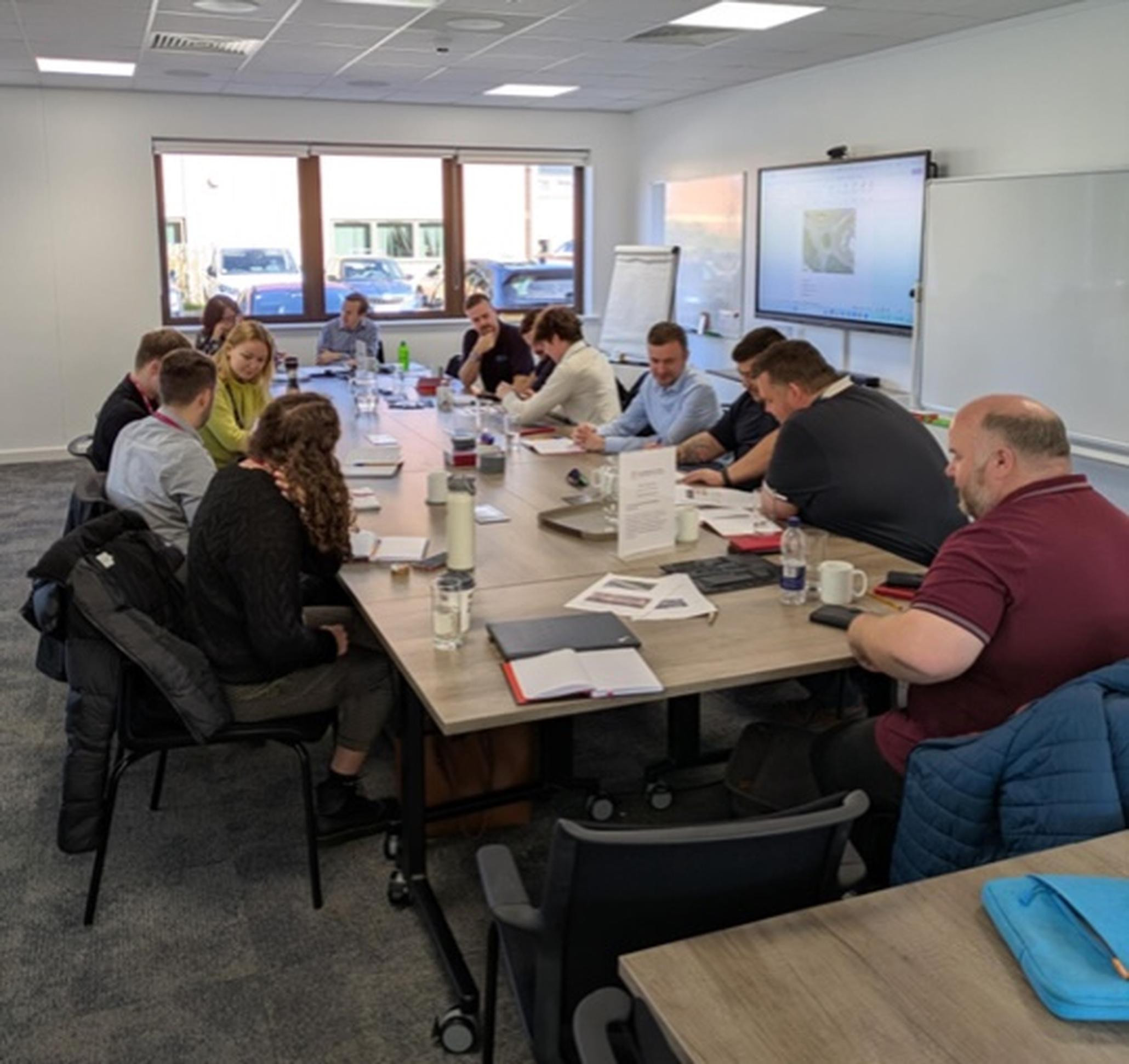
Transport for Wales (TfW) and the Department for Infrastructure (DfI) in Northern Ireland have both taken steps to address this. Working with AtkinsRéalis, each has developed bespoke training that draws on specialist input across road safety, inclusive design, behaviour change and geometric design. The programmes are structured around the practical blockers professionals encounter in delivery, not just the application of technical standards.
In Northern Ireland, consistency across the supply chain was the priority. In-house design teams, consultants and developers now share a common framework for what high-quality active travel infrastructure looks like, which will support the Active Travel Delivery Plan across Northern Ireland.
In Wales, the programme forms part of Transport for Wales’s Academi Teithio Llesol - the Active Travel Academy. A core part of TfW’s programme includes enabling leaders to appreciate the wider societal benefits that active travel schemes can bring and enabling local authority officers to develop high quality solutions with road safety and inclusive design knowledge as well as overcoming some of the more common scheme delivery blockers.
Both approaches reflect AtkinsRéalis’ own internal approach to structured training and development in active travel, showing it is both a private and public sector organisational responsibility (as well as academia) to get the wider, holistic results needed.
The sector is at a point where the scale of ambition is outpacing the pace at which professional practice is adapting. Closing that gap - through structured training, cross-disciplinary working and a clearer understanding of success requires a joined up approach at an individual and organisational level to build and maintain the capability we collectively need to deliver high quality infrastructure.
Organisations should scrutinise their current training programmes, career development opportunities and cross-departmental links and ask, is it enough to enable the change?
1. Embed user experience into design development.. This requires storytelling, visioning and community engagement. Explaining objectives without technical jargon, bringing communities along, and embedding safety and inclusion are crucial. Site visits with colleagues from different disciplines can reveal more than a dozen drawings.
2. Use temporary infrastructure to test before committing. Trials using light segregation, allow alignment, demand and user response to be assessed and refined before permanent construction. Iteration at this stage is faster and cheaper than post-completion change.
3. Bring maintenance in from the start. Infrastructure that degrades quickly undermines both the scheme and confidence in future investment. Involving operational teams in design decisions - particularly around planting, surfacing and drainage - is more effective than retrofitting maintainability later.
4. Measure what matters. Tracking comfort, perceived safety, independent mobility and local economic activity builds the evidence base the sector needs - and makes the case for the next scheme as well as facilitating continuous improvement that can help refine wider standards and guidance.
Policy support for active travel is broad: national guidance, local plans, health strategies and climate commitments point in the same direction. Funding and appraisal frameworks are improving. But delivery credibility still depends on design quality and user experience. The public will back schemes that feel safe, direct and dignified. They will not sustain support for schemes that are confusing, piecemeal or inconvenient.
This is why multidisciplinary awareness isn’t a nice-to-have, it’s a delivery risk if it’s absent.
By Fraser Arnot, AtkinsRéalis UK Technical Authority for Active Travel, and Callan Burchell, AtkinsRéalis Active Travel Lead – Wales
Visit the AtkinsRéalis website

TransportXtra is part of Landor LINKS

© 2026 TransportXtra | Landor LINKS Ltd | All Rights Reserved
Subscriptions, Magazines & Online Access Enquires
[Frequently Asked Questions]
Email: subs.ltt@landor.co.uk | Tel: +44 (0) 20 7091 7959
Shop & Accounts Enquires
Email: accounts@landor.co.uk | Tel: +44 (0) 20 7091 7855
Advertising Sales & Recruitment Enquires
Email: daniel@landor.co.uk | Tel: +44 (0) 20 7091 7861
Events & Conference Enquires
Email: conferences@landor.co.uk | Tel: +44 (0) 20 7091 7865
Press Releases & Editorial Enquires
Email: info@transportxtra.com | Tel: +44 (0) 20 7091 7875
Privacy Policy | Terms and Conditions | Advertise
Web design london by Brainiac Media 2020
